Jesus’ Feeding of the Five Thousand: An Historical Parable
Introduction
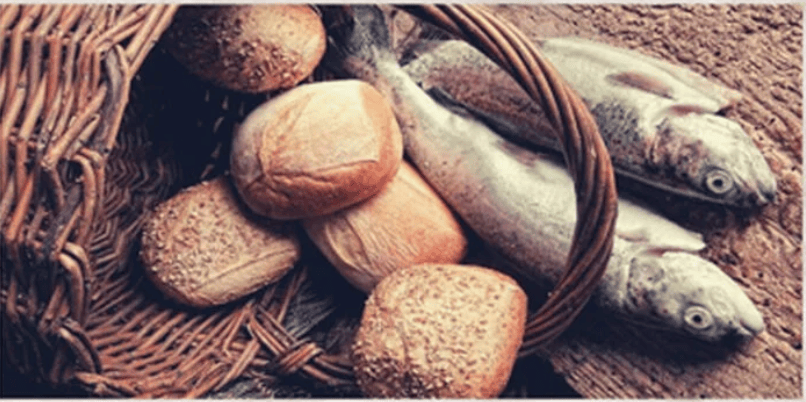
Much has been made of Jesus’ miracles from a purely literal, temporal point of view. One of the better-known miracles is the feeding of about five thousand people with five barley loaves and two small fish, recorded in all four of the New Testament Gospels (Matthew 14:13–21; Mark 6:30–44; Luke 9:10–17, and John 6:1–15). Afterward the disciples gathered twelve baskets of leftover fragments.
Many treat this miracle (and others) as little more than a demonstration that Jesus is the Creator. That is not its primary purpose. While the event had a real earthly setting and a real physical result, it is also an Historical Parable. It carries deeper spiritual meaning that Scripture itself interprets.
The Setting (John 6:1-4)
John 6:1&2 places the scene by the Sea of Galilee (also called the Sea of Tiberias). A great crowd followed Jesus because they had seen His healings. “¶After these things Jesus went over the sea of Galilee, which is [the sea] of Tiberias. And a great multitude followed him, because they saw his miracles which he did on them that were diseased.”
Then “Jesus went up into a mountain, and there he sat with his disciples.” (John 6:3). This is not an attempt to escape the people. Mountains or the mountain was a place to where Jesus resorted to commune with The Father. More broadly, it can refer to Heavenly Realm (Luke 6:12).
John 6:4 inserts an important note: “¶And the passover, a feast of the Jews, was nigh.“ was a meal, instituted by God, prepared in haste when God delivered the Israelites from bondage in Egypt. The entire feast was typifying and commemorating God’s salvation through the redemption from death of the first born, and the necessity of blood atonement in the sacrifice of a lamb without blemish.
By Jesus’ day the feast had generally become a mere cultural ceremony. The language “a feast of the Jews” (compare John 5:1) distinguishes it from the true “feasts of the Lord.” However, Jesus is about to demonstrate, by way of a new miracle/sign, a feast that points to the salvation of the true eternal Israel of God from every nation.
The Question and the Test (John 6:5–7)
In John 6:5, we read, “When Jesus then lifted up [his] eyes, and saw a great company come unto him, he saith unto Philip, Whence shall we buy bread, that these may eat?“
The initial part of the verse is a bit strange considering the context. If Jesus and His disciples had gone up into a mountain, then anyone who followed Jesus would have been ascending from below. Jesus lifting His eyes to see the approaching multitude (John 6:5) maybe a hint that Jesus, referring to him, seeing among those following him, individuals who truly belong to His Heavenly Kingdom.—the “cloud of witnesses” of Hebrews 12:1.
- Philip (Φίλιππος (philippos)G5376, “lover of horses”) was recruited to be one of Jesus’ Apostles in Matthew 10:3, and was from Bethsaida, in Galilee (the city of Andrew and Peter; John 1:43), and would have known local markets.
- “Buy” (ἀγοράζω (agorazō)G59) can also mean “redeem.”
- “Bread” (ἄρτος (artos)G740) is both ordinary food and a symbol of Christ and His Word.
Jesus asked Philip, “Whence shall we buy bread, that these may eat?” But Jesus, Who already knew what He would do; He asked “to prove him” as we read in John 6:6, “And this he (Jesus) said to prove him (Philip): for he himself knew what he would do.“
Philip answers, in John 6:7, that two hundred pennyworth—roughly two hundred days’ wages—would not buy even a little for each person: “¶Philip answered him, Two hundred pennyworth of bread is not sufficient for them, that every one of them may take a little.” [Note that the word “pennyworth” is in the original Greek, δηνάριον (dēnarion)G1220, which means “containing ten”, and the denarius was the principal silver coin of the Roman empire or about a days wage according to the parable in Matthew 20:2-13.] Man’s resources cannot feed this multitude.
Jesus instructs later in John 6:27, “Labour (earn wages) not for the meat which perisheth, but for that meat which endureth unto everlasting life, which the Son of man shall give unto you: for him hath God the Father sealed.”
Note also that the “200” pennyworth is 2 x 10 x 10 and is therefore suggestive of a “complete” “witness” to what is in view, given what we can glean regarding the use of Numbers in the Bible.
The Impossible: The Short Supply (John 6:8&9)
Andrew reports,”…There is a lad here, which hath five barley loaves, and two small fishes: but what are they among so many?” Barley is the first grain to ripen each year (2 Samuel 21:9) and is associated with the season of Pentecost / the Feast of Firstfruits. The scene therefore looks ahead to the harvest of souls that begins at Pentecost in 33 AD (Acts 2:1-47) when 3000 were saved.
“Two” (found both in the “two” hundred pennyworth and the two fishes) is representative of being a “Witness“.
[Note also the role played by the “barely harvest” in the Book of Ruth here: The Threshing Floor of God.]
The Miracle (John 6:10-13)
We have already been put on notice that there might be something in this historical parable that is pointing to us to the Feast of Pentecost…or more simply, “The First Harvest”. Could it be that we are being prepared to see a miracle that is pointing us to the means and method of evangelizing the world as represented by “Galilee of the Nations” (Isaiah 9:1)?
John 6:10, “¶And Jesus said, Make the men sit down. Now there was much grass in the place. So the men sat down, in number about five thousand.“
Jesus instructs for the men to sit on the grass—about five thousand. The grass provides the “comfort” to those who sat down to “eat”. Much like Psalm 23:2, “He maketh me to lie down in green pastures: he leadeth me beside the still waters.“
Note that the “number“, ἀριθμός (arithmos)G706 was “about” “five thousand“. In a previous study it was shown that Numbers in the Bible Convey Spiritual Concepts. We should note that 5000 is 5 x 1000 (or 10x 10 x 10). “Five” in the Bible (as with the five barley loaves) can picture “grace” for those who are saved, or “judgment” to those who are condemned, as we are taught in the “Parable of the Ten Virgins” [five wise (saved) opposed to five foolish (condemned)]. “Ten” or its multiple, a thousand can refer to the totality (in number), especially, as we read in Revelation 20:1&2, which describes the total time of the New Testament Era.” The seated multitude can therefore represent the corporate church, elect and non-elect, collectively fed throughout the Gospel era from throughout the whole world.
Jesus’ Prayer of Thanks:
John 6:11, “And Jesus took the loaves (ἄρτος (artos))G740; and when he had given thanks (εὐχαριστέω (eucharisteō)) G2168, he distributed to the disciples, and the disciples to them that were set down; and likewise of the fishes as much as they would (θέλω (thelō))G2309.”
Jesus gives thanks (εὐχαριστέω (eucharisteō))G2168and distributed the loaves/bread and the fishes to both the disciples and to those who sat down “as much as they would“. There are several spiritual implications that we can draw from this verse.
- Jesus Is Eternal God, and as we read in James 1:17, “Every good gift and every perfect gift is from above, and cometh down from the Father of lights, with whom is no variableness, neither shadow of turning.” Therefore, Jesus in His submission to, and recognition of, His Father’s Gifts, gave “Thanks“.
- The word translated as “when he had given thanks” is from the original Greek word, εὐχαριστέω (eucharisteō)G2168 —the same word used at the Last Supper, in Mark 14:23, “And he (Jesus) took the cup, and when he had given thanks, εὐχαριστέω (eucharisteō) G2168, he (Jesus) gave [it] to them (the disciples): and they all drank of it.” Thus we are provided a subtle link to the Holy Eucharist, where in Jesus instituted “the Lord’s Supper”, that Jesus provided to His beloved church with a perpetual, continual, remembrance meal of “thanks” for His Atoning Sacrifice. The bread representing His Body and the wine representing His shed Blood.
- The Lord’s Supper is not the only time or way that for the believer to remember God’s gifts and to be thankful, but it was instituted by Jesus to make sure the believers remember THE GIFT, Who is Jesus, and His Atoning Sacrifice for their sins that grants the believer eternal life as we read in Romans 6:23, “For the wages of sin [is] death; but the gift of God [is] eternal life through Jesus Christ our Lord.“
- Indeed at every opportunity, but especially, at the eating of every meal (which is a shadow of God’s continual feeding of our souls), we should always “give thanks.” Psalm 55:17, “Evening, and morning, and at noon, will I pray, and cry aloud: and he shall hear my voice.“
- The word translated as “would” is (θέλω (thelō))G2309, which can also be translated as “intended”, “willed”, or “desired”. It hearkens us back to the bread from Heaven, the “manna”, that God provided as a gift to the Israelites in their wilderness sojourn where we read in both Exodus 16:18, “And when they did mete [it] with an omer, he that gathered much had nothing over, and he that gathered little had no lack; they gathered every man according to his eating.” and in 2 Corinthians 8:15, “As it is written, He that [had gathered] much had nothing over; and he that [had gathered] little had no lack.” So all the people were satisfied by what was provided to each from the five loaves and two fishes and no one lacked for hunger.
Abundance, but Nothing Lost
John 6:12, “When they were filled, he said unto his disciples, Gather up the fragments that remain, that nothing be lost ἀπόλλυμι (apollymi)G622.” The original Greek word translated as “lost” is the compound word, ἀπόλλυμι (apollymi)G622, which is formed by the combination of “apo“, which means “away”, and “ollymi”, which means “destroy” as in “cast away to perish and be destroyed”. The King James translators interpreted ἀπόλλυμι (apollymi)G622 variously as: perish (33x), destroy (26x), lose (22x), be lost (5x), lost (4x),
John 6:13, “Therefore they gathered [them] together, and filled twelve baskets with the fragments of the five barley loaves, which remained over and above unto them that had eaten.” The amount leftover far exceeded that was available from the start.
“Twelve” (the number of baskets filled with leftovers) is a number that represents “Fullness“, which in this case points to the fact that the food was fully sufficient for the feeding and that none was destroyed. The number 12 is the number assigned to the corporate body of Christ, the church of God, like the 12 tribes, the 12 Apostles. This is another hidden point, that Christ’s Church, which is being fully built beginning with His First Advent, will have sufficient gospel “food” and it (the church and it’s message) will not be destroyed.
Spiritual Meaning of the Elements
- Loaves/Bread. We should already be thinking that this relates directly to Jesus:
- In John 6:35, we read, “And Jesus said unto them, I am the bread of life: he that cometh to me shall never hunger; and he that believeth on me shall never thirst.“
- In John 6:48, Jesus said, “I am that bread of life.”
- In John 6:51, Jesus said, “I am the living bread which came down from heaven: if any man eat of this bread, he shall live for ever: and the bread that I will give is my flesh, which I will give for the life of the world.“
- And we also know that Jesus is the Word incarnate as we read in John 1:14, “¶And the Word was made flesh, and dwelt among us, (and we beheld his glory, the glory as of the only begotten of the Father,) full of grace and truth.“
- We also know that “bread” typifies the Word of God as we read in Matthew 4:4, “¶But he (Jesus) answered and said, It is written, Man shall not live by bread alone, but by every word that proceedeth out of the mouth of God.” and in Amos 8:11&12, “Behold, the days come, saith the Lord GOD, that I will send a famine in the land, not a famine of bread, nor a thirst for water, but of hearing the words of the LORD: And they shall wander from sea to sea, and from the north even to the east, they shall run to and fro to seek the word of the LORD, and shall not find [it].
- We should also be aware that the loaves can be a symbol that Jesus gave to depict His Body, the Body of Christ, which is the church, the body of believers. Therefore loaves/bread not only represent The Word, but also those who possess it and bear it!
- Fishes. Jesus as the Creator, particularly designed and created fish, and hence fishing, from the beginning of Creation. The spiritual purpose being to depict and teach about the evangelism of mankind.
- Men are represented by fish to be caught.
- Fish live in the waters/seas which are spiritual representations of the world.
- Jesus called and ordained fishermen (Simon Peter and his brother Andrew) to be his disciples and were explicitly told by Jesus that they would be fishers of men in Mark 1:16, “¶Now as he walked by the sea of Galilee, he saw Simon and Andrew his brother casting a net into the sea: for they were fishers. And Jesus said unto them, Come ye after me, and I will make you to become fishers of men.“
- The Gospel of Jesus Christ has also been likened to a net that catches the fish of God, men’s souls, who are the evangelized. And the fishers of men, the believers, who preach the Gospel, are the evangelists.
Conclusion
The miracle of the feeding of the five thousand is not about producing food from almost nothing. It is Jesus teaching, by deed, the Gospel message of why He came and how His Church will play the primary role in the distribution of that message, both to save and nurture His Elect People (made up of multitudes of mankind out of the whole world).
So then we can see that the various factors in this historical narrative each form a piece of a puzzle that together complete a spiritual message:
- The “Multitude” = humanity to be evangelized.
- The “Hunger= the to be fed” equates to the spiritual need everyone has for the Word of God for salvation, the Bread of Life, that is the only sustenance that can bring eternal life.
- The small supply = the seemingly inadequate gospel and the relatively few messengers; God nevertheless provides enough for the whole New Testament. The twelve baskets leftover declare that Christ’s provision for His people is more than sufficient, and that not one fragment of His saving work will be lost. And we also know from Isaiah 55:11, “So shall my word be that goeth forth out of my mouth: it shall not return unto me void, but it shall accomplish that which I please, and it shall prosper in the thing whereto I sent it.“
- “Nothing be lost” = the Father’s will that of all given to the Son, none should perish.
- John 17:12, “While I was with them in the world, I kept them in thy name: those that thou gavest me I have kept, and none of them is lost (ἀπόλλυμι (apollymi))G622, but the son of perdition; that the scripture might be fulfilled.” and in
- John 18:9, “That the saying might be fulfilled, which he spake, Of them which thou gavest me have I lost (ἀπόλλυμι (apollymi))G622 none.”
- Also earlier in John 6:39, Jesus said, “And this is the Father’s will which hath sent me, that of all which he hath given me I should lose (ἀπόλλυμι (apollymi))G622 nothing, but should raise it up again at the last day.“
Discover more from Bereansearching Bible Studies
Subscribe to get the latest posts sent to your email.
Leave a Reply