
Judges Chapters 4 & 5: The Battle of Armageddon (Judgment Day) Prefigured!
Introduction
Judges Chapters 4&5 are unique in the Bible
Judges chapters 4&5 are unusual. This is because God not only records an “HISTORICAL PARABLE” in chapter 4, but then God provides us with the revelation of the deeper spiritual meaning of that “historical parable” in chapter 5. We are therefore provided the uncommon opportunity to empirically test (and to prove) this methodology of allegorical/typological interpretation through a direct comparison of the preliminary derived spiritual understanding of, and conclusions drawn from, Judges chapter 4 with those that God Himself specifies in Judges chapter 5. Judges chapters 4&5 are particularly salient for us today as they also provide prophetic insights (and foreshadowings) on what we can expect at the end of time culminating with Jesus’s return on Judgment Day.
Judges Chapters 4&5 deals with end-times prophecy
Concerning end-times prophecy, you can pick up almost any book on the subject today and you’ll find many references to “the Battle of Armageddon” (mentioned in Revelation 16:14-16). In those books you’ll often find a description of some future earthly/physical battle that the authors believe will take place between various nations of the world and national Israel in the literal physical location of the plain of Megiddo in northern Israel. Is there any validity to this interpretation? Let’s take a look at what God has to say in Judges chapters 4&5, focusing in particular on the roles of Deborah and Barak in the total destruction of the Canaanites and the implications that they hold for us today.
And as we proceed, please bear in mind that this Judges 4 account is entirely prophetic with spiritual implications! Although the events in the account actually occurred in history, and are accurately recorded in the Bible, the account nonetheless foretells, as a “Prefigurement”, what will occur in the run-up to the end of the world and Judgment Day, when Jesus returns from Heaven on the clouds of Glory with all of His Saints and destroys this world and all who hate God and His Word.
The Backstory: A Recurring Theme in the Book of Judges is Israel Comes Under the Judgment of God
The time of the Judges was a period following the conquering of the Promised Land (“the land of Canaan”) under Joshua’s leadership and leading up to the period of the kings that later ruled Israel. Judges 2:7-19 tells us (following the death of Joshua, and the generation that accompanied him into the promised land “who had seen all the great works of the LORD” had passed away) that “there arose another generation after them, which knew not the LORD, nor yet the works which he had done for Israel.” And then that new generation “did evil in the sight of the LORD, and served Baalim:” God rightfully became extremely angry and punished Israel for its apostasy and “delivered them into the hands of spoilers that spoiled them, and he sold them into the hands of their enemies round about, so that they could not any longer stand before their enemies.” But then we told that “Nevertheless the LORD raised up judges, which delivered them out of the hand of those that spoiled them.” Israel would then have peace until the death of each successive judge, after which the cycle, sadly, would be repeated.
The Canaanites Become a Snare to Israel
We should remember that the Canaanites were descendants of Canaan, whom Noah cursed because of the sin of Canaan’s father, Ham, as we read in Genesis 9:25, “And he said, Cursed [be] Canaan; a servant of servants shall he be unto his brethren.“
We learn from Joshua 17:12&13, “Yet the children of Manasseh could not drive out [the inhabitants of] those cities; but the Canaanites would dwell in that land. Yet it came to pass, when the children of Israel were waxen strong, that they put the Canaanites to tribute; but did not utterly drive them out.”
The Israelites did not obey God’s command to utterly destroy the Canaanites (along with other native peoples), which command is clearly stated here in Deuteronomy 20:17, and which is recounted here in Judges 1:27&28, “¶Neither did Manasseh drive out [the inhabitants of] Bethshean and her towns, nor Taanach and her towns, nor the inhabitants of Dor and her towns, nor the inhabitants of Ibleam and her towns, nor the inhabitants of Megiddo and her towns: but the Canaanites would dwell in that land. And it came to pass, when Israel was strong, that they put the Canaanites to tribute, and did not utterly drive them out. ¶Neither did Ephraim drive out the Canaanites that dwelt in Gezer; but the Canaanites dwelt in Gezer among them. Neither did Zebulun drive out the inhabitants of Kitron, nor the inhabitants of Nahalol; but the Canaanites dwelt among them, and became tributaries. ¶Neither did Asher drive out the inhabitants of Accho, nor the inhabitants of Zidon, nor of Ahlab, nor of Achzib, nor of Helbah, nor of Aphik, nor of Rehob: But the Asherites dwelt among the Canaanites, the inhabitants of the land: for they did not drive them out. ¶ Neither did Naphtali drive out the inhabitants of Bethshemesh, nor the inhabitants of Bethanath; but he dwelt among the Canaanites, the inhabitants of the land: nevertheless the inhabitants of Bethshemesh and of Bethanath became tributaries unto them.”
Please note”Taanach” and “Megiddo” are highlighted above because they are specifically mentioned in Judges 5:19 and discussed below.
Rather than utterly destroying them, the Israelites made the Canaanites slaves. Judges chapters 4&5 make it clear that God deliberately raised up the Canaanites during a portion of that period to punish Israel for its disobedience and apostasy. In Judges 2:1-3, we read, “¶And an angel of the LORD came up from Gilgal to Bochim, and said, I made you to go up out of Egypt, and have brought you unto the land which I sware unto your fathers; and I said, I will never break my covenant with you. And ye shall make no league with the inhabitants of this land; ye shall throw down their altars: but ye have not obeyed my voice: why have ye done this? Wherefore I also said, I will not drive them out from before you; but they shall be [as thorns] in your sides, and their gods shall be a snare (מוֹקֵשׁ (môqēš)) H4170 unto you.” The word “snare” is also significant as we will see below.
NOTE: The reader should also be aware that God is a most merciful God, beyond imagination. Although “Ruth the Moabitess” was a descendant of Moab and of another people whom God cursed like the Canaanites, Ruth was nonetheless shown mercy by God and became the great-grandmother of King David…and ultimately part of the ancestral line of Jesus Christ via Mary. So too was at least one Canaanite shown mercy from God! His name was Simon, and “Simon the Canaanite” became one of Jesus’ disciples, as we read in Matthew 10:4 and Mark 3:18. These two people were used by God to be representative of all mankind, as we are all by nature cursed of God, and reminders that it is by His Great Divine Mercy alone, that anyone can, nonetheless, still be saved by the Great Redeemer, the Lord Jesus Christ, through His Atoning Sacrifice.
Exposition of Judges Chapter 4
Judges Chapter 4 begins with the death of the previous Judge, Ehud
Judges 4:1, begins with the ominous statement, “And the children of Israel again did evil in the sight of the LORD, when Ehud was dead.“
This statement is reminiscent of what God said earlier in the book of Judges and it bears reviewing again in full. In Judges 2:11-23, “And the children of Israel did evil in the sight of the LORD, and served Baalim: And they forsook the LORD God of their fathers, which brought them out of the land of Egypt, and followed other gods, of the gods of the people that [were] round about them, and bowed themselves unto them, and provoked the LORD to anger. And they forsook the LORD, and served Baal and Ashtaroth. And the anger of the LORD was hot against Israel, and he delivered them into the hands of spoilers that spoiled them, and he sold them into the hands of their enemies round about, so that they could not any longer stand before their enemies. Whithersoever they went out, the hand of the LORD was against them for evil, as the LORD had said, and as the LORD had sworn unto them: and they were greatly distressed. Nevertheless the LORD raised up judges, which delivered them out of the hand of those that spoiled them. And yet they would not hearken unto their judges, but they went a whoring after other gods, and bowed themselves unto them: they turned quickly out of the way which their fathers walked in, obeying the commandments of the LORD; [but] they did not so. And when the LORD raised them up judges, then the LORD was with the judge, and delivered them out of the hand of their enemies all the days of the judge: for it repented the LORD because of their groanings by reason of them that oppressed them and vexed them. And it came to pass, when the judge was dead, [that] they returned, and corrupted [themselves] more than their fathers, in following other gods to serve them, and to bow down unto them; they ceased not from their own doings, nor from their stubborn way. And the anger of the LORD was hot against Israel; and he said, Because that this people hath transgressed my covenant which I commanded their fathers, and have not hearkened unto my voice; I also will not henceforth drive out any from before them of the nations which Joshua left when he died: That through them I may prove Israel, whether they will keep the way of the LORD to walk therein, as their fathers did keep [it], or not. Therefore the LORD left those nations, without driving them out hastily; neither delivered he them into the hand of Joshua.“
What is particularly ominous about the first verse of Judges 4 is that it was Israel, the people of God, that did evil in the sight of the LORD. As a result, in the very next verse we learn, “And the LORD sold them into the hand of Jabin king of Canaan, that reigned in Hazor; the captain of whose host [was] Sisera, which dwelt in Harosheth of the Gentiles.“
It should be noted from the preceding that God Is Sovereign, and God Is fully in charge of the historical situation and the destiny of His people. Old Testament Israel was the corporate church of that time. God’s corporate church in our day includes all those who claim to be Christian, but who have, in almost every case, become apostate. Just as we can read in the Book of Judges, it is GOD Who turns the corporate church over to the oppressor, the devil, the “Abomination of Desolation”, as spoken of by Jesus in Matthew 24:15 and Mark 13:14, as a judgment against it for its sin of apostasy (rebellion, a form of spiritual fornication). God would “prove” or test His people to see if they would remain faithful.
Revelation 20:7&8 tells us that, in the very last few days leading up to Judgment Day, God would “loose” the devil for a “little season”(Revelation 20:3) as a judgment against the whole world, beginning with the apostate corporate church (1 Peter 4:17),”And when the thousand years are expired, Satan shall be loosed out of his prison, And shall go out to deceive the nations which are in the four quarters of the earth, Gog and Magog (see Ezekiel 38:1-23), to gather them together to battle: the number of whom [is] as the sand of the sea.”
We should also remember the status of the Canaanites before God. We know that, like the devil in Genesis 3:14, they are a cursed people because Noah cursed Canaan in Genesis 9:25, “And he said, Cursed [be] Canaan; a servant of servants shall he be unto his brethren.” Canaan was cursed because his father, Ham, had exposed Noah’s nakedness (to Shem and Japheth).
Jabin (the king of Canaan) and Sisera (the Captain of Jabin’s Army) Are “Types” for the Devil/the Abomination of Desolation
We should therefore not be surprised to learn that the oppresser in the Judges 4&5 case is Jabin (יָבִין (yāḇîn)) H2985, which means “whom God observes”, but is from the root word בִּין (bîn) H995 meaning “intelligent”, “cunning”, “wisely”, who is the king of Canaan, the country originally inhabited by Canaan, the grandson of Noah, who Noah cursed in Genesis 9:25. Furthermore, Jabin reigned in Hazor, which happens to be a city (like Ai), which Joshua (Hebrew for Jesus, meaning “Saviour”) burned and where Joshua slew a previous king, also named Jabin (Joshua 11:1-15). Although we are not given an exact derivation for the name “Sisera”(סִיסְרָא (sîsrā’)) H5516, who was the captain of Jabin’s army, the name is said to mean something like a “field of battle” or “battle array” or “onset”. However, we do know that Sisera is from “Harosheth”(חֲרֹשֶׁת (ḥărōšeṯ))H2800. Harosheth, also spelled Charosheth, meaning to engage in “mechanical work”, “carving”, or “cutting”, is derived from the root word, “charash” (חָרַשׁ (ḥāraš)) H2790, which is often translated negatively as “deviseth”, as is found in Proverbs 6:14; and in Proverbs 6:16-19, where it is used in a context to describe the things that God “hates” and are an “abomination” to God. It appears already, therefore, that Jabin and Sisera can be none other than “types” or “allegorical figures” of Satan/antichrist, the “abomination of desolation”, (Matthew 24:15 & Mark 13:14), as he is loosed upon the world (by God) just before Judgment Day, as we read in Revelation 20:3 and Revelation 20:7-10.
It is imperative to understand that this Old Testament account is indeed a very clear allegory for the short time period when God will pour out His wrath and punishment on the corporate church for its apostasy, as well upon the world that is also in rebellion against God, just before Final Judgment Day, and which is often called the Great Tribulation. During that short period of time, which is identified in Revelation 20:3 and Revelation 20:7 as a “little season” when the devil will be loosed “out of his prison” upon the world to do his worst and afterwards will be defeated in the final battle of Armageddon and “cast into the lake of fire and brimstone.” One has to wonder whether or not the world has already entered into that short period of time when God unleashes the devil as a judgment tool, just as God did with Jabin and Sisera upon the people of Israel?
In Judges 4:3, we read how “the children of Israel cried unto the LORD: for he (Jabin) had nine hundred chariots of iron; and twenty years he mightily oppressed the children of Israel.“ The iron represents the judgment of bondage and its accompanying oppression for sin (see Psalm 107:10 &11, Revelation 2:27 and Revelation 19:15). That is why God refers to the land of Egypt as the “iron furnace” in Deuteronomy 4:20, 1 Kings 8:51, and Jeremiah 11:4. It also corresponds to what we find in Daniel 7:19-27, where the fourth beast (representing the antichrist during the final tribulation?) had “iron teeth” (1 Peter 4:17, “judgment must begin at the house of God“), but his kingdom would be destroyed at the end of that period when the “Ancient of days (God Himself) came, and judgment was given to the saints of the most High; and the time came that the saints possessed the kingdom.“
Deborah, a Portrait of the Bride of Christ, Declaring Judgment
In the next verse we learn of the faithful woman, Deborah. Deborah was a prophetess, and she was the only female to be a judge in the nation of Israel. However, what is really key within this account, is that Deborah is also a portrait of the Bride of Christ, the body of true believing Christians, the Saints, who continue to faithfully proclaim God’s Word within the context of the apostate era in which God will be pouring out His wrath on the apostate church, and this God-hating world, just prior to Judgment Day. Therefore, every believer should take note of what we read in Jude 21 “Keep yourselves in the love of God, looking for the mercy of our Lord Jesus Christ unto eternal life.”, as each believer will be expected to be a faithful and watching witness for Jesus until He comes back on Judgment Day.
Deborah Means “Bee” and She Faithfully Declares God’s Word
Deborah means “bee”, by interpretation from the original Hebrew, דְּבוֹרָה (dᵊḇôrâ) H1682, which is from the root word דָּבַר (dāḇar) H1696 meaning to “speak” or “declare” and is intimately linked with the Hebrew word for “word” דָּבָר (dāḇār)H1697. (For more on God’s use and meaning of the word “dāḇar” in the Bible, please see Chapter 2 here.) It is also an interesting fact that, where bees gather, you will also find honey, and “honey” is a type that God uses in relation to His Word/the Gospel of Jesus Christ (see Judges 14:8&9, and Psalm 119:103, and Revelation 10:9&10 and below under Abinoam). For a detailed exposition on the meaning of “Honey” and “Honeycomb” in the Bible, please see The Meaning of Honey in the Bible.
However, “bees” דְּבוֹרָה (dᵊḇôrâ) H1682 are also used by God in the Bible to denote a means of judgment that God sends in response to rebellion (because they are given power to chase and sting). See for example:
Isaiah 7:18, “And it shall come to pass in that day, [that] the LORD shall hiss for the fly that [is] in the uttermost part of the rivers of Egypt, and for the bee that [is] in the land of Assyria.”
Deuteronomy 1:44, “And the Amorites, which dwelt in that mountain, came out against you, and chased you, as bees do, and destroyed you in Seir, [even] unto Hormah“).
Psalm 118:12, “They compassed me about like bees; they are quenched as the fire of thorns: for in the name of the LORD I will destroy them.”
It is also noteworthy that Jesus told us that His Word is what will bring judgment on Judgment Day in John 12:48, “He that rejecteth me, and receiveth not my words, hath one that judgeth him: the word that I have spoken, the same shall judge him in the last day.” That last day is Judgment Day!
Please also note the parallels with Isaiah 11:4, “But with righteousness shall he judge the poor, and reprove with equity for the meek of the earth: and he shall smite the earth with the rod of his mouth, and with the breath of his lips shall he slay the wicked.” and
Revelation 1:16 also tells us the following, “And he (Jesus) had in his right hand seven stars: and out of his mouth went a sharp twoedged sword: and his countenance [was] as the sun shineth in his strength.” And that Sword is the Word of God (Who Is also Jesus).
Note: It is interesting to note that although Psalm 145:5 reads, “I will speak of the glorious honour of thy majesty, and of thy wondrous (פָּלָא (pālā’))H6381 works.” The Hebrew word that was translated as “works” should more accurately be translated “words” (דָּבָר (dāḇār))H1697. Therefore, we can more correctly read it as saying “I will speak of the glorious honour of thy majesty, and of thy wondrous words.“
Deborah is NOT an Allegorical “Type” of Jesus Christ!, but rather a “Type” of the Bride of Jesus Christ (His Church)!
It is often claimed by theologians (particularly in our day) that, in this historical account, it was the woman, Deborah, who “saved the Israelites from Canaanite forces”, and moreover…”if there is any allegory to be found in this account…it must therefore be Deborah who is the one who should be viewed as a “Type” of Jesus Christ”.
However, in this study, it will be clearly shown, and proven, that it was NOT Deborah, but rather Barak, who was the key figure as a “Type” of The LORD Jesus Christ.
Today, Barak is shoved aside by modern, humanistically and worldly (not Godly) focused theologians, who, consciously or not, are in complete rebellion against God’s line of authority. Such theologians (and so-called academics) want only to elevate the woman, Deborah (who actually represents the Church, the “Body” of Believers, the “Bride” of Jesus Christ), above the man, Barak, who was really the savior in this historical allegorical account. Barak serves as an allegorical “Type”, who God used to represent The Lord Jesus Christ in this historical account (which is therefore also an historical parable). Jesus Christ, Alone, Is The Head of the Church, as well as The “Bridegroom” in the Heavenly Marriage, as we read in the Book of Revelation.
Anyone who interprets and argues that Deborah was the “savior” is entirely contradicting God’s clearly established, and clearly enunciated, plan of authority and headship…for we know, according to 1 Corinthians 11:3, that, “But I would have you know, that the head of every man is Christ; and the head of the woman [is] the man; and the head of Christ [is] God.” as well as what we read in Ephesians 5:23, “For the husband is the head of the wife, even as Christ is the head of the church: and he is the saviour of the body.” and Colossians 1:18, “And he is the head of the body, the church: who is the beginning, the firstborn from the dead; that in all things he might have the preeminence.”
And is it not interesting that, when God recounts the great men of Faith in Hebrews, Chapter 11, that in amongst the Judges Gideon and Sampson, it was NOT Deborah who was mentioned, but rather Barak? We find this in Hebrews 11:32-34, “And what shall I more say? for the time would fail me to tell of Gedeon, and [of] Barak, and [of] Samson, and [of] Jephthae; [of] David also, and Samuel, and [of] the prophets: Who through faith subdued kingdoms, wrought righteousness, obtained promises, stopped the mouths of lions, Quenched the violence of fire, escaped the edge of the sword, out of weakness were made strong, waxed valiant in fight, turned to flight the armies of the aliens.” This is because in each case the “man” named is actually an allegorical “Type” of The LORD Jesus Christ, which is entirely consistent with what we read in Luke 24:27 and John 5:39.
Deborah Was the Wife of “Lapidoth”
Deborah was a prophetess (one who declares the word of God) and a judge in Israel. We also know that she was the wife of Lapidoth (לַפִּידוֹת (lapîḏôṯ)H3941), which is a plural form of the Hebrew word, “lapid” (לַפִּיד (lapîḏ)H3940 ), meaning “lamp” “torch” “lightning“, see below under Barak). We see the word lapid used 14 times in the Bible: lamp(7x), firebrand(2x), torch(2x), brand(1x), lightning(1x), burning(1x).

The first time “lapid” appears in the Bible, it is quite terrifying, as we read in Genesis 15:1-21 where God promised Abram (Abraham) a future land of inheritance, and instructed that Abram prepare a sacrifice of five animals (heifer, goat, ram, turtledove, and pigeon; of which the first three were divided (cut) into pieces), and afterward Abram fell into a deep sleep and had a horrible vision where God revealed that the descendants of Abram (Abraham) would be in servitude in Egypt for 400 years, spanning four generations (to wit, Levi, Kohath, Amram, and Aaron), but then would come out with great substance. Then we next read in Genesis 15:17 “And it came to pass, that, when the sun went down, and it was dark, behold a smoking furnace, and a burning lamp (“lapid” לַפִּיד (lapîḏ)H3940) that passed between those pieces.” And then the LORD made a covenant with Abram (Abraham) regarding the Promised Land of Israel for an inheritance to his descendants.
In Isaiah 62:1, we read, “For Zion’s sake will I not hold my peace, and for Jerusalem’s sake I will not rest, until the righteousness thereof go forth as brightness, and the salvation thereof as a lamp (לַפִּיד (lapîḏ)H3940 ) that burneth.”
In Nahum 2:4 we read, “The chariots shall rage in the streets, they shall justle one against another in the broad ways: they shall seem like torches (לַפִּיד (lapîḏ)H3940), they shall run like the lightnings (בָּרָק (bārāq)H1300).” (More on this below under Barak)
In Zechariah 12:6, we read, “In that day will I make the governors of Judah like an hearth of fire among the wood, and like a torch (לַפִּיד (lapîḏ)H3940) of fire in a sheaf; and they shall devour all the people round about, on the right hand and on the left: and Jerusalem shall be inhabited again in her own place, [even] in Jerusalem.“
The word “lapid” (לַפִּיד (lapîḏ)H3940 ) thus appears to have more generally been used in the verses above in a manner that speaks more to God’s Holy Covenant, His Justice, His Atonement for Salvation, and His Righteous Judgment, just as the word “Barak” also implies. The use of the original Hebrew word (לַפִּיד (lapîḏ)H3940 ) is therefore generally much more ominous than the other word in the original Hebrew (נִיר (nîr) H5216), which the King James translators also interpreted as “lamp” or “candle” (see below).
Deborah would seem therefore to be a typological representation of the true believers during a time of great apostasy who actively, and faithfully, declare the whole counsel of God’s Word that brings the message of both deliverance and judgment when the devil is loose. Deborah is indeed an allegorical picture of the remnant of the Christian Church which remains faithful to the end, enduring the end-times’ “Great Tribulation” as Jesus described in Matthew 24:21. Such true believers, together with all other believers throughout history, are described in the Bible as the Bride of Christ as described in Revelation 21:2.

We should also remember that Jesus is The “Lamp”, which is translated from a different Hebrew word (נִיר (nîr))H5216), which is normally translated to English in the King James Bible variously as lamp (35x), candle (9x), light (4x). It is translated in English as “lamp” here in 2 Samuel 22:29 “For thou [art] my lamp (נִיר (nîr) H5216), O LORD: and the LORD will lighten my darkness.” and Psalm 119:105, “Thy word is a lamp (נִיר (nîr) H5216) unto my feet, and a light (אוֹר (‘ôr)H216), unto my path.” and Psalm 132:17, “There will I make the horn of David to bud: I have ordained a lamp (נִיר (nîr) H5216) for mine anointed.” And lastly, these two verses provide additional proof texts for this correlation: 2 Chronicles 21:7, “Howbeit the LORD would not destroy the house of David, because of the covenant that he had made with David, and as he promised to give a light (נִיר (nîr)) H5216 to him and to his sons for ever.” and 1 Kings 11:36, “And unto his son will I give one tribe, that David my servant may have a light (נִיר (nîr))H5216 alway before me in Jerusalem, the city which I have chosen me to put my name there.“
We can derive the correlation between Jesus and the lamp because Jesus is The Word made flesh, as we read in John 1:14, “And the Word was made flesh, and dwelt among us, (and we beheld his glory, the glory as of the only begotten of the Father,) full of grace and truth.”
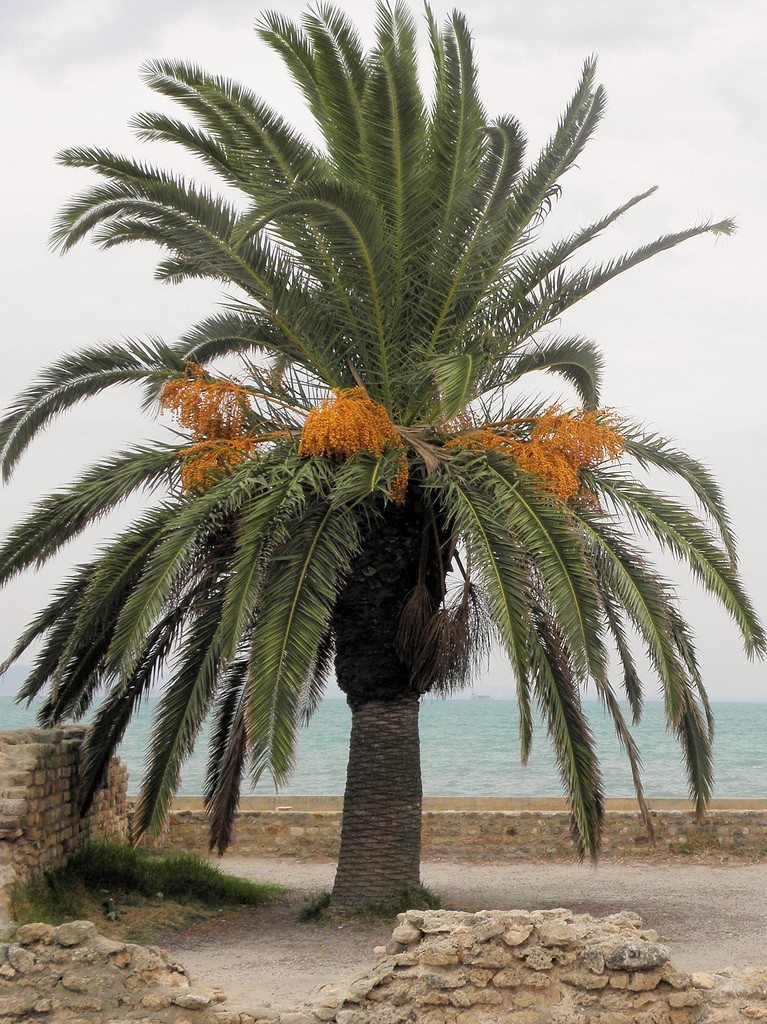
Deborah’s Palm Tree
We are also told that Deborah “dwelt under the palm tree of Deborah“ (the “palm tree” may be another reference to Jesus, because as we read in Psalm 92:12, “The righteous shall flourish like the palm tree: he shall grow like a cedar in Lebanon.“).
NOTE: It has been pointed out to this teacher by another Bible student that there is more information regarding “palm tree” than this teacher was previously aware. The name “Tamar”, in the original Hebrew is תָּמָר (tāmār)H8559, means “Palm tree”. Tamar is the name given to three women in the Bible: 1) The widow of Er (the son of Judah), who was chosen by God to be a progenitor of the Lord Jesus Christ via Judah; 2) A daughter of David by Maacah, sister of Absalom, and rape victim of Amnon her half brother, another son of David, and 3) a daughter of Absalom.
We should also remember the use of “palm branches” found in the New Testament in the worship, praise, and adoration of the Lord Jesus Christ. There was the first “Palm Sunday” where we read in John 12:12&13, “¶On the next day much people that were come to the feast, when they heard that Jesus was coming to Jerusalem, Took branches of palm trees, G5404 and went forth to meet him, and cried, Hosanna: Blessed is the King of Israel that cometh in the name of the Lord.“, and in Revelation 7:9&10, “After this I beheld, and, lo, a great multitude, which no man could number, of all nations, and kindreds, and people, and tongues, stood before the throne, and before the Lamb, clothed with white robes, and palms G5404 in their hands; And cried with a loud voice, saying, Salvation to our God which sitteth upon the throne, and unto the Lamb.“). Hence we can see additional indications that the “palm tree” is also a sign of the joyous reflection of Jesus’s Righteousness providing a protective covering of Salvation for believers from the just penalty for sin. Psalm 132:16, “I will also clothe her priests with salvation: and her saints shall shout aloud for joy.” and Leviticus 23:40, “And ye shall take you on the first day the boughs of goodly trees, branches of palm trees, and the boughs of thick trees, and willows of the brook; and ye shall rejoice before the LORD your God seven days.“
Interestingly, the doors of Solomon’s temple included carved palm trees covered in gold (together with cherubims and open flowers) in 1 Kings 6:29-35.
Palm trees also represent life in the Old Testament, because where they were located there were springs of life giving water (Exodus 15:27, Numbers 33:9 typifying another of the Attributes of Jesus Christ. Reinforcing this idea is the use of the word “dwelt.” For the believer, Jesus is our dwelling place (i.e., Psalm 90:1, {A Prayer of Moses the man of God.} “LORD, thou hast been our dwelling place in all generations. Before the mountains were brought forth, or ever thou hadst formed the earth and the world, even from everlasting to everlasting, thou [art] God“).
We also know that the palm tree was located “between Ramah and Bethel in mount Ephraim“. Ramah means “high place,” and Bethel means “house of God.” Ephraim pertains to the tribe of Ephraim, descended from the younger son of Joseph who received the double portion, and who Jacob blessed with his right hand and said “in thee shall Israel bless.” Shechem in mount Ephraim was established by Joshua (“Jesus”&”Saviour”) as a “city of refuge for the slayer” (together with the city of Kedesh in Galilee in mount Naphtali where Barak was from, see Joshua 20:7)
It is worth a moment to consider why “the children of Israel came up to her for judgment.“ A judge is someone who hears a matter and then pronounces a sentence against an accusation, whether vindication or condemnation and subsequent punishment. When the believers bring the gospel of salvation they are always bringing the two-fold message of deliverance from the bondage to sin and Satan through Jesus Christ or the alternative just punishment of sin which is an eternity in Hell on Judgment Day. How can anyone truly know about salvation through Jesus Christ unless they first understand from what they are being saved? Every human being is by nature in desperate need of a Savior to protect him or her from the coming judgment and wrath of God, which is the just penalty for his or her sins. Furthermore, we know that if “He that spared not his own son” (Romans 8:32) in that Jesus had to endure God’s wrath in Hell, will not God also do the same to those who do not become saved? 2 Corinthians 5:11, “Knowing therefore the terror of the Lord, we persuade men;“
Barak, a Portrait of Jesus Christ as the Ultimate Judge
Next we read in Judges 4:6, “And she sent and called Barak the son of Abinoam out of Kedesh-naphtali, and said unto him, Hath not the LORD God of Israel commanded, [saying], Go and draw toward mount Tabor, and take with thee ten thousand men of the children of Naphtali and of the children of Zebulun?“

This is the first reference to Barak. Barak (בָּרָק (bārāq)H1300), interestingly enough, also means “lightning” (exactly as Lapidoth, the husband of Deborah!), but also “glittering sword.” Might Barak therefore also be a “Type” or “Allegorical Prefigurement” of the LORD Jesus Christ? The Bible provides us with the affirming answer:
- In Exodus 19:16, we read of when Moses was on Mount Sinai and God made His presence known to the people, “And it came to pass on the third day in the morning, that there were thunders and lightnings (בָּרָק (bārāq)H1300), and a thick cloud upon the mount, and the voice of the trumpet exceeding loud; so that all the people that [was] in the camp trembled.“
- It should be noted that immediately following the giving forth of the Ten Commandments by God to Moses, we also read in Exodus 20:18, “And all the people saw the thunderings, and the lightnings (לַפִּיד (lapîḏ)H3940 ), and the noise of the trumpet, and the mountain smoking: and when the people saw [it], they removed, and stood afar off.“
The words “baraq” and “lapid” are effectively being used by God interchangeably, so then…
It is as if God is saying “Spiritually”, that Barak and Lapidoth “Typify”, or “Represent”, the same Person, Who Is Jesus Christ!
God provides us with ample evidence to conclude that, from a “spiritual” (NOT “literal” or “historical”) standpoint, Deborah is, “typologically”, married to Barak. We have therefore been presented another “Historical Parable“. One might immediately ask, “How can anyone justify making such a claim?” Well let us look to see what God is actually telling us by simply searching out His Word, the Bible:
- In Ezekiel 1:13, we read, in the very same verse, where Ezekiel describes the “visions of God,” (which the believing Christian should understand were figuratively representative of the four different offices of the Lord Jesus Christ), “As for the likeness of the living creatures, their appearance [was] like burning coals of fire, [and] like the appearance of lamps (לַפִּיד (lapîḏ)H3940 ): it went up and down among the living creatures; and the fire was bright, and out of the fire went forth lightning (בָּרָק (bārāq)H1300).”
- This is repeated again, with the same words are used together again in Daniel 10:5&6,, where we read how Daniel, just like Ezekiel, actually described Jesus in a vision, saying, “Then I lifted up mine eyes, and looked, and behold a certain man clothed in linen, whose loins were girded with fine gold of Uphaz: His body also [was] like the beryl, and his face as the appearance of lightning (בָּרָק (bārāq)H1300), and his eyes as lamps (לַפִּיד (lapîḏ)H3940 ) of fire, and his arms and his feet like in colour to polished brass, and the voice of his words like the voice of a multitude.“
- And is it not most interesting, that we see the same two words together again for a third time in Nahum 2:4, where judgment is being pronounced against Nineveh, “The chariots shall rage in the streets, they shall justle one against another in the broad ways: they shall seem like torches (לַפִּיד (lapîḏ)H3940 ), they shall run like the lightnings (בָּרָק (bārāq)H1300).” These three verses inextricably link “lapid” and “barak” together.
We should also not forget, or miss, how God also reiterates the co-mingling of these same two terms in the New Testament. They are found together again in the vision presented to John in Revelation 4:5, “And out of the throne proceeded lightnings and thunderings and voices: and [there were] seven lamps of fire burning before the throne, which are the seven Spirits of God.“
Moreover, as if the picture of Barak representing the Lord Jesus Christ is not clear enough, we find in Psalm 77:18 and Psalm 97:4 the following declarations of the LORD reigning and His works and judgments, “The voice of thy thunder [was] in the heaven: the lightnings(בָּרָק bārāq)H1300) lightened the world: the earth trembled and shook.” and “His lightnings(בָּרָק bārāq)H1300) enlightened the world: the earth saw, and trembled.” [Note also that the word “lightened“, which in the original Hebrew is אוֹר (‘ôr)H215, is also consistent with what Jesus said in John 8:12, “Then spake Jesus again unto them, saying, I am the light of the world: he that followeth me shall not walk in darkness, but shall have the light of life.”(See also John 9:5)
Remember how, in Matthew 24:27, we read where Jesus Christ told us directly that His coming on Judgment Day will appear as “lightning“, “For as the lightning cometh out of the east, and shineth even unto the west; so shall also the coming of the Son of man be.” Note the harmony with what we just saw above in Psalm 77:18 and Psalm 97:4! Clearly then, God is telling us that Jesus Is both the Light of the world and the Judge of all the world.
We should also note perfect harmony of what Jesus said with what we find in Job 37:2-5, “Hear attentively the noise of his voice, and the sound [that] goeth out of his mouth. He directeth it under the whole heaven, and his lightning unto the ends of the earth. After it a voice roareth: he thundereth with the voice of his excellency; and he will not stay them when his voice is heard. God thundereth marvellously with his voice; great things doeth he, which we cannot comprehend.” Lightning heralds the thunder and is always associated with it. Jesus will come as the Lightning that shines from east to west (the ends of the earth) and His Voice (His Words) will be heard, like thunder, that will judge and destroy the nations of the unsaved, and nothing will stop His wrath from fulfilling His purpose at that point. It cannot be comprehended how horrific that will be on Judgment Day. We had all better listen attentively to God’s Word!
So then, while there is no doubt in the literal, historical, earthly account, Deborah was married to a man named “Lapidoth“, and NOT “Barak” (who is an entirely different man in the historical account), the spiritual meaning that is nonetheless being conveyed to us by God is that Deborah is spiritually representative of Jesus’ Bride, the eternal church, and Barak is spiritually representative of the Lord Jesus Christ. What we are seeing therefore is another Historical Parable, which God has opened up to us out of the Bible in these very last of the last days, and only those with the eyes to see and the ears to hear will be able and made to understand.
Lightning, Swords, and Arrows Are Used Together to Bring Judgment
When we search the Bible we can see that there is a clear connection with Jesus, Being God’s Word, and His association with bringing judgment in the form of lightning, sword, and arrows, such as in Zechariah 9:14, “And the LORD shall be seen over them, and his arrow (חֵץ (ḥēṣ) H2671) shall go forth as the lightning (בָּרָק bārāq)H1300): and the Lord GOD shall blow the trumpet, and shall go with whirlwinds of the south.” Also please note the particular and unmistakable harmony of these three additional verses that also tie “lightning” with “arrows“, or weapons of warfare like the “sword” (or “spear“), to bring destruction, hence judgment, and in particular, JUDGMENT DAY! (and please also note that “the Lord GOD shall blow the trumpet” unequivocally also points to Judgment Day as we read in 1 Corinthians 15:52, “In a moment, in the twinkling of an eye, at the last trump: for the trumpet shall sound, and the dead shall be raised incorruptible, and we shall be changed.“)
Habakkuk 3:11 “The sun [and] moon stood still in their habitation: at the light of thine arrows (חֵץ (ḥēṣ) H2671) they went, [and] at the shining of thy glittering. (בָּרָק (bārāq))H1300 spear (חֲנִית (ḥănîṯ))H2595.
And please note the consistency between the Psalm of David as found in 2 Samuel 22:15, “And he sent out arrows (חֵץ (ḥēṣ) H2671), and scattered them; lightning (בָּרָק (bārāq))H1300), and discomfited them.” with what is written in Psalm 18:14, “Yea, he sent out his arrows (חֵץ (ḥēṣ) H2671), and scattered them; and he shot out lightnings (בָּרָק (bārāq))H1300), and discomfited them.”
Psalm 144:6, “Cast forth lightning (בָּרָק (bārāq)H1300,) and scatter them: shoot out thine arrows (חֵץ (ḥēṣ) H2671), and destroy them.“
The verse just preceding the one above, Psalm 144:5, makes clear to us that God is unequivocally describing Judgment Day, “Bow thy heavens, O LORD, and come down: touch the mountains, and they shall smoke.” Judgment Day is the Day when the elements will melt with fervent heat and the earth will dissolve, and the heavens will be rolled back as a scroll, the sun and moon and stars will be darkened as we read in 2 Peter 3:10, 2 Peter 3:12, Isaiah 64:1&2, Amos 9:13, Nahum 1:5, Isaiah 34:4, Revelation 6:14, Matthew 24:35, and Isaiah 13:9&10. Therefore all those people in the world who are counted by God as His enemies will be destroyed, just like the Canaanites in the Valley of Megiddo (also known as the Valley of Jehoshaphat/Decision in Joel 3:2, Joel 3:12 & Joel 3:14) .
NOTE: Psalm 45 is another synopsis of Jesus coming on the clouds of Glory as KING of KINGS and LORD of LORDS (1 Timothy 6:15, Rev 17:14, Rev 19:16) conquering and coming to conquer (Revelation 6:2) with a “sword” and “arrows” on Judgment Day (the first seven verses) and they Jesus coming to meet His Bride (Revelation 21:2), the Queen, the Eternal Church, to take Her to Heaven with Him (the last ten verses). This Psalm, to a large degree, mirrors what we find also in Solomon’s Song.
Psalm 45:1-7 “¶ [[To the chief Musician upon Shoshannim, for the sons of Korah, Maschil, A Song of loves.]] My heart is inditing a good matter: I speak of the things which I have made touching the king: my tongue [is] the pen of a ready writer. Thou art fairer than the children of men: grace is poured into thy lips: therefore God hath blessed thee for ever. Gird thy sword (חֶרֶב (ḥereḇ)H2719) upon thy thigh, O [most] mighty, with thy glory and thy majesty. And in thy majesty ride prosperously because of truth and meekness [and]righteousness; and thy right hand shall teach thee terrible things. Thine arrows (חֵץ (ḥēṣ)) H2671 [are] sharp in the heart of the king’s enemies; [whereby] the people fall under thee. Thy throne, O God, [is] for ever and ever: the sceptre of thy kingdom [is] a right sceptre. Thou lovest righteousness, and hatest wickedness: therefore God, thy God, hath anointed thee with the oil of gladness above thy fellows.”
Psalm 45:8-17, “All thy garments [smell] of myrrh, and aloes, [and] cassia, out of the ivory palaces, whereby they have made thee glad. Kings’ daughters [were] among thy honourable women: upon thy right hand did stand the queen in gold of Ophir. Hearken, O daughter, and consider, and incline thine ear; forget also thine own people, and thy father’s house; So shall the king greatly desire thy beauty: for he [is] thy Lord; and worship thou him. And the daughter of Tyre [shall be there] with a gift; [even] the rich among the people shall intreat thy favour. The king’s daughter [is] all glorious within: her clothing [is] of wrought gold. She shall be brought unto the king in raiment of needlework: the virgins her companions that follow her shall be brought unto thee. With gladness and rejoicing shall they be brought: they shall enter into the king’s palace. Instead of thy fathers shall be thy children, whom thou mayest make princes in all the earth.“
Another note: The use of the word “myrrh” (מֹר (mōr)) H4753 is particularly noteworthy as it points to Jesus and His Sacrificial Death and Atonement. Solomon’s Song 1:13 “A bundle of myrrh [is] my well beloved unto me; he shall lie all night betwixt my breasts” and
Matthew 2:11, “And when they were come into the house, they saw the young child with Mary his mother, and fell down, and worshipped him: and when they had opened their treasures, they presented unto him gifts; gold, and frankincense, and myrrh.” and
John 19:39, “And there came also Nicodemus, which at the first came to Jesus by night, and brought a mixture of myrrh and aloes, about an hundred pound [weight].”
God uses “Lightning/Lightnings” to Describe Jesus and His Second and Final Coming in the New Testament
Remember how, in Matthew 24:27, we read where Jesus Christ tells us directly that His coming on Judgment Day will appear as lightning, “For as the lightning cometh out of the east, and shineth even unto the west; so shall also the coming of the Son of man be.” Note the harmony with Psalm 77:18, “The voice of thy thunder was in the heaven: the lightnings (בָּרָק (bārāq)H1300) lightened the world: the earth trembled and shook.” Clearly this points to Jesus being both the Light of the world and the Judge of the world.
In Matthew 28:3, describing “the angel of the Lord descended from heaven”, we read that, “His countenance was like lightning, and his raiment white as snow:“Luke 17:24, “For as the lightning, that lighteneth out of the one [part] under heaven, shineth unto the other [part] under heaven; so shall also the Son of man be in his day.”
Revelation 4:5, “And out of the throne proceeded lightnings and thunderings and voices: and [there were] seven lamps of fire burning before the throne, which are the seven Spirits of God.“
Revelation 8:5, “And the angel took the censer, and filled it with fire of the altar, and cast [it] into the earth: and there were voices, and thunderings, and lightnings, and an earthquake.”
Revelation 11:19, “And the temple of God was opened in heaven, and there was seen in his temple the ark of his testament: and there were lightnings, and voices, and thunderings, and an earthquake, and great hail.”
Revelation 16:18, “And there were voices, and thunders, and lightnings; and there was a great earthquake, such as was not since men were upon the earth, so mighty an earthquake, [and] so great.
The verses above clearly link “lightning” with “thunder” together with Judgment Day, but we also have this verse that also points to Judgment Day (albeit only directly mentioning “thunder”)…In 1 Samuel 2:10, Hannah, the mother of Samuel, prophesied, “The adversaries of the LORD shall be broken to pieces; out of heaven shall he thunder upon them: the LORD shall judge the ends of the earth; and he shall give strength unto his king, and exalt the horn of his anointed.“
Finally, back in Deuteronomy 32:41, the same word Hebrew word “barak” is alternatively translated as “glittering sword”, “If I whet my glittering sword (בָּרָק bārāq)H1300, and mine hand take hold on judgment; I will render vengeance נָקָם (nāqām)H5359 to mine enemies, and will reward them that hate me.” We this also in Job 20:25, where God has just outlined what will happen to the wicked and the hypocrites of the world on Judgment Day, “It is drawn, and cometh out of the body; yea, the glittering sword (בָּרָק bārāq)H1300cometh out of his gall: terrors [are] upon him.”
Note also the similarity with the above given the military armor context of Isaiah 59:17, “For he put on righteousness as a breastplate, and an helmet of salvation upon his head; and he put on the garments of vengeance נָקָם (nāqām)H5359 [for] clothing, and was clad with zeal as a cloke. According to [their] deeds, accordingly he will repay, furyto his adversaries, recompence to his enemies; to the islands he will repay recompence.“
This is all describing Jesus’ Coming on Judgment Day!
More verses to ponder:
Job 38:35 “Canst thou send lightnings (בָּרָק (bārāq)H1300), that they may go, and say unto thee, Here we [are]?“
Job 19:29, “Be ye afraid of the sword (חֶרֶב (ḥereḇ)H2719): for wrath [bringeth] the punishments of the sword (חֶרֶב (ḥereḇ)H2719), that ye may know [there is] a judgment.“
Isaiah 34:5&6 “For my sword (חֶרֶב (ḥereḇ)H2719) shall be bathed in heaven: behold, it shall come down upon Idumea, and upon the people of my curse, to judgment. The sword (חֶרֶב (ḥereḇ)H2719) of the LORD is filled with blood, it is made fat with fatness, and with the blood of lambs and goats, with the fat of the kidneys of rams: for the LORD hath a sacrifice in Bozrah, and a great slaughter in the land of Idumea.“
Ezekiel 21:28 “And thou, son of man, prophesy and say, Thus saith the Lord GOD concerning the Ammonites, and concerning their reproach; even say thou, The sword (חֶרֶב (ḥereḇ)H2719), the sword (חֶרֶב (ḥereḇ)H2719) [is] drawn: for the slaughter [it is] furbished, to consume because of the glittering (בָּרָק (bārāq)H1300):”
Nahum 3:3, “The horseman lifteth up both the bright sword (חֶרֶב (ḥereḇ)H2719) and the glittering (בָּרָק bārāq)H1300) spear: and [there is] a multitude of slain, and a great number of carcases; and [there is] none end of [their] corpses; they stumble upon their corpses:“
Habakkuk 3:11 “The sun [and] moon stood still in their habitation: at the light of thine arrows (חֵץ (ḥēṣ) H2671) they went, [and] at the shining of thy glittering (בָּרָק (bārāq)H1300) spear.
The Word of God Is A “Sword” of the Spirit Out of the Mouth of Jesus !
Ephesians 6:17, “And take the helmet of salvation, and the sword of the Spirit, which is the word of God:”
Revelation 19:21, “And the remnant were slain with the sword of him that sat upon the horse, which [sword] proceeded out of his mouth: and all the fowls were filled with their flesh.“
Isaiah 49:1-3, “¶ Listen, O isles, unto me; and hearken, ye people, from far; The LORD hath called me from the womb; from the bowels of my mother hath he made mention of my name. And he hath made my mouth like a sharp sword (חֶרֶב (ḥereḇ))H2719 ; in the shadow of his hand hath he hid me, and made me a polished shaft (חֵץ (ḥēṣ)H2671); in his quiver hath he hid me; And said unto me, Thou [art] my servant, O Israel, in whom I will be glorified.“(See also Psalm 45:1-7)
For more details please see the post “Swords and Arrows“
The Word of God Is Also a Sharp “Twoedged” Sword!

Finally, what else can we know about the Word of God in relationship to a “Sword”? Hebrews 4:12, “For the word of God [is] quick, and powerful, and sharper than any twoedged sword, piercing even to the dividing asunder of soul and spirit, and of the joints and marrow, and [is] a discerner of the thoughts and intents of the heart.” And please note how “the Word” is figuratively protruding out of the Mouth of Jesus in Revelation 1:16, “And he had in his right hand seven stars: and out of his mouth went a sharp twoedged sword: and his countenance [was] as the sun shineth in his strength.” (Note how this relates directly back to Isaiah 49:2 and again to Revelation 19:21)
But why is the “Word of God” specifically identified with a “TWOEDGED” sword? It is because the Word of God brings both life and death, both salvation or condemnation, “Comfort” and “Vengeance” (see: the Book of Nahum) . We read in 2 Corinthians 2:14-17, “Now thanks be unto God, which always causeth us to triumph in Christ, and maketh manifest the savour of his knowledge by us in every place. For we are unto God a sweet savour of Christ, in them that are saved, and in them that perish:To the one we are the savour of death unto death; and to the other the savour of life unto life. And who [is] sufficient for these things? For we are not as many, which corrupt the word of God: but as of sincerity, but as of God, in the sight of God speak we in Christ.“
When we consider that all of the above verses are talking about Judgment Day, we must conclude that not only does “Barak” clearly and irrefutably represent Jesus Christ, but Barak also represents Jesus Christ as Both The Judge, and The Means of Judgment coming on Judgment Day!
NOTE: Some other verses come to mind that support this last statement. First in Psalm 7:11-13 we read, “God judgeth the righteous, and God is angry [with the wicked] every day. If he turn not, he will whet his sword (חֶרֶב (ḥereḇ)H2719; he hath bent his bow, and made it ready. He hath also prepared for him the instruments of death; he ordaineth his arrows against the persecutors.” It is very difficult to begin to understand the might of God’s wrath against the wicked, against God’s enemies on Judgment Day. But that Sword of Truth is Jesus as we read Ephesians 6:17, “And take the helmet of salvation, and the sword of the Spirit, which is the word of God:” and Jesus specifically told us that His Word is what will bring judgment on Judgment Day as we read in John 12:48, “He that rejecteth me, and receiveth not my words, hath one that judgeth him: the word that I have spoken, the same shall judge him in the last day.” and Revelation 19:21, “And the remnant were slain with the sword of him that sat upon the horse, which [sword] proceeded out of his mouth: and all the fowls were filled with their flesh.“
Abinoam, a Portrait of The Father in Heaven
Barak is also “the son of Abinoam“. If the typological/allegorical methodology of interpretation, that has so far been employed in this study (and throughout all of the posts of Bereansearching.com), is Biblically valid (e.g, That it is entirely God ordained and true), then we should logically expect, given the evidence that Barak so clearly and unequivocally represents Jesus Christ, that Barak’s father, Abinoam, would provide at least some evidence that Abinoam is a “Typological” representation of God, The Father, in Heaven. In other words, we have a sound basis, or “scientific” means, to both test, and hopefully prove, this methodology of allegorical interpretation, and moreover to see whether it is God ordained or not.
We start with the theory based on previous evidence found in God’s Word (1 Corinthians 2:13), and now, using deductive reasoning, we are enabled to make a prediction using that derived theory. In this passage of scripture, regarding Abinoam, we can put the theory to the test. If the prediction (e.g., that Abinoam should be expected to be a clear “type” of The Father in Heaven) is validated, then likewise the theory is also validated!
In perfect confirmation, with the above prediction, we find that Abinoam means “father (אָב (‘āḇ)) H1“ of “beauty (נֹעַם (nōʿam)) H5278” or “father (אָב (‘āḇ)) H1 of pleasantness (נֹעַם (nōʿam)) H5278).” Both progenitive attributes, “beauty” and “pleasantness“, as translated from the original Hebrew texts, can be shown to be unequivocal references to Jesus Christ, therefore, the “father” of those attributes (“beauty” and “pleasantness”), which unequivocally point to Jesus Christ, must be a “Typological” representation of God the Father in Heaven! Can this be proven? It most certainly can!
Noam (“Beauty”), the name of the first staff in Zechariah 11:10, represents the Lord Jesus Christ!
In Psalm 27:4 we read, “One [thing] have I desired of the LORD, that will I seek after; that I may dwell in the house of the LORD all the days of my life, to behold the beauty (נֹעַם (nōʿam)) H5278 of the LORD, and to inquire in his temple.” Also in Psalm 90:17 we read, “And let the beauty (נֹעַם (nōʿam)) H5278 of the LORD our God be upon us: and establish thou the work of our hands upon us; yea, the work of our hands establish thou it.“
And it is EXTREMELY significant to find that God tells us in Zechariah 11:10-13*, “And I took my staff, [even] Beauty (נֹעַם (nōʿam)) H5278, and cut it asunder, that I might break my covenant which I had made with all the people. And it was broken in that day: and so the poor of the flock that waited upon me knew that it [was] the word of the LORD. And I said unto them, If ye think good, give [me] my price; and if not, forbear. So they weighed for my price thirty [pieces] of silver. And the LORD said unto me, Cast it unto the potter: a goodly price that I was prised at of them. And I took the thirty [pieces] of silver, and cast them to the potter in the house of the LORD.” Note, specifically, that it was the “poor of the flock that waited on me” … it was the believers who knew that it was the Word of the LORD! The believers who wait upon God must “know” that it was Jesus who was cut asunder, and that the price paid by the chief priests was thirty pieces of silver, because Jesus is the Word made flesh as we read in John 1:14.
These prophetic verses also describe exactly what happened to Jesus Christ (we know that Jesus (The WORD of the LORD) was cut asunder and that Jesus was broken by God for all believers. This was so that the first covenant of works would be fulfilled, in order that the new covenant of grace could be instituted. The thirty pieces of silver were the price given to Judas Iscariot to betray Jesus, and that Judas “cast down the pieces of silver in the temple” (“The house of the LORD“), and which were later used to buy “the potter’s field, to bury strangers in“!
Note to the Reader: There is widespread agreement by most theologians and Biblical scholars that the passage in Zechariah, chapter 11, regarding the broken staff named “Beauty” (נֹעַם (nōʿam)) H5278 and its price, the thirty pieces of silver cast down in the temple (which was subsequently used to buy the potter’s field), prophetically points to the Lord Jesus Christ, but only because they are satisfied that there is an explicit reference/description of the reference in both Matthew 27:3-10 and Acts 1:15-19.
In the Matthew account, Judas is seemingly filled with remorse for betraying Jesus, and he tries to return the thirty pieces of silver to the chief priests (Matthew 27:3). When the chief priests and elders refuse to accept the money, Judas casts the thirty pieces of silver to the temple floor, and then leaves and hangs himself (Matthew 27:4&5). Not wanting to put “blood money” into the treasury, the priests use the silver pieces to buy a potter’s field (Matthew 27:6&7). “Then was fulfilled that which was spoken by Jeremy* the prophet, saying, And they took the thirty pieces of silver, the price of him that was valued, whom they of the children of Israel did value; And gave them for the potter’s field, as the Lord appointed me.” (Matthew 27:9).
It should also be noted that Exodus 21:32 lists “thirty shekels of silver” as the price the must be paid by an owner of any ox that gores another’s manservant or maidservant (hence it is the established value by God for a servant’s life), and we all should know that Jesus’s earthly life was one of servitude and that Jesus is also known as the “Suffering Servant”.
But what about “pleasantness“? In Proverbs 3:17, God, through King Solomon, is describing wisdom and understanding (again clear references to Jesus Christ) where we read, “Her ways [are] ways of pleasantness , and all her paths [are] peace.” [Note: Don’t let the feminine gender reference confuse you, because in the very next two verses, we see wisdom equated to “the tree of Life” and “that by wisdom the LORD founded the earth.” We know, therefore, that “wisdom” has to be referring to Jesus Christ because of what we read in John 14:6, and Revelation 2:7 and Revelation 22:2, and John 1:1-4.] Given that all of wisdom’s “paths are peace”, we should bear in mind that Jesus is also the “Prince of Peace” according to Isaiah 9:6.
It is worth also noting that Proverbs 8:1-36 (the whole chapter) refers to Wisdom as “She”, but it says that Wisdom was there with God before Creation, so Wisdom can be none other than Jesus.
The Proof That The Bible Is Self-Validatiing!
The above exposition reveals yet another excellent example of the perfection of God’s craftsmanship of both the actual history, and the recording of it in the Bible, to convey spiritual truth which can be found out if sought for like hidden treasure (see Proverbs 3:13-15).
- Barak in the Hebrew (meaning “Lightning” or “Glittering Sword”), as well as God’s use of “barak” in Biblical scripture, make clear that Barak is a “type” of the Lord Jesus Christ (and this particularly so when we look at the descriptions of Barak, e.g., 10,000 men coming with him into the valley of Megiddo to slay all of God’s enemies as we similarly see in Jude 1:14-16).
- If “beauty” and “pleasantness” (נֹעַם (nōʿam)) H5278 represents Jesus Christ, then Abinoam unequivocally represents The Father of Jesus Christ, hence God, The Father, in Heaven.
- Because Abinoam is the father of Barak, Barak is again seen from a new perspective, to represent Jesus Christ, the Son of God The Father.
Perhaps most importantly, the prediction was correct and therefore, likewise, the methodology is also proven to be valid. We have thus all been clearly shown a proven means of interpretation of the Bible from the Bible! (and it was all simply done by only comparing spiritual things with spiritual things…by comparing scripture with scripture)
* In the Matthew 27:3-10 account of the 30 pieces of silver being cast down in the temple, which were used by the chief priests to buy the potter’s field (“the field of blood“), please note that in verse 9 it references the prophet “Jeremy” (Jeremiah) versus Zechariah, which can lead to some confusion. If we look at Jeremiah 32:6-15, we can indeed see a number of similarities, as it references “redemption“, that it was “a field” purchased for “17“ shekels of “silver” and reference to an “earthen vessel” (a pot made by a potter), and “Then I knew that this [was] the word of the LORD.” Note how this compares to Zechariah 11:11, “the poor of the flock that waited upon me knew that it [was] the word of the LORD.” And please do not forget that Jesus is the Word of the LORD! John 1:14
It is not clear why Jeremiah states “17” “shekels of silver” versus “30″ “pieces of silver” as is found in both Matthew 27 and Zechariah 11 (Interestingly, Exodus 21:32 lists “thirty shekels of silver” as the penalty to an owner of any ox that gores another’s manservant or maidservant). Then Jeremiah 32:12 concludes that the evidence of the purchase would be written in “the book of the purchase, before all the Jews that sat in the court of the prison.” The purpose of these passages was to provide a testimony that although the Jews (Judah and Benjamin) would go into Babylonian captivity, God would free the captives after 70 years, (Jeremiah 29:10) and return them to Jerusalem and the surrounding areas, which allegorically pointed to Jesus freeing the believers from captivity in prison (in bondage within the gates of hell) to the New Jerusalem (heaven). So, nonetheless, the Gospel theme remains consistent.
What about the second staff, “Bands”?
We should also note that in reading one verse further in Zechariah 11:14, we find God telling us, “Then I cut asunder mine other staff, [even] Bands (חֵבֶל (ḥēḇel) H2256),that I might break the brotherhood between Judah and Israel.” The Hebrew word translated as “Bands” i חֵבֶל (ḥēḇel) H2256, which is used in the Bible to indicate a “bond” or “pledge” with reference to “a cord/rope (as twisted), especially a measuring line; by implication, a district or inheritance (as measured)” or figuratively, to pervert, destroy or bring “sorrows like a woman in travail”. The use of the name “Bands” for the second of the two staves would seem to be telling us that God is providing a second witness to His ending, or dissolution, of His marital relationship with National Israel, because Jesus is of the tribe of Judah, and when the first staff, “Beauty” (Noam, hence Jesus, “the word of the LORD”), was cut asunder, so too was the marital covenant relationship with National Israel. Remember the the moment that Jesus died, the veil of the Temple leading to the Holy of Holies was rent, from top to bottom (Matthew 27:51, Mark 15:38, Luke 23:45 ) which indicated that God’s temporal marriage to National Israel (the Old Testament church) had ended, along with all animal sacrifices, and which marked the beginning of the new eternal marital covenant (the New Testament church) with the Gentiles with a remnant of national Israel.
There might also be the implication that with the breaking of the stave “Beauty“, representing Jesus in His Atoning Sacrifice, that the just judgment that is due to all of mankind, represented by the stave “Bands“, חֵבֶל (ḥēḇel)H2256 would also be broken as well, and that first covenant (represented by the stave “Bands”), which was previously limited to only National Israel, would subsequently apply to the whole world through the Tribe of Judah (Jesus is from the Tribe of Judah).
“Bands“, the original Hebrew word, חֵבֶל (ḥēḇel)H2256, has been translated into English by the King James translators variously as cord (16x), sorrows (10x), line (7x), coast (4x), portion (4x), region (3x), lot (3x), ropes (3x), company (2x), pangs (2x), bands (1x), country (1x), destruction (1x), pain (1x), snare (1x), tacklings (1x).
Moreover, it should also be noted how the words “bands” and “cords” (albeit different in the original Hebrew) are used in Psalm 2:1-3, where we read, “¶Why do the heathen rage, and the people imagine a vain thing? The kings of the earth set themselves, and the rulers take counsel together, against the LORD, and against his anointed, [saying], Let us break their bands (מוֹסֵר (môsēr)) H4147asunder, and cast away their cords (עֲבֹת (ʿăḇōṯ))H5688 from us.” The majority of mankind (the “heathen”) have no interest in a marital relationship with the Lord Jesus Christ, as they are opposed to Him and His Church. We also find in Psalm 129:4, “The LORD [is] righteous: he hath cut asunder the cords (עֲבֹת (ʿăḇōṯ))H5688 of the wicked“, which is indicative of the fact that all believers were captives to the devil and have now been set free by Jesus. Those captives are spoken about here in Psalm 102:19&20, “For he (God) hath looked down from the height of his sanctuary; from heaven did the LORD behold the earth; To hear the groaning of the prisoner; to loose those that are appointed to death;“
And is it not interesting what we read in Hosea 11:4, I drew them with cords (חֵבֶל (ḥēḇel))H2256 of a man, with bands (עֲבֹת (ʿăḇōṯ))H5688 of love: and I was to themas they that take off the yoke on their jaws, and I laid meat unto them.“
Kedesh-naphtali?
The Believers are From Every Nation, Typified by “Galilee of the Gentiles”
But what does it mean to be from Kedesh-naphtali? Kedesh (קֶדֶשׁ (qeḏeš) H6943, which means “holy place”, “ceremonially clean”, or “sanctuary”) was established by Joshua (“Jesus”&”Saviour”) as a “city of refuge for the slayer” (together with the city of Shechem in mount Ephraim, see Joshua 20:7). Furthermore, in Joshua 21:32 we read that Kedesh is in the area of land given to the tribe of Naphtali known as Galilee. So we can see therefore that Barak was a Galilean just as Jesus was! And Jesus most certainly was ceremonially clean and from a Holy Place (Heaven)!
But what about Barak taking ten thousand men of the children of Naphtali and Zebulun toward mount Tabor? From Matthew 4:12-15 (and Isaiah 9:1), we learn that the land encompassing both Naphtali (“Wrestling” in Hebrew) and Zebulun (“Dwelling in Hebrew) or Naphtalim and Zabulon in Greek, is identified as being within the region of Galilee, “Now when Jesus had heard that John was cast into prison, he (Jesus) departed into Galilee; And leaving Nazareth, he came and dwelt in Capernaum, which is upon the sea coast, in the borders of Zabulon and Nephthalim: That it might be fulfilled which was spoken by Esaias (Isaiah 9:1) the prophet, saying, The land of Zabulon, and the land of Nephthalim, [by] the way of the sea, beyond Jordan, Galilee of the Gentiles;” And when we look at Isaiah 9:1, we see that it read specifically as, “Nevertheless the dimness [shall] not [be] such as [was] in her vexation, when at the first he lightly afflicted the land of Zebulun and the land of Naphtali, and afterward did more grievously afflict [her by] the way of the sea, beyond Jordan, in Galilee of the nations.” (But PLEASE also be sure to read the rest of Isaiah 9:2-6, footnoted below, as it succinctly lays out salvation is for the believers from every nation through Jesus Christ).**

But what does it mean to be from Zebulun? Is it not also most interesting that the town of Nazareth, where Jesus grew up, in not only in the Galilee region, but it is also specifically in the land of Zebulun, just as was the home of Jonah (almost next-door in Gath-Hepher), but now, not surprisingly, we see that this same area was also the home of Barak! Please see: An Exposition of the Book of Jonah and the map below:
Map Source: https://i2.wp.com/ladderofjacob.com/wp-content/uploads/2016/01/galilee-01.jpg
Barak Went Up (Ascended) “With Ten Thousand Men at His Feet”
When we look closer at the verses in Judges 4:6-10, we get the distinct impression that God is declaring that a multitude (typified by the number “ten thousand“) of believers who follow Jesus is drawn from all the nations of the world, both Gentile (non-Israeli) nations, as well as the remnant saved by grace from the nation of Israel. The latter primarily during the New Testament era (hence relating to the New Testament Church) and that they would all go up (ascend) with Jesus to whatever mount Tabor represents (see below).
NOTE: The number “Ten Thousand” is used by God in the Bible to spiritually represent ALL of the believers throughout ALL time, because it can be broken down as follows: 10X10X10X10 (or ten to the fourth power). In the Bible, the number ten spiritually represents “completeness” or “totality”, while the number four spiritually represents “universality”.
This interpretation is corroborated by Revelation 5:9-13, where, with respect to the Lamb (Jesus Christ, “Lion of the Tribe of Judah, the Root of David” Who “prevailed to open the book, and to loose the seven seals thereof” Revelation 5:5-6, and Who we know Is “the Lamb of God” (John 1:29), we read the following:
“And they sung a new song, saying, Thou art worthy to take the book, and to open the seals thereof: for thou wast slain, and hast redeemed us to God by thy blood out of every kindred, and tongue, and people, and nation; And hast made us unto our God kings and priests: and we shall reign on the earth. And I beheld, and I heard the voice of many angels round about the throne and the beasts and the elders: and the number of them was ten thousand times ten thousand, and thousands of thousands; Saying with a loud voice, Worthy is the Lamb that was slain to receive power, and riches, and wisdom, and strength, and honour, and glory, and blessing.” And every creature which is in heaven, and on the earth, and under the earth, and such as are in the sea, and all that are in them, heard I saying, Blessing, and honour, and glory, and power, be unto him that sitteth upon the throne, and unto the Lamb for ever and ever.”
It is important to note the very close similarity of the above to that which can be found in the Old Testament, in Daniel 7:9-14, where we see another account of Judgment Day illustrated by very similar language, “I beheld till the thrones were cast down, and the Ancient of days did sit, whose garment was white as snow, and the hair of his head like the pure wool: his throne was like the fiery flame, and his wheels as burning fire. A fiery stream issued and came forth from before him: thousands thousands ministered unto him, and ten thousand times ten thousand stood before him: the judgment was set, and the books were opened. I beheld then because of the voice of the great words which the horn spake: I beheld even till the beast was slain, and his body destroyed, and given to the burning flame. As concerning the rest of the beasts, they had their dominion taken away: yet their lives were prolonged for a season and time. I saw in the night visions, and, behold, one like the Son of man came with the clouds of heaven, and came to the Ancient of days, and they brought him near before him. And there was given him dominion, and glory, and a kingdom, that all people, nations, and languages, should serve him: his dominion is an everlasting dominion, which shall not pass away, and his kingdom that which shall not be destroyed.” The Ancient of Days would have to be God The Father, while the Son of man is clearly Jesus Christ. But we must also bear in mind what Jesus said in John 10:30, “I and [my] Father are one.” and in John 14:7, “If ye had known me, ye should have known my Father also: and from henceforth ye know him, and have seen him.”
And even back during the wilderness sojourn, we are told that when the Ark of the Covenant rested, then Moses said in Numbers 10:36, “And when it rested, he said, Return, O LORD, unto the many thousands of Israel.” The words translated for many thousands in the original Hebrew text read, רָבַב (H7231) אֶלֶף (H504) which can be read as “myriad thousand”, “millions of thousand”, or “ten thousand thousand.” So again, the eternal Israel is being typified by God by these numbers in the Bible.
The “out every kindred, and tongue, and people, and nation” and “all people, nations, and languages” refers to all those saved by grace from both national Israel together with the Gentile nations and “the number of them was ten thousand times ten thousand, and thousands of thousands” shows us that the number of believers, the eternal Israel, saved by Jesus out of all nations, is a great multitude consistent with “all nations, and kindreds, and people, and tongues“, and was therefore indeed “a great multitude, which no man could number.”
It should also be noted that we read of a seemingly smaller number “an hundred and forty and four thousand.” in Revelation 7:4 and in Revelation 14:1-3, it is clear that the number 144,000 is a spiritual number representing all who are saved by the Lord Jesus Christ (the number is composed of 12 (representing the twelve tribes of ancient Israel) time 12 (representing the 12 Apostles of the New Testament era) times 1000 which emphasizes “completeness”. “And I looked, and, lo, a Lamb stood on the mount Sion, and with him an hundred forty and four thousand, having his Father’s name written in their foreheads. And I heard a voice from heaven, as the voice of many waters, and as the voice of a great thunder: and I heard the voice of harpers harping with their harps: And they sung as it were a new song before the throne, and before the four beasts, and the elders: and no man could learn that song but the hundred and forty and four thousand, which were redeemed from the earth.“
So then, we see again that the “ten thousand(s)” is a spiritual number used by God for typifying the great multitude of all of those who are saved by Jesus Christ, Who Is their Redeemer, just as the number 144,000 also represents all those who are redeemed.
That multitude of believers is found in Heaven, praising God for their salvation, as we read on in Revelation 7:9-10 where they, “stood before the throne, and before the Lamb, clothed with white robes, and palms in their hands; And cried with a loud voice, saying, Salvation to our God which sitteth upon the throne, and unto the Lamb.”
Remember also what we read in Matthew 12:14-18, after Jesus healed the man with the withered hand, “Then the Pharisees went out, and held a council against him, how they might destroy him. But when Jesus knew it, he withdrew himself from thence: and great multitudes followed him, and he healed them all; And charged them that they should not make him known: That it might be fulfilled which was spoken by Esaias the prophet, saying, Behold my servant, whom I have chosen; my beloved, in whom my soul is well pleased: I will put my spirit upon him, and he shall shew judgment to the Gentiles.“
Mount Tabor, a Portrait of Heaven with Judgment in View?
As a mountain, we know that there is at least the possibility that mount “Tabor” (תָּבוֹר (tāḇôr)) H8396, a prominent dome-shaped mountain (whose meaning in Hebrew is simply “mount” or “lofty place”) could represent “Heaven“. This is because of what we read in Psalm 121:1&2 {A Song of degrees.} “I will lift up mine eyes unto the hills (from הַר (har)) H2022 in Hebrew, which can also be translated “mountains” or “mount”), from whence cometh my help. My help [cometh] from the LORD, which made heaven and earth. And shortly afterward, we read in Psalm 123:1, “¶[[A Song of degrees.]] Unto thee lift I up mine eyes, O thou that dwellest in the heavens.“
Moreover, we read in Psalm 3:4 “I cried unto the LORD with my voice, and he heard me out of his holy hill (הַר (har)) H2022. Selah.” We can also see this relationship expounded to us in Psalm 68:15&16, “The hill (הַר (har)) H2022of God [is as] the hill (הַר (har)) H2022of Bashan; an high hill (הַר (har)) H2022 [as] the hill (הַר (har)) H2022of Bashan. Why leap ye, ye high hills (הַר (har)) H2022? [this is] the hill (הַר (har)) H2022 [which]God desireth to dwell in;yea, the LORD will dwell [in it]for ever.”
Psalm 87:1 “¶[[A Psalm [or] Song for the sons of Korah.]] His foundation [is] in the holy mountains (הַר (har)) H2022.”
Psalms 114:6, “Ye mountains (הַר (har)) H2022, [that] ye skipped like rams; [and] ye little hills (גִּבְעָה (giḇʿâ)) H1389, like lambs?“
Our Only Help is From God, and God Is Upon His Holy Hill, Which Can Only Be Pointing Us to Heaven.
Then in Psalm 123:1 {A Song of degrees.}, we read, “Unto thee lift I up mine eyes, O thou that dwellest in the heavens.” We also know from Psalm 11:4 “The LORD [is] in his holy temple, the LORD’S throne [is] in heaven: his eyes behold, his eyelids try, the children of men.” However, we also find God’s use of allegory, with hills and mountains being representative of Heaven, such as we find in Psalm 24:3 “Who shall ascend into the hill (הַר (har) H2022) of the LORD? or who shall stand in his holy place” and Psalm 48:1 “Great is the LORD, and greatly to be praised in the city of our God, in the mountain (הַר (har) H2022) of his holiness.“
Psalm 87:1 “e¶[[A Psalm [or] Song for the sons of Korah.]] His foundation [is] in the holy mountains (הַר (har) H2022).“
Psalm 125:2, “As the mountains (הַר (har) H2022 [are] round about Jerusalem, so the LORD [is] round about his people from henceforth even forever.“
And we should also consider that while both Isaiah 2:2–4 and Micah 4:1–5 were temporally referring to the earthly Jerusalem, they both were actually, spiritually, pointing to the eternal Heavenly Jerusalem. “…the mountain of the LORD’S house shall be established in the top of the mountains, and shall be exalted above the hills; and all nations shall flow unto it (be lighted by it).”
We are assured that this is the case because of what we read in Revelation 21:2 “And I John saw the holy city, new Jerusalem, coming down from God out of heaven, prepared as a bride adorned for her husband.“
It is not entirely clear what is the true derivation of the meaning of the word “Tabor” (תָּבוֹר (tāḇôr)) H8396. There do seem to be a number of somewhat conflicting explanations. One explanation is that it is derived from the root word that means to be “broken in pieces” (תְּבַר (tᵊḇar)) H8406 , or something akin to broken rocks as can be found in a rock quarry. In that case, perhaps it could be an indirect reference to a place where believers are found before God, given that believers are referred to as “lively stones” (1 Peter 2:5) who are also “broken” in terms of the heart (Psalm 34:18, “The LORD is nigh unto them that are of a broken heart; and saveth such as be of a contrite spirit.”) as well as the spirit (Psalm 51:17 “The sacrifices of God [are] a broken spirit: a broken and a contrite heart, O God, thou wilt not despise.“). Another explanation is that it is related to the root word “taher” (טָהֵר (ṭāhēr))H2891 , meaning to be “pronounced clean” or “purged” and “purified”. Without doubt, Heaven is entirely “Pure” and all believers who ascend to Heaven are made spiritually “clean” and “purged of sin” and “purified” through sanctification by the Holy Spirit as a result of Jesus Christ’s Atoning Sacrifice.
It is also interesting to note here that mount Tabor is generally considered to be the leading candidate for the site of Jesus’ Transfiguration (The “Mount of Transfiguration“)…and while we can’t confirm or deny that assertion from the Bible; we can say that based on what we can learn in the course of this study, it would not be surprising if it was. For the record, Mt. Hermon is also considered to be another prime candidate for the location of Jesus’s Transfiguration.
More Evidence that Mt. Tabor Represents Heaven
It is also noteworthy that we do find mount Tabor in association with “the heavens” as we read in Psalm 89:11&12, “The heavens [are] thine, the earth also [is] thine: [as for] the world and the fulness thereof, thou hast founded them. The north and the south thou hast created them: Tabor and Hermon shall rejoice in thy name.” The “heavens” and “earth” are mentioned together, and then immediately following so too we find a counterpoint, with “the north and the south” being representative of this created earth, and the high mountains, specifically mount Tabor and mount Hermon, representing “the heavens” that “rejoice“. Psalm 89:11&12 therefore provides a clear correlation in the Bible between mount Tabor with heaven!
And is this not also consistent with what we read in Matthew 5:12, where Jesus said, “Rejoice, and be exceeding glad: for great [is] your reward in heaven: for so persecuted they the prophets which were before you.” and Luke 6:23, “Rejoice ye in that day, and leap for joy: for, behold, your reward [is] great in heaven: for in the like manner did their fathers unto the prophets.” Finally in Revelation 18:20, “Rejoice over her, [thou] heaven, and [ye] holy apostles and prophets; for God hath avenged you on her.“
Note: From a topological perspective, mount Tabor is only 575 m (1,886 ft) above sea level, while mount Hermon, the highest point in Israel (which even now includes a ski resort, as it is generally snow capped in winter) is 2,236 m (7,336 ft) in elevation. However, mount Tabor, while only a quarter as high as mount Hermon, is uniquely prominent in that it is a singular peak rising abruptly as unique mound from the surrounding Megiddo plain as shown in the photo at the top of this post.
Mount Tabor is also mentioned in a somewhat different way in Judges 8:18 in that when Gideon asked the two remaining Midianite kings the following question and their reply (just before Gideon had them killed), “Then said he unto Zebah and Zalmunna, What manner of men [were they] whom ye slew at Tabor? And they answered, As thou [art], [so were] they; each one resembled the children of a king.” The children of a king refers to the believers who are the children of God. For more about the meaning of “children of a king”, please see: mephibosheth-and-a-covenant-of-grace/
Note also that these Midianite kings, Zebah (זֶבַח (zeḇaḥ) H2078) which means “sacrifice“, and Zalmunna (צַלְמֻנָּע (ṣalmunnāʿ) H6759) which means “deprived of protection“, had earlier killed the brothers of Gideon, evidently at the foot of mount Tabor, and were themselves then killed by Gideon. . Note also that in Psalm 83:9-12, where we read of the death brought to the enemies of God, “Do unto them as [unto] the Midianites; as [to] Sisera, as [to] Jabin, at the brook of Kison (Kishon) [Which] perished at Endor (Endor, the same that was the home of a witch 1 Samuel 28:7, is located in the valley of Megiddo): they became [as] dung for the earth. Make their nobles like Oreb, and like Zeeb: yea, all their princes as Zebah, and as Zalmunna: Who said, Let us take to ourselves the houses of God in possession.” (For more on the details of the events concerning these four kings, please see the post concerning Gideon).
Note also that “Endor” is located in the valley of Megiddo, near the base of Mount Tabor, through which the river Kishon (Kison) flows. Moreover “Endor”, “Megiddo”, and “Taanach” are linked together as part of three counties in Joshua 17:11, “And Manasseh had in Issachar and in Asher Bethshean and her towns, and Ibleam and her towns, and the inhabitants of Dor and her towns, and the inhabitants of Endor and her towns, and the inhabitants of Taanach and her towns, and the inhabitants of Megiddo and her towns, even three countries.” And Taanach is also specifically linked with Megiddo (and the waters of Megiddo is the same as the river Kishon) in Judges 5:19, “The kings came [and] fought, then fought the kings of Canaan in Taanach by the waters of Megiddo; they took no gain of money.“
The other two Midianite kings, who Gideon also slew, were named Oreb (עֹרֵב (ʿōrēḇ)H6159) means “Raven” (an unclean “fowl of the air”) which represents the forces of the devil, as Jesus expounded upon in the “Parable of the Sower“, and Zeeb (זְאֵב (zᵊ’ēḇ)H2062) means “Wolf“, [which the Good Shepherd, Jesus Christ, protects His flock from, remembering also in Matthew 7:15 “¶Beware of false prophets, which come to you in sheep’s clothing, but inwardly they are ravening wolves.”].
Therefore, in Psalm 83:9-12, God is clearly equating Barak and Gideon, because they both defeated and killed those named individuals who were clearly identified as “enemies” of God as stated in Psalm 83:2. And is it not most interesting that those two named individuals each won their victories in the Valley of Megiddo…both prefiguring “Armageddon”. Moreover, we can see more clearly how Barak and Gideon are spiritual representations of Jesus, Who, on Judgment Day, will defeat the devil and his accomplices, the false teachers who have sought to subdue the Church of God (take “the houses of God in possession”) through apostasy. “They have taken crafty counsel against thy people, and consulted against thy hidden ones.” Psalm 83:3.
The Valley of Megiddo
The plain of Megiddo, or Armageddon, is a large fertile plain in the northern portion of Israel that is actually famous in the Bible for two great victories in Israel’s history: 1) Barak’s victory over the Canaanites (covered here) and 2) Gideon’s victory over the Midianites that we read about in Judges Chapter 7 and which is expounded upon in more depth here. It should also be noted that the exact location of “Armageddon” is unclear, because there is no mountain specifically called Megiddo. However, since Har can also mean “hill,” which some commentators believe is the hill country surrounding the plain of Megiddo, some sixty miles north of Jerusalem. However, it could more likely be a reference to mount Tabor, which overlooks the valley of Megiddo, given that this is the mountain from which Barak and his army came victoriously into that valley.
Zechariah 12:1-14 points back to the second “tragedy” in the context of Judgment Day, where judgment will be brought against the world for laying siege against the eternal Jerusalem. Megiddo is specifically mentioned in that context in Zechariah 12:11, “In that day shall there be a great mourning in Jerusalem, as the mourning of Hadadrimmon in the valley of Megiddon.“ “That Day” is Judgment Day! The First Judgment Day was when Jesus died on the cross, and the second and final Judgment Day will be at the end of the world!
Megiddo Tragedies
It should also be noted that the plain of Megiddo and its environs (also referred to as the Valley of Jezreel) has also been recorded as the location of three great tragedies that befell National Israel:
1) The death of Saul and his sons on Mt. Gilboa (“swollen heap”) which is considered to be the head waters of the River Kishon in the Jezreel plain.( 1 Samuel 31:8); and…
2) The death of King Ahaziah was in Megiddo. In 2 Kings 9:27, we read, “But when Ahaziah the king of Judah saw [this], he fled by the way of the garden house. And Jehu followed after him, and said, Smite him also in the chariot. [And they did so] at the going up to Gur, which [is] by Ibleam. And he fled to Megiddo, H4023 and died there.“
3) The death of King Josiah, by which we are provided another link between Armageddon and Judgment Day, when Jesus returns as Judge (but also with salvation for the believers). In Zechariah 12:10-12 “And I will pour upon the house of David, and upon the inhabitants of Jerusalem, the spirit of grace and of supplications: and they shall look upon me whom they have pierced, and they shall mourn for him, as one mourneth for [his] only son, and shall be in bitterness for him, as one that is in bitterness for [his] firstborn. In that day shall there be a great mourning in Jerusalem, as the mourning of Hadadrimmon in the valley of Megiddon.” These verses are referring back to 2 Kings 23:29&30 and 2 Chronicles 35:22-24, when King Josiah was slain by Pharaoh Nechoh in the valley of Megiddo and there was a great mourning for King Josiah in Jerusalem. (Hadadrimmon is a town in the valley of Megiddo named after two false gods of Syria (Haddad and Rimmon))
And we know from Judges 5:21 that the river Kishon flows through the Valley of Megiddo (1 Kings 18:40), “The river of Kishon swept them away, that ancient river, the river Kishon. O my soul, thou hast trodden down strength.”
The Valley of Megiddo is like the Valley of Jehoshaphat
Note also the following, which is found in Joel 3:11-17, “Assemble yourselves, and come, all ye heathen, and gather yourselves together round about: thither cause thy mighty ones to come down, O LORD. Let the heathen be wakened, and come up to the valley of Jehoshaphat: for there will I sit to judge all the heathen round about. Put ye in the sickle, for the harvest is ripe: come, get you down; for the press is full, the fats overflow; for their wickedness [is] great. Multitudes, multitudes in the valley of decision: for the day of the LORD [is] near in the valley of decision. The sun and the moon shall be darkened, and the stars shall withdraw their shining. The LORD also shall roar out of Zion, and utter his voice from Jerusalem; and the heavens and the earth shall shake: but the LORD [will be] the hope of his people, and the strength of the children of Israel. So shall ye know that I [am] the LORD your God dwelling in Zion, my holy mountain: then shall Jerusalem be holy, and there shall no strangers pass through her any more.“
A couple of things to note here. There is no clear geographical location for the Valley of Jehoshaphat. Jehoshaphat in the original Hebrew is יְהוֹשָׁפָט (yᵊhôšāp̄āṭ)H3092 which means “Jehovah judges” or “Jehovah decides” (hence also valley of decision).
Some Biblical scholars have speculated that the Valley of Jehoshaphat represents the valley Kidron next to Jerusalem. While the Kidron Valley can be shown to be symbolic of “Hell” (an allegorical “type”, or word picture for Hell) where the final Judgment by God will be carried out, the “Valley of Jehoshaphat” on the other hand (and hence also the valley of decision) could just as well be another symbolical reference to the Valley of Megiddo, in that it also represents the spiritual location where the actual Judgment/Decision of God will take place.
The River Kishon is at the Foot of Mount Tabor (to which Judgment Comes from Heaven Like a Snare Upon Mankind)
In Judges 4:7, we read how God, speaking through Deborah, would bring Sisera to the river Kishon* קִישׁוֹן (qîšôn)H7028 (meaning “winding” or “twisted/bent“, like a fishhook?) from the Hebrew root word “qowsh”(קוֹשׁ (qôš)) H6983, which is the diminutive of “yaqosh” (יָקֹשׁ (yāqōš))H3369, meaning “entangled” or “to set a trap or snare” like that of a fowler) that is located at the foot of mount Tabor in the middle of the plain of Megiddo (from which Armageddon is derived) for Barak to meet in battle.
Nonetheless, God promises security from Judgment Day to the believer who trusts in the LORD Jesus Christ, as we read in Psalm 91:1-3, “¶He that dwelleth in the secret place of the most High shall abide under the shadow of the Almighty. I will say of the LORD, [He is] my refuge and my fortress: my God; in him will I trust. Surely he shall deliver thee from the snare (פַּח (paḥ))H6341 of the fowler (קוֹשׁ (qôš)H6983, [and] from the noisome pestilence.“
Also a fishhook is without doubt also a snare as we read in Amos 4:2, “The Lord GOD hath sworn by his holiness, that, lo, the days shall come upon you, that he will take you away with hooks, and your posterity with fishhooks.“
The Allegorical Location of the Battle of Armageddon (Judgment Day) SET AS A “SNARE“
Armageddon is specifically mentioned as the location representing the end of the world as we read in Revelation 16:16-18, “And he gathered them together into a place called in the Hebrew tongue Armageddon. And the seventh angel poured out his vial into the air; and there came a great voice out of the temple of heaven, from the throne, saying, It is done. And there were voices, and thunders, and lightnings; and there was a great earthquake, such as was not since men were upon the earth, so mighty an earthquake, and so great.”
On the one hand, we know from Joshua 23:13, that to God would use other nations as “snares” and “traps” to punish the disobedient of His people, “Know for a certainty that the LORD your God will no more drive out [any of] these nations from before you; but they shall be snares (פַּח (paḥ))H6341 and traps (מוֹקֵשׁ (môqēš)) H4170 unto you, and scourges in your sides, and thorns in your eyes, until ye perish from off this good land which the LORD your God hath given you.“
We also note that in Psalm 69:22&23 we read, “Let their table become a snare (פַּח (paḥ))H6341 before them: and [that which should have been] for [their] welfare, [let it become] a trap (מוֹקֵשׁ (môqēš)) H4170. Let their eyes be darkened, that they see not; and make their loins continually to shake.” These verses are referenced in Romans 11:9&10, ¶And David saith, Let their table be made a snare, and a trap, and a stumbling block, and a recompence unto them: Let their eyes be darkened, that they may not see, and bow down their back alway”.
Note also that the wicked try to snare the righteous, but they will be caught in the net of their own devices as we read in,
Psalm 140:5, “The proud have hid a snare (פַּח (paḥ))H6341 for me, and cords (or “bands”, (חֵבֶל (ḥēḇel) H2256); they have spread a net (רֶשֶׁת (rešeṯ)) H7568 by the wayside; they have set gins (מוֹקֵשׁ (môqēš)) H4170 for me. Selah.“
Psalm 141:9 &10, Keep me from the snares (פַּח (paḥ))H6341 [which] they have laid (יָקֹשׁ (yāqōš))H3369 for me, and the gins (מוֹקֵשׁ (môqēš)) H4170 of the workers of iniquity. Let the wicked fall into their own nets (מִכְמָר (miḵmār))H4364, whilst that I withal escape.“
Psalm 142:3, “When my spirit was overwhelmed within me, then thou knewest my path. In the way wherein I walked have they privily laid a snare (פַּח (paḥ))H6341 for me.“
Proverbs 13:14, “The law of the wise [is] a fountain of life, to depart from the snares (מוֹקֵשׁ (môqēš))H4170 of death.” Jesus is The Fountain of Life, He is the Law of the wise, and He will keep the believers from being caught in the snares of death and hell! This is repeated in Proverbs 14:27, “The fear of the LORD [is] a fountain of life, to depart from the snares (מוֹקֵשׁ (môqēš))H4170 of death.“
Ecclesiastes 9:12, “For man also knoweth not his time: as the fishes that are taken in an evil net (מָצוֹד (māṣôḏ))H4685, and as the birds that are caught in the snare (פַּח (paḥ))H6341; so [are] the sons of men snared (יָקֹשׁ (yāqōš))H3369 in an evil time, when it falleth suddenly upon them.“
That “evil time” is Judgment Day, and that “snare” the Hebrew “qowsh”(קוֹשׁ (qôš)) H6983, which is the diminutive of “yaqosh” (יָקֹשׁ (yāqōš))H3369, meaning “entangled” or “to set a trap or snare“, is the word from which Kishon (the river) is derived, and clearly tells us it is allegorically pointing to the ultimate “snare” for mankind that awaits everyone who is unsaved on Judgment Day!
Isaiah 8:15, “And many among them shall stumble, and fall, and be broken, and be snared (יָקֹשׁ (yāqōš)) H3369, and be taken.“
Isaiah 24:18, “And it shall come to pass, [that] he who fleeth from the noise of the fear shall fall into the pit; and he that cometh up out of the midst of the pit shall be taken in the snare (פַּח (paḥ))H6341: for the windows from on high are open, and the foundations of the earth do shake.”
Jeremiah 50:24, “I have laid a snare (יָקֹשׁ (yāqōš)) H3369 for thee, and thou art also taken, O Babylon, and thou wast not aware: thou art found, and also caught, because thou hast striven against the LORD.“Remember that in the Bible, “Babylon” represents “the world”, and the “great city”, “Jerusalem”, represents “the corporate church” when Judgment Day comes (Revelation 14:8, Revelation 16:19, Revelation 17:5, Revelation 18:2, Revelation 18:10, Revelation 18:21). And for the record, the separation of the great city into thirds in Revelation 16:19 points to the separation of the wheat and the chaff found in the corporate church on Judgment Day which be fulfilled at the rapture of the saints still living at that time, “And the great city was divided into three parts, and the cities of the nations fell: and great Babylon came in remembrance before God, to give unto her the cup of the wine of the fierceness of his wrath.” Compare with 2 Samuel 8:2, “And he smote Moab, and measured them with a line, casting them down to the ground; even with two lines measured he to put to death, and with one full line to keep alive. And so the Moabites became David’s servants, [and] brought gifts.”
Lamentations 3:47, “Fear and a snare (פַּחַת (paḥaṯ))H6354 is come upon us, desolation and destruction.”
Jesus Warned of The Snare to Come!
Remember, that Jesus spoke of Judgment Day in the context of a “snare” in Luke 21:34&35, “And take heed to yourselves, lest at any time your hearts be overcharged with surfeiting, and drunkenness, and cares of this life, and [so] that day come upon you unawares. For as a snare (παγίς (pagis))G3803 shall it come on all them that dwell on the face of the whole earth.”
And look at how Jesus statement harmonizes with what God gives to us in Psalm 9:15-17, “The heathen are sunk down in the pit [that] they made: in the net (רֶשֶׁת (rešeṯ))H7568 which they hid is their own foot taken. The LORD is known [by] the judgment [which] he executeth: the wicked is snared (נָקַשׁ (nāqaš)) H5367 in the work of his own hands. Higgaion. Selah. The wicked shall be turned into hell, [and] all the nations that forget God.“
And the harmony with Psalm 11:6, “Upon the wicked he shall rain snares (פַּח (paḥ))H6341, fire and brimstone, and an horrible tempest: [this shall be] the portion of their cup.“
Please note also that God tells us clearly in Isaiah 28:13 that those, who refuse to hear the Word of God, will be condemned as though they would be caught in a snare. “But the word of the LORD was unto them precept upon precept, precept upon precept; line upon line, line upon line; here a little, [and] there a little; that they might go, and fall backward, and be broken, and snared (יָקֹשׁ (yāqōš))H3369, and taken.” (Again this is the very root word from which Kishon (the river) is derived.)
Jesus had to deal with the Snares of death in Hell in the Atonement
These two verses are prophetic and Messianic, 2 Samuel 22:6, “The sorrows of hell compassed me about; the snares (מוֹקֵשׁ (môqēš)) H4170 of death prevented (went before) me;“and Psalm 18:5, “The sorrows of hell compassed me about: the snares (מוֹקֵשׁ (môqēš)) H4170 of death prevented (went before) me.“
Mount Tabor and the River Kishon Viewed Together
Moreover, regardless of the derivation of mount Tabor, which the evidence provided above makes a strong case for Tabor to represent Heaven, we do know that God clearly has established severe Judgment at the foot of mount Tabor in association with the river Kishon (“to snare”), and the Megiddo (e.g., Armageddon) valley that it flows through. This is because it is also a fact that after Elijah confounded the 450 prophets of Baal in 1 Kings 18:20-40 on top of mount Carmel (near the Mediterranean Sea), that we read in verse 40, “And Elijah said unto them, Take the prophets of Baal; let not one of them escape. And they took them: and Elijah brought them down to the brook Kishon, and slew them there.“
We should also take particular note that both mount Tabor and mount Carmel are both mentioned in the same verse in Jeremiah 46:18, “[As] I live, saith the King, whose name [is] the LORD of hosts, Surely as Tabor [is] among the mountains, and as Carmel by the sea, [so] shall he come.” It would seem that God is saying that He Is surely coming again in Judgment (on Judgment Day) as surely as He did bring Judgment to the valley of Megiddo (Armageddon) from both mount Tabor and mount Carmel in the past.
*Note: The destruction of Sisera and Jabin at the river Kishon is corroborated in Psalm 83:9, “Do unto them as [unto] the Midianites; as to Sisera, as to Jabin, at the brook of Kison (Kishon):“
Deborah “Arose”
By Judges 4:9 we find that Deborah “arose” (קוּם (qûm))H6965 and went with Barak to Kedesh (the city of refuge). In Judges 4:10, we read how Barak “called” Zebulun and Naphtali (the believers from out of the Gentile nations) and he “went up with ten thousand men at his feet: and Deborah went with him.“ These references of going up with Barak prophetically make it clear that all believers are partakers of the first resurrection of the dead “in Christ” which took place on Easter Sunday, 33 A.D. This is why we read in verse eight, “And Barak said unto her, If thou wilt go with me, then I will go: but if thou wilt not go with me, [then] I will not go.” While anyone can speculate that in the earthly historical account that Barak was “fearful”, hence cowardly, the Bible does not support that anywhere explicitly. In fact, quite to the contrary, Hebrews 11:32 lists Barak as one of the great men of faith! This is because the spiritual implication (that Jesus’s resurrection and ascension to Heaven includes that of His Church…without whom He would not go) would otherwise be lost. This idea is also entirely consistent with what we find in Ephesians 1:20, “Which he wrought in Christ, when he raised him from the dead, and set [him] at his own right hand in the heavenly [places],” and in Ephesians 2:6, “And hath raised [us] up together, and made [us] sit together in heavenly [places] in Christ Jesus:“

Map source: https://sonlightcamp.org/2017/01/15/first-light/
Judges 4:14-16, Judgment Day (The Ultimate Armageddon) is Coming!
Skipping ahead to Verse 14 we read, “And Deborah said unto Barak, Up (קוּם (qûm))H6965; for this [is] the day in which the LORD hath delivered Sisera into thine hand: is not the LORD gone out before thee? So Barak went down from mount Tabor, and ten thousand men after him.” Does this sound familiar? It should, because in Jude 14&15 we are given a prophesy of the second coming of Jesus on Judgment Day with “ten thousands of his saints.” There we read, “And Enoch also, the seventh from Adam, prophesied of these, saying, Behold, the Lord cometh with ten thousands of his saints,: To execute judgment upon all, and to convince all that are ungodly among them of all their ungodly deeds which they have ungodly committed, and of all their hard [speeches] which ungodly sinners have spoken against him.”
It is also interesting that the number “ten thousand” also appears In the Song of Solomon 5:10, Jesus is Messianically being referred to as, “My beloved [is] white and ruddy, the chiefest among ten thousand.” The word “chiefest” in the original Hebrew is דָּגַל (dāḡal)H1713 which is generally translated as “banners” and so it is though that it could also be interpreted as a “standard bearer” but it can also mean “conspicuous leader“. This is no incidental coincidence, but rather it is another very clear indication that both the “Beloved” represents Jesus to his Bride the Church, just as Barak Typifies Jesus coming down from Heaven in which Jesus is the Leader, The Captain, and the Standard Bearer for His Saints represented by the number “Ten Thousand(s)“.
Please note the similarity in the language we find concerning the last words of Moses in blessing Israel just before his death in Deuteronomy 33:2&3, “And he said, The LORD came from Sinai, and rose up from Seir unto them; he shined forth from mount Paran, and he came with ten thousands of saints: from his right hand [went] a fiery law for them. Yea, he loved the people; all his saints [are] in thy hand: and they sat down at thy feet; [every one] shall receive of thy words.” Similarly, in blessing the offspring of Joseph (who serves as a “Type” for the Lord Jesus Christ), we read where Moses said in Deuteronomy 33:17, “His glory [is like] the firstling of his bullock, and his horns [are like] the horns of unicorns: with them he shall push the people together to the ends of the earth: and they [are] the ten thousands of Ephraim, and they [are] the thousands of Manasseh.“
Remembering also that just previously in Judges 4:10, we read how Barak “called” Zebulun and Naphtali (the believers from out of the Gentile nations) and he “went up with ten thousand men at his feet: and Deborah went with him.“ Again, we must remember that Barak is used of God to provide a clear and unequivocal “Type” of the LORD Jesus Christ!
Note: The phrase “at his feet” can more readily be understood to mean “to follow after”
An Exceeding Great Army
At the end of time, Jesus will come back with all His Saints from Heaven to destroy this ungodly world and all the ungodly people on Judgment Day as we read more fully in Jude 14-21, “¶And Enoch also, the seventh from Adam, prophesied of these, saying, Behold, the Lord cometh with ten thousands of his saints, To execute judgment upon all, and to convince all that are ungodly among them of all their ungodly deeds which they have ungodly committed, and of all their hard [speeches] which ungodly sinners have spoken against him. ¶These are murmurers, complainers, walking after their own lusts; and their mouth speaketh great swelling [words], having men’s persons in admiration because of advantage. But, beloved, remember ye the words which were spoken before of the apostles of our Lord Jesus Christ; How that they told you there should be mockers in the last time, who should walk after their own ungodly lusts. These be they who separate themselves, sensual, having not the Spirit. ¶But ye, beloved, building up yourselves on your most holy faith, praying in the Holy Ghost, Keep yourselves in the love of God, looking for the mercy of our Lord Jesus Christ unto eternal life.“
The last words of Ezekiel’s vision in the Valley of Dry Bones, in Ezekiel 37:9&10, specifically mentions “an exceeding great army” as we see here: “¶Then said he unto me, Prophesy unto the wind, prophesy, son of man, and say to the wind, Thus saith the LordGOD; Come from the four winds, O breath, and breathe upon these slain, that they may live. So I prophesied as he commanded me, and the breath came into them, and they lived, and stood up upon their feet,an exceeding great army.“
When Jesus returns on the Clouds of Glory on the Last Day, Judgment Day, Jesus will be accompanied by all of His Saints who had physically died but their souls went to Heaven. We know this directly from 1 Thessalonians 3:13, “To the end he may stablish your hearts unblameable in holiness before God, even our Father, at the coming of our Lord Jesus Christ with all his saints.”
And then also in 2 Thessalonians 1:7-10, we read, “And to you who are troubled rest with us, when the Lord Jesus shall be revealed from heaven with his mighty angels, In flaming fire taking vengeance on them that know not God, and that obey not the gospel of our Lord Jesus Christ: Who shall be punished with everlasting destruction from the presence of the Lord, and from the glory of his power; When he shall come to be glorified in his saints, and to be admired in all them that believe (because our testimony among you was believed) in that day.“
For more on this please see: “The Believers (The “Saints”) Will Be With Jesus in Bringing Judgment on Judgment Day!”
The Words of God, as are found only in the Bible, contain both the Spirit of God and the Gospel of Salvation through Jesus’ Sacrifice, exemplified by His shed blood, which is the means of obtaining eternal life. The proclamation of this “good news” is the means that God uses to raise people from the dead to eternal life.
And note in particular what God tells us within the context of the Coming of Jesus Christ on Judgment Day described in Revelation 19:11-21 in Revelation 19:14, “And the armies [which were] in heaven followed him (Jesus Christ) upon white horses, clothed in fine linen, white and clean.“
NOTE to the reader: When Deborah said “Up” to Barak, the word “Up” in the original Hebrew is the word קוּם (qûm)H6965, which means to “Arise“, and this is the same word that we find in Psalm 82:8, “Arise (קוּם (qûm))H6965, O God, judge the earth: for thou shalt inherit all nations.” It is also the same word that we read as “arose” in Judges 4:9, “And she said, I will surely go with thee: notwithstanding the journey that thou takest shall not be for thine honour; for the LORD shall sell Sisera into the hand of a woman. And Deborah arose, (קוּם (qûm))H6965, and went with Barak to Kedesh.” (Please see also Judges 5:7 and Judges 5:12.) So again, we can see that this statement by Deborah to Barak is consistent with what we read from the Psalmist petitioning God (Jesus) to “Arise” “to Judge the Earth.”
Barak is therefore a clear and unequivocal “Type” of the LORD Jesus Christ!
Remember also what we find in the clearly Messianic verses of Zechariah 14:4&5, where the verses end by declaring that on Judgment Day, Jesus will come with all of His saints with Him, “and the LORD my God shall come, [and] all the saints with thee.”
And there are these key verses in 1 Thessalonians 4:13-18, “¶ But I would not have you to be ignorant, brethren, concerning them which are asleep, that ye sorrow not, even as others which have no hope. For if we believe that Jesus died and rose again, even so them also which sleep in Jesus will God bring with him. ¶ For this we say unto you by the word of the Lord, that we which are alive [and] remain unto the coming of the Lord shall not prevent (not precede) them which are asleep. For the Lord himself shall descend from heaven with a shout, with the voice of the archangel, and with the trump of God: and the dead in Christ shall rise first: Then we which are alive [and] remain shall be caught up together with them in the clouds, to meet the Lord in the air: and so shall we ever be with the Lord. Wherefore comfort one another with these words.”
Other verses to ponder regarding God’s use of “ten thousand” as it pertains to the saints in Heaven and the Judgment to come:
Daniel 7:9 &10, “I beheld till the thrones were cast down, and the Ancient of days did sit, whose garment was white as snow, and the hair of his head like the pure wool: his throne [was like] the fiery flame, [and] his wheels as burning fire. A fiery stream issued and came forth from before him: thousand thousands ministered unto him, and ten thousand times ten thousand stood before him: the judgment was set, and the books were opened.”
Revelation 5:11&12 “And I beheld, and I heard the voice of many angels round about the throne and the beasts and the elders: and the number of them was ten thousand times ten thousand, and thousands of thousands; Saying with a loud voice, Worthy is the Lamb that was slain to receive power, and riches, and wisdom, and strength, and honour, and glory, and blessing.”
In Judges 4:15&16, we see the total defeat of Sisera and all his host: “And the LORD discomfited (הָמַם (hāmam))H2000 Sisera, and all [his] chariots, and all [his] host, with the edge of the sword before Barak; so that Sisera lighted down off [his] chariot, and fled away on his feet. But Barak pursued after the chariots, and after the host, unto Harosheth of the Gentiles: and all the host of Sisera fell upon the edge of the sword; [and] there was not a man left.” [NOTE: The original Hebrew word translated as discomfited is הָמַם (hāmam)H2000, which has been translated by the King James translators variously as discomfit (5x), destroy (3x), vex (1x), crush (1x), break (1x), consume (1x) trouble (1x).]
Note how well this harmonizes with what we read in Psalm 106:10&11, regarding God’s salvation of national Israel leading them through the Red Sea, and the subsequent destruction of Egyptians led by Pharaoh that sought to kill them in the Red Sea. “And he saved them from the hand of him that hated [them], and redeemed them from the hand of the enemy. And the waters covered their enemies: there was not one of them left.” When Judgment Day comes, Jesus with all of His Saints will forever destroy ALL of Jesus’s (and their) enemies, the devil and his host, and consign them to Hell, and there will be none of them left. [And please note the similarity with how God recounts the destruction of the Egyptians (the enemies of Israel) in the Red Sea in Psalm 106:11, “And the waters covered their enemies: there was not one of them left.“]
The Believers (The “Saints”) Will Actively Take Part in Bringing Judgment on Judgment Day!
It should also be noted here that the 10,000 men who come down from mount Tabor after Barak represent all of the “saints”, the “believers”, the “saved”, the “sons of God” who will come down from Heaven with Jesus on Judgment Day (we know this from Jude 1:14, “…Behold, the Lord cometh with ten thousands of his saints.“). It is the eternal Church, the body of believers, of which Jesus Is The Eternal Head. It is clear that the physical destruction of the host of Sisera was by the “physical sword“, and, in the historical account, it could not have been done by Barak alone, that Judgment by the “physical sword” would have had to have also been done by those who came with Barak.
Repeating what was said earlier…the last words of Moses, before his death in Deuteronomy 33:2&3, were, “And he said, The LORD came from Sinai, and rose up from Seir unto them; he shined forth from mount Paran, and he came with ten thousands of saints: from his right hand [went] a fiery law for them. Yea, he loved the people; all his saints [are] in thy hand: and they sat down at thy feet; [every one] shall receive of thy words.” Remembering also that just previously in Judges 4:10, we read how Barak “called” Zebulun and Naphtali (the believers from out of the Gentile nations) and he “went up with ten thousand men at his feet: and Deborah went with him.” Barak is a clear and unequivocal “Type” of the LORD Jesus Christ!
And note the correlation with what we read in 2 Thessalonians 1:7-10, “And to you who are troubled rest with us, when the Lord Jesus shall be revealed from heaven with his mighty angels, In flaming fire taking vengeance on them that know not God, and that obey not the gospel of our Lord Jesus Christ: Who shall be punished with everlasting destruction from the presence of the Lord, and from the glory of his power; When he shall come to be glorified in his saints, and to be admired in all them that believe (because our testimony among you was believed) in that day.“
Moreover, we read in Matthew 25:31-34, “¶When the Son of man shall come in his glory, and all the holy angels with him, then shall he sit upon the throne of his glory:, And before him shall be gathered all nations: and he shall separate them one from another, as a shepherd divideth [his] sheep from the goats: And he shall set the sheep on his right hand, but the goats on the left. Then shall the King say unto them on his right hand, Come, ye blessed of my Father, inherit the kingdom prepared for you from the foundation of the world:” (Note that the “holy angels” can also be interpreted “holy messengers”, who can mean “the saints”, please see also The Great Division)
Remember also what we read earlier in the clearly Messianic verses of Zechariah 14:4&5, where the verses end by declaring that on Judgment Day, Jesus will come with all of His saints with Him, “and the LORD my God shall come, [and] all the saints with thee.”
If we turn to Psalm 149:5-9, we read that, “Let the saints be joyful in glory: let them sing aloud upon their beds.[Let] the high [praises] of God be in their mouth, and a twoedged sword in their hand; To execute vengeance נָקָם (nāqām)H5359 upon the heathen, [and] punishments upon the people; To bind their kings with chains, and their nobles with fetters of iron; To execute upon them the judgment written: this honour have all his saints. Praise ye the LORD.”
God graciously grants this participation in the Judgment, on Judgment Day, as an “honor” to His Saints. As frail human beings, it is difficult for us to fathom, and disturbingly hard to imagine and look forward to, but the saints will become like Jesus in their new glorified bodies at the resurrection, and then the saints, “the sons of God”, will see things perfectly like Jesus does now. We know this because of what we find in 1 John 3:2, “Beloved, now are we the sons of God, and it doth not yet appear what we shall be: but we know that, when he shall appear, we shall be like him; for we shall see him as he is.“
Additional corroboration can be found in these prophetic verses, in 1 Corinthians 6:2&3, “Do ye not know that the saints shall judge the world? and if the world shall be judged by you, are ye unworthy to judge the smallest matters? Know ye not that we shall judge angels? how much more things that pertain to this life?“
Please also see again 1 Thessalonians 4:13-18. “For if we believe that Jesus died and rose again, even so them also which sleep in Jesus will God bring with him. ¶For this we say unto you by the word of the Lord, that we which are alive [and] remain unto the coming of the Lord shall not prevent (not go before) them which are asleep. For the Lord himself shall descend from heaven with a shout, with the voice of the archangel, and with the trump of God: and the dead in Christ shall rise first: Then we which are alive [and] remain shall be caught up together with them in the clouds, to meet the Lord in the air: and so shall we ever be with the Lord. Wherefore comfort one another with these words.“
Speaking of “Clouds“…There are several verses that mention clouds in the context of reflecting God’s Glory and the Saints becoming part of those clouds. Revelation 1:7 says, “¶Behold, he cometh with clouds; and every eye shall see him, and they [also] which pierced him: and all kindreds of the earth shall wail because of him. Even so, Amen.” Hebrews 12:1, “Wherefore seeing we also are compassed about with so great a cloud of witnesses, let us lay aside every weight, and the sin which doth so easily beset [us], and let us run with patience the race that is set before us,“
Jesus also declared the following:
Matthew 24:30, “And then shall appear the sign of the Son of man in heaven: and then shall all the tribes of the earth mourn, and they shall see the Son of man coming in the clouds of heaven with power and great glory.“
Matthew 26:64, “Jesus saith unto him, Thou hast said: nevertheless I say unto you, Here after shall ye see the Son of man sitting on the right hand of power, and coming in the clouds of heaven.“
Mar 13:26, “And then shall they see the Son of man coming in the clouds with great power and glory.“
Mark 14:62, “And Jesus said, I am: and ye shall see the Son of man sitting on the right hand of power, and coming in the clouds of heaven.“
We also know from 2 Chronicles 5:14, that God uses the “cloud” to be representative of His glory, “So that the priests could not stand to minister by reason of the cloud: for the glory of the LORD had filled the house of God“.
Acts 1:9, “¶And when he had spoken these things, while they beheld, he was taken up; and a cloud received him out of their sight. And while they looked stedfastly toward heaven as he went up, behold, two men stood by them in white apparel; Which also said, Ye men of Galilee, why stand ye gazing up into heaven? this same Jesus, which is taken up from you into heaven, shall so come in like manner as ye have seen him go into heaven.“
And then there is the cloud on the top of the Mount of the Transfiguration from which God the Father Spoke.
The TwoEdged Sword
And what is the “twoedged sword”? It is the Word of God, and therefore a “Spiritual Sword”! The Bible tells us so here in Hebrews 4:12, “For the word of God [is] quick, and powerful, and sharper than any twoedged sword, piercing even to the dividing asunder of soul and spirit, and of the joints and marrow, and [is] a discerner of the thoughts and intents of the heart.” Also in Revelation 1:16 where we read about the twoedged sword coming out of the mouth of Jesus (“the Son of man“), “And he had in his right hand seven stars: and out of his mouth went a sharp twoedged sword: and his countenance [was] as the sun shineth in his strength.” Everyone who is unsaved will be judged on the basis of God’s Word, Who is Jesus, and it is the saved believers who are the attendant messengers and witnesses of that Word, both now and forever. Finally, we know from John 12:48 where Jesus said, “He that rejecteth me, and receiveth not my words, hath one that judgeth him: the word that I have spoken, the same shall judge him in the last day.“
A final reference to a sword out of the Mouth of Jesus can be found in Revelation 19:15&16, “And out of his mouth goeth a sharp sword, that with it he should smite the nations: and he shall rule them with a rod of iron: and he treadeth the winepress of the fierceness and wrath of Almighty God. And he hath on [his] vesture and on his thigh a name written, KING OF KINGS, AND LORD OF LORDS.” While not specifically saying “twoedged”, by implication, it is the same “sharp sword”.
The Word of God (Jesus is both The Word and the Bringer of the Word) is also the Spiritual “Twoedged Sword” by which God will both Judge and Destroy all of the unbelievers on Judgment Day.
But why is the “Word of God” specifically identified with a “twoedged” sword? It is because the Word of God brings both life and death, both salvation or condemnation, “comfort” and “vengeance” (see: https://bereansearching.com/2022/07/20/a-christian-perspective-on-the-book-of-nahum-comfort-and-consolation/) . We read in 2 Corinthians 2:14-17, “Now thanks be unto God, which always causeth us to triumph in Christ, and maketh manifest the savour of his knowledge by us in every place. For we are unto God a sweet savour of Christ, in them that are saved, and in them that perish:To the one we are the savour of death unto death; and to the other the savour of life unto life. And who [is] sufficient for these things? For we are not as many, which corrupt the word of God: but as of sincerity, but as of God, in the sight of God speak we in Christ.“
Jael is Another Picture of the Church’s Role in the Final Judgment
There is one last aspect of final judgment in the literal historical account of Judges chapter 4, which involves the woman, Jael, (the wife of, Heber, a Kenite, and a descendent of the Father-in-Law of Moses, Jethro who was a Midianite priest), who is directly involved in the slaying of Sisera with a hammer and tent peg. Jael is the woman who fulfilled the prophesy of Deborah. She had the honor of killing Sisera, the captain of Jabin’s army. Sisera had come to Heber’s property and sought refuge there, knowing that Heber was in alliance with the Canaanite King, Jabin. Jael brought Sisera into her tent, covered him with a blanket, and gave him some milk to drink (verses 18–19). Jael seemed hospitable at the time, but she knew what had to be done next. When Sisera subsequently fell asleep, Jael took a tent peg and a hammer and silently placed the nail to Sisera’s temple and hit the peg with the hammer, driving it through his head with such force that it killed Sisera.
That is the historical, surficial, summary, but there is a bit more to consider. In Judges 4:21, we read “¶Then Jael Heber’s wife took a nail of the tent, and took an hammer in her hand, and went softly unto him, and smote the nail into his temples, and fastened it into the ground: for he was fast asleep and weary. So he died.” The word translated from the original Hebrew for “smote” is תָּקַע (tāqaʿ)H8628 which is most often (46 of 69 times) as blow (like a trumpet) as it is used in Joshua 6:20, when the trumpets were “blown”, and the people shouted, and the walls of Jericho fell, “¶So the people shouted when [the priests] blew with the trumpets: and it came to pass, when the people heard the sound of the trumpet, and the people shouted with a great shout, that the wall fell down flat, so that the people went up into the city, every man straight before him, and they took the city.” Just as the blowing of the trumpets hearalded judgment for Jericho, so did Jael’s smiting the nail bring judgment to Sisera.
It is also interesting that this same word is translated as “clap” in Psalm 47:1, [[To the chief Musician, A Psalm for the sons of Korah.]] O clap H8628 your hands, all ye people; shout unto God with the voice of triumph.”, and in Nahum 3:19, “[There is] no healing of thy bruise; thy wound is grievous:all that hear the bruit of thee shall clap H8628 the hands over thee: for upon whom hath not thy wickedness passed continually?” These words are also pointing to the victory in Jesus Christ of the saints and and the judgment of the wicked on Judgment Day. Moreover, Psalm 47:3 tells us that, “He shall subdue the people under us, and the nations under our feet.” [Note that the original Hebrew word that is translated as subdue is actually the word דָּבַר (dāḇar)H1696, which means to “declare” or to “speak” and is the basis for the “word” דָּבָר (dāḇār)H1696 ].
In this account, Jael served as another “Type” of the eternal church bringing about the death of the devil’s captain through the bringing of the Gospel of Jesus Christ, Who Is The “Word” (Jeremiah 52:7, “[Is] not my word like as a fire? saith the LORD; and like a hammer [that] breaketh the rock in pieces?”.
Jael serves as a reminder that the Church will be directly involved in bringing judgment on Judgment Day.
For more on Jael’s role, see below in Chapter 5.
Judges Chapter 5 is God’s Commentary on Judges Chapter 4
Let us move ahead to Chapter 5 to test the validity of this exposition and interpretation of Judges chapter 4. In Judges chapter 5, we read of the song of Deborah (representing the Church) and Barak (representing the LORD Jesus Christ). In that song, giving praise to God for “the avenging of Israel,” it is possible to derive some very significant spiritual insights. (Note that each and every verse will yield such spiritual insights, if one prayerfully studies them out, but these are just the ones developed by this teacher thus far.)
Some Selected Very Significant Verses In Judges, Chapter 5
#1… Judges 5:12…Pointing Us to the Resurrection on Judgment Day
In Judges 5:12, we read, “Awake, awake, (עוּר (ʿûr))H5782 Deborah: awake, awake, (עוּר (ʿûr))H5782 utter a song: arise, (קוּם (qûm))H6965 Barak, and lead thy captivity captive, thou son of Abinoam.“ We need to take a close look a the underlined phrases in this verse.
#1A: “Awake, awake”
The repetition of the words “Awake, awake” (two times) is worthy of note. When God repeats something “twice”, God is doing it to emphasize the point. Remember what we read in Job 33:14, “For God speaketh once, yea twice, [yet man] perceiveth it not.” This would seem to indicate that there is a spiritual dimension that can be associated with the point, which only the believer, having been given the spiritual “ears to hear and eyes to see” by God, will be able to “perceive”.
Such repetition of the specific words “Awake, awake” should remind us of what we find three times in the Book of Isaiah (with the first of the verses including the word “awake” appearing three times):
Isaiah 51:9, “Awake, awake,(עוּר (ʿûr))H5782 put on strength, O arm of the LORD; awake,(עוּר (ʿûr))H5782 as in the ancient days, in the generations of old. [Art] thou not it that hath cut Rahab, [and] wounded the dragon?”
Isaiah 51:17, “Awake, awake,(עוּר (ʿûr))H5782 stand up, O Jerusalem, which hast drunk at the hand of the LORD the cup of his fury; thou hast drunken the dregs of the cup of trembling, [and] wrung [them] out.“
Isaiah 52:1, “Awake, awake;(עוּר (ʿûr))H5782 put on thy strength, O Zion; put on thy beautiful garments, O Jerusalem, the holy city: for henceforth there shall no more come into thee the uncircumcised and the unclean.“
1C: “Arise“
Psalm 7:6 is particularly noteworthy as it involves the use of both “awake” and “arise” in the same verse, but, most importantly, the words are found within a verse that is entirely focusing on Judgment Day! “Arise,(קוּם (qûm)) H6965 O LORD, in thine anger, lift up thyself because of the rage of mine enemies: and awake (עוּר (ʿûr))H5782 for me [to] the judgment [that] thou hast commanded.”
Psalm 9:19&10, harmonize with the above, “Arise, קוּם (qûm) H6965 O LORD; let not man prevail: let the heathen be judged in thy sight. Put them in fear, O LORD: that the nations may know themselves [to be but] men. Selah.”
These awakenings (“Awake, awake” and Arise”)are pointing to the resurrection of the saints (the holy city adorned in beautiful garments as a bride for her Husband, Jesus) because of Jesus Christ’s resurrection, but also clearly pointing to Judgment Day when Jesus will arise from His Throne in Heaven and come down from Heaven to destroy all of His, and the believers’, enemies. Jesus is the arm of the LORD Who destroyed Egypt (Rahab) wounded the dragon, the devil (Sisera in this historical account). In Isaiah 51:17, God is referring to the earthly Jerusalem, while in Isaiah 52:1, God is referring to the Jerusalem and Zion which are the true eternal Church (typified by Deborah in this historical account).
Regarding that Judgment, we read in Psalm 9:7-10, “But the LORD shall endure for ever: he hath prepared his throne for judgment. And he shall judge the world in righteousness, he shall minister judgment to the people in uprightness. The LORD also will be a refuge for the oppressed, a refuge in times of trouble. And they that know thy name will put their trust in thee: for thou, LORD, hast not forsaken them that seek thee.“
#1C: Leading “Captivity Captive”
The key phrase is “lead thy captivity captive.” This phraseology describes the action of Jesus, through His Atoning Sacrifice, plundering the devil’s prison house of hell and freeing the captives/prisoners and the restoring of God’s elect to their former estate. It refers to the action of God in bringing His people back, or delivering them, from the bondage and oppression into which He had earlier placed them for their transgressions of His law in Adam and through time (see Jeremiah 29:14, Jeremiah 30:3, Jeremiah 32:44, all of Jeremiah 33, Ezekiel 39:25, Amos 9:14, and Zephaniah 3:20). The phraseology describes the ultimate restoration of the fellowship mankind initially had with God in the Garden of Eden; the significant difference being that this restored fellowship is more intimate and can never be lost again.
The specific phraseology of “lead thy captivity captive” is found in only two other places in the whole Bible.
In Psalms 68:18, “Thou hast ascended on high, thou hast led captivity captive: thou hast received gifts for men; yea, [for] the rebellious also, that the LORD God might dwell [among them].” and in
Ephesians 4:8, “Wherefore he saith, When he ascended up on high, he led captivity captive, and gave gifts unto men.“
In Psalm 68 it is a Messianic prophecy pointing to Jesus, and in Ephesians it is a specific statement about the Lord Jesus Christ referring back to Psalm 68! Jesus Is the Only means whereby the Elect of God are delivered from the bondage to sin and oppression of Satan and finally and fully restored into fellowship with God at the end of time!
There can therefore be absolutely no doubt that God, using this phraseology, specifically established Barak as a pre-figurement of Jesus Christ, and what Jesus will do to the oppressor (the devil) and his host (the unsaved) when Jesus returns on Judgment Day!
And looking back at Psalms 68:18, notice how the verse just before it reads in Psalm 68:17 “The chariots of God [are] twenty thousand, [even] thousands of angels: the Lord [is] among them, [as in] Sinai, in the holy [place].
Note how this is also consistent with what we read in Isaiah 61:1, “The Spirit of the Lord GOD is upon me; because the LORD hath anointed me to preach good tidings unto the meek; he hath sent me to bind up the brokenhearted, to proclaim liberty to the captives, and the opening of the prison to [them that are] bound;”
In Psalm 146:7, we read of God, “Which executeth judgment for the oppressed: which giveth food to the hungry. The LORD looseth the prisoners:“
Psalm 102:19, “For he (God) hath looked down from the height of his sanctuary; from heaven did the LORD behold the earth; To hear the groaning of the prisoner; to loose those that are appointed to death; To declare the name of the LORD in Zion, and his praise in Jerusalem;“
And to what prison is the Bible is referring? It is the prison house of the devil (“Lucifer” in Isaiah 14:12) due to the fall of Adam, as we read 14:17, “[That] made the world as a wilderness, and destroyed the cities thereof; [that] opened not the house of his prisoners? And remember that Jesus made clear in Matthew 16:18, “And I say also unto thee, That thou art Peter, and upon this rock I will build my church; and the gates of hell shall not prevail against it.”
Also Psalm 53:6, “Oh that the salvation of Israel [were come] out of Zion! When God bringeth back the captivity of his people,Jacob shall rejoice, [and] Israel shall be glad.” Jesus came out of Zion, the City of God, and He (“Typified” by Barak) sets the captives free from the prison house of the devil.
This is also made clear by Jesus in Matthew 12:29 (and Mark 3:27), “Or else how can one enter into a strong man’s house, and spoil his goods, except he first bind the strong man? and then he will spoil his house.” The strong man is the devil, the house is the prison house of lost souls, and Jesus Is The One Who bound the devil on the cross of Calvary and plunders/spoils that prison house.
#2… is Judges 5:19, The Valley of Migiddo Represents Armageddon and Judgment Day
God makes it clear in Judges 5:19 that the battle in chapter 4 is to be linked with the valley of Megiddo, and therefore there is no question of its relationship to the Battle of Armageddon, “The kings came [and] fought, then fought the kings of Canaan in Taanach by the waters of Megiddo; they took no gain of money.” if we compare this to what we find in Revelation 16:16, which describes Judgment Day, “¶And he gathered them together into a place called in the Hebrew tongue Armageddon.“
#3…in Judges 5:19,
“The kings came [and] fought, then fought the kings of Canaan in Taanach by the waters of Megiddo; they took no gain of money.” Taanach (Tanach) (תַּעְנָךְ (taʿnāḵ))H8590, meaning “sandy place” and Megiddo (מְגִדּוֹן (mᵊḡidôn))H4023 meaning “place of crowds”, are both royal Canaanite towns, where kings reigned previously according to Joshua 12:21, “The king of Taanach, one; the king of Megiddo, one;” The point here is that the “kings” of God came down from Mount Tabor and fought with the kings of the Canaanites and their leaders (The Canaanite king, Jabin, and Sisera, who led Jabin’s army). This verse again makes clear that the battle took place in the valley of Megiddo. As is explained below, this is an Historical Parable, which points to the great battle of Judgment Day yet to come.
#4… in Judges 5:20,
God shows that this whole event has been a perfectly crafted Historical Parable typifying Armageddon at Judgment Day, because He says, “They fought from heaven; the stars in their courses fought against Sisera.“ Clearly, this description has nothing to do with the earthly, historical and physical battle that we read about in Chapter 4. Nor do physical stars in physical space “fight” against anyone. Rather God is telling us that Chapter 4 contained “allegorical” or “typological” representations, which form another “Historical Parable“. Chapter 4 portrayed Jesus Christ (typified by Barak in this historical account) coming down from Heaven (typified by mount Tabor in this historical account) accompanied by His multitudes of Saints (typified first by the “ten thousand men at his feet”, and secondly, by the “stars” in heaven in Chapter 5). Please see below regarding Genesis 22:17, Isaiah 14:13, Dan 12:1-3.
On Judgment Day, “The day of the LORD”, typified by the battle in the valley of Megiddo, a.k.a. “Armageddon”, when Jesus comes with all of His Saints , Jesus will slay Satan and all of the devil’s host, the fallen angels along with all of the unsaved of the world (typified by the kings of Canaan and all their host). Joel 2:11, “And the LORD shall utter his voice before his army: for his camp [is] very great: for [he is] strong that executeth his word: for the day of the LORD [is] great and very terrible; and who can abide it?“
The Stars Represent the Believers, the Elect of God, the Church
Genesis 22:17, “That in blessing I will bless thee, and in multiplying I will multiply thy seed as the stars of the heaven, and as the sand which is upon the sea shore; and thy seed shall possess the gate of his enemies;“
Job 38:7, “When the morning stars sang together, and all the sons of God shouted for joy?“
Also, in Psalm 147:4, we read where God knows all the stars (the believers, the sons of God) and their names, “He telleth the number of the stars; he calleth them all by [their] names.”
Daniel 12:3, “And they that be wise shall shine as the brightness of the firmament; and they that turn many to righteousness as the stars for ever and ever.“
From Isaiah 14:12-15, we clearly see that Satan, the chief prince of all the angels that became devils, in his great pride sought to “be like the most High,” and “above the stars of God“, but was subsequently consigned to Hell. “How art thou fallen from heaven, O Lucifer, son of the morning! [how] art thou cut down to the ground, which didst weaken the nations. For thou hast said in thine heart, I will ascend into heaven, I will exalt my throne above the stars of God: I will sit also upon the mount of the congregation, in the sides of the north: I will ascend above the heights of the clouds; I will be like the most High. Yet thou shalt be brought down to hell, to the sides of the pit.“
Note that Satan wanted to exalt his throne above the “stars” of God; In the Bible the stars represent the believers as we read next in Daniel 12:3, “And they that be wise shall shine as the brightness of the firmament; and they that turn many to righteousness as the stars for ever and ever.” And this verse is particularly salient to this exposition, given that it was written within the context of the end of the World and Judgment Day!
Please note that the two preceding verses, Daniel 12:1&2, read as follows: “¶And at that time shall Michael stand up, the great prince which standeth for the children of thy people: and there shall be a time of trouble, such as never was since there was a nation even to that same time: and at that time thy people shall be delivered, every one that shall be found written in the book. And many of them that sleep in the dust of the earth shall awake, some to everlasting life, and some to shame [and] everlasting contempt.“
#5…in Judges 5:21, The River Kishon
God tells us that, “The river of Kishon swept them away, that ancient river, the river Kishon. O my soul, thou hast trodden down strength.“ This appears to be further evidence of the finality of the death that is in view, i.e. when God casts Satan and all his dominion into the lake of fire (from Revelation Chapter 20) for all eternity! And it is also consistent with the last verse, Judges 5:31, “So let all thine enemies perish, O LORD: but [let] them that love him [be] as the sun when he goeth forth in his might. And the land had rest forty years.” (for more on the spiritual meaning of the River Kishon, please see this post.)
#6… In Judges 5:24-27, Jael is praised by Deborah and Barak
We read in the song of Deborah and Barak concerning the heroism of Jael, “Blessed above women shall Jael the wife of Heber the Kenite be, blessed shall she be above women in the tent. He asked water, [and] she gave [him] milk; she brought forth butter in a lordly dish. She put her hand to the nail, and her right hand to the workmen’s hammer; and with the hammer she smote Sisera, she smote off his head, when she had pierced and stricken through his temples. At her feet he bowed, he fell, he lay down: at her feet he bowed, he fell: where he bowed, there he fell down dead.” As was mentioned above, in this account, Jael served as another “Type” of the eternal church bringing about the death of the devil’s captain through the bringing of the Gospel of Jesus Christ, the “Word” (Jeremiah 52:7, “[Is] not my word like as a fire? saith the LORD; and like a hammer [that] breaketh the rock in pieces?” Jael might therefore spiritually represent the true believers, at the end of time, who will play a role with Jesus in the Final Judgment in the defeating of the devil, the arch-enemy of God and man.
Judges 5:28-30, is a lamentation of Sisera’s mother who longingly waits for the return of her son with the spoils of war, but Sisera, like the devil and his minions, will never return. The devil and all those who are also enemies of God will be destroyed in the final battle on Judgment Day!
#7…Judges 5:31: “[Let] Them that Love Him [be] as the Sun“
Judges 5:31, ““So let all thine enemies perish, O LORD: but [let] them that love him [be] as the sun when he goeth forth in his might. And the land had rest forty years.”.
This verse is similar to Revelation 1:16, which describes Jesus as being like the sun, “And he had in his right hand seven stars: and out of his mouth went a sharp twoedged sword: and his countenance [was] as the sun shineth in his strength.”
Malachi 4:2, “But unto you that fear my name shall the Sun of righteousness arise with healing in his wings; and ye shall go forth, and grow up as calves of the stall.
Matthew 13:43, “Then shall the righteous shine forth as the sun in the kingdom of their Father. Who hath ears to hear, let him hear.“
Romans 8:28-30, “¶And we know that all things work together for good to them that love God, to them who are the called according to [his] purpose. For whom he did foreknow, he also did predestinate [to be] conformed to the image of his Son, that he might be the firstborn among many brethren. Moreover whom he did predestinate, them he also called: and whom he called, them he also justified: and whom he justified, them he also glorified.”
1 John 3:2, “Beloved, now are we the sons of God, and it doth not yet appear what we shall be: but we know that, when he shall appear, we shall be like him; for we shall see him as he is.“
Happily, for the believer, we are encouraged by the last verse, because the believers are the ones who love Jesus (1 John 4:19, “We love him, because he first loved us.“), and they will be like Him in Heaven, and there will the believers have their rest, in Jesus, for all eternity!
Conclusion
In this study we have seen yet another case where God has masterfully crafted history, and the recording of it, to prefigure the return of the Lord Jesus Christ on Judgment Day. From it we have learned that the battle of Armageddon is not some future earthly battle involving earthly political nations, i.e. Russia, etc., attacking the political state we now know as national Israel in the valley of Megiddo. That scenario has nothing to do with the Armageddon of the Bible, because Armageddon is actually Judgment Day itself!
Judgment Day will be the last event in history when the Lord Jesus Christ will come back on the clouds of Glory to destroy all wickedness, and send all of the unsaved to an eternity in Hell, and put an end to this entire creation, which is under the curse of sin. It will mark the end of time and the beginning of eternity wherein righteousness will dwell in new heavens and a new earth forever.
In 2 Peter 3:10 we read, “But the day of the Lord will come as a thief in the night; in the which the heavens shall pass away with a great noise, and the elements shall melt with fervent heat, the earth also and the works that are therein shall be burned up.” Note the consistency with Isaiah 66:15, “For, behold, the LORD will come with fire, and with his chariots like a whirlwind, to render his anger with fury, and his rebuke with flames of fire.“
But thankfully in 2 Peter 3:13 we read, “Nevertheless we, according to his promise, look for new heavens and a new earth, wherein dwelleth righteousness.“ And please also note that this is not something that is an isolated verse. Peter is reiterating what can be found in these three verses:
- Isaiah 65:17, “For, behold, I create new heavens and a new earth: and the former shall not be remembered, nor come into mind.”
- Isaiah 66:22, “For as the new heavens and the new earth, which I will make, shall remain before me, saith the LORD, so shall your seed and your name remain.”
- Revelation 21:1, “¶And I saw a new heaven and a new earth: for the first heaven and the first earth were passed away; and there was no more sea.“
It should also be noted how prevalent judgment is in the word picture painted by God in Judges 4 & 5. It is safe to say that the whole account is dripping with judgment. First we found that Deborah, who typified the believers, is described as a judge who declared judgment during a time of judgment from God on National Israel. Then we found that Barak represents Jesus as the ultimate Judge at a battle that perfectly typifies the ultimate judgment that definitely will come on the Last Day, Judgment Day. We even saw how the geographic setting appears to be pointing to that judgment. It is therefore entirely appropriate that God has painted this so very vivid picture of judgment in the book entitled “Judges.”
In 2 Corinthians 5:11, we are admonished, “Knowing therefore the terror of the Lord, we persuade men; but we are made manifest unto God; and I trust also are made manifest in your consciences.” Given that God has recorded such a clear and unequivocal prophetic warning of the final judgment that is so assuredly coming; it is incumbent on everyone to search his or her own conscience (and heart) and ask himself or herself the big question: Am I ready to meet God? It is my sincere prayer that whosoever reads this review will undergo that self-examination and be able to answer in the affirmative. If not, it is still possible to cry out to God for mercy, for it is still the day of salvation. (Please also remember that Barak was just a pre-figuring “shadow” of Jesus Christ, not the “substance.” Only through the Person and Work of Jesus Christ is there any hope of salvation. Acts 4:12, “Neither is there salvation in any other: for there is none other name under heaven given among men, whereby we must be saved.“)
**Isaiah 9:2-6, “The people that walked in darkness have seen a great light: they that dwell in the land of the shadow of death, upon them hath the light shined. Thou hast multiplied the nation, and not increased the joy: they joy before thee according to the joy in harvest, and as men rejoice when they divide the spoil. For thou hast broken the yoke of his burden, and the staff of his shoulder, the rod of his oppressor, as in the day of Midian. For every battle of the warrior is with confused noise, and garments rolled in blood; but this shall be with burning and fuel of fire. For unto us a child is born, unto us a son is given: and the government shall be upon his shoulder: and his name shall be called Wonderful, Counsellor, The mighty God, The everlasting Father, The Prince of Peace.“
Today’s Application: Are You Ready to Meet God on Judgment Day?
Jesus is the only Way of escape from the just penalty for our sins. All other ways that man can devise will lead only to Hell come Judgment Day. You are either with God or against God. Have you made peace with God through Jesus Christ? Please pray to God for mercy through Jesus Christ and He will show you mercy. Judgment Day is only a heart beat away for any individual, but for entire the world Judgment Day is coming very soon, given all of the signs of the times through which we are currently all now living.


You must be logged in to post a comment.