Archive for October 2024

God’s Equity, and the Parable of the Laborers in the Vineyard

October 21, 2024

Introduction

God’s thoughts and ways are far above mankind’s thoughts and ways

There are many places in the Bible where God shows us how He works His magnificent plan of salvation through the Person and Work of the Lord Jesus Christ. And, from a human perspective, God’s ways do not necessarily always seem fair. The doctrine of election is perhaps the clearest example of that, which will be addressed below.

In our world today, we all hear a lot about “Equity”. This term has an earthly social context with the meaning of “freedom from disparities in the way people of different races, genders, etc. are treated”. However, God’s uses this term with His spiritual, eternal focus. In the Bible, in the Old Testament, we find that the word translated as equity from the original Hebrews is מֵישָׁר (mêšār)H4339, which means “evenness“, “uprightness“, “correctness“…as would be administered in righteous judgment.

For example:

  • Psalm 9:8, “And he (God) shall judge the world in righteousness, he shall minister judgment to the people in uprightness (מֵישָׁר (mêšār))H4339.”
  • Psalm 58:1, “[[To the chief Musician, Altaschith, Michtam of David.]] Do ye indeed speak righteousness, O congregation? do ye judge uprightly (מֵישָׁר (mêšār))H4339, O ye sons of men?
  • Psalm 98:9, “Before the LORD; for he cometh to judge the earth: with righteousness shall he judge the world, and the people with equity (מֵישָׁר (mêšār))H4339.”

The Doctrine of Election is a Manifestation of God’s Equity (“So the last shall be first, and the first last: for many be called, but few chosenMatthew 20:16 )

Mankind’s View of “Equity”

Mankind’s view of ‘equity’ would say that each person is his or her final arbiter, or captain, in the determination of his or her’s own fate. They would argue that ‘fairness’ and ‘equity’ dictates that every person has a ‘free will”, which he or she can exercise at his or her own discretion (for either salvation or damnation) and when asked most people will say that they have done more good than bad. Many have been sold on the idea that God loves everyone and/or that there is no Hell to pay for sin. But does that conform with what God declares?

God’s View of Equity

But God’s statements flip that idea upside down. God’s Equity is NOT mankind’ equity…Jesus made this clear in the following verses:

  1. Matthew 19:30, “But many [that are] first shall be last; and the last [shall be] first.
  2. Matthew 20:16, “So the last shall be first, and the first last: for many be called, but few chosen.”
  3. Mark 9:35, “And he sat down, and called the twelve, and saith unto them, If any man desire to be first, [the same] shall be last of all, and servant of all.”
  4. Mark 10:31, “But many [that are] first shall be last; and the last first.
  5. Luke 9:48, “And said unto them, Whosoever shall receive this child in my name receiveth me: and whosoever shall receive me receiveth him that sent me: for he that is least among you all, the same shall be great.
  6. Luke 13:30, “And, behold, there are last which shall be first, and there are first which shall be last.” Jesus expands a bit more on the meaning of this in Luke 13:24, “Strive to enter in at the strait gate: for many, I say unto you, will seek to enter in, and shall not be able. When once the master of the house is risen up, and hath shut to the door, and ye begin to stand without, and to knock at the door, saying, Lord, Lord, open unto us; and he shall answer and say unto you, I know you not whence ye are: Then shall ye begin to say, We have eaten and drunk in thy presence, and thou hast taught in our streets. But he shall say, I tell you, I know you not whence ye are; depart from me, all [ye] workers of iniquity. There shall be weeping and gnashing of teeth, when ye shall see Abraham, and Isaac, and Jacob, and all the prophets, in the kingdom of God, and you [yourselves] thrust out. And they shall come from the east, and [from] the west, and from the north, and [from] the south, and shall sit down in the kingdom of God. And, behold, there are last which shall be first, and there are first which shall be last.
  7. Luke 17:33, “Whosoever shall seek to save his life shall lose it; and whosoever shall lose his life shall preserve it.” Similarly, Matthew 10:39, “He that findeth his life shall lose it: and he that loseth his life for my sake shall find it.” and Matthew 16:25, “For whosoever will save his life shall lose it: and whosoever will lose his life for my sake shall find it.” and Mark 8:35, “For whosoever will save his life shall lose it; but whosoever shall lose his life for my sake and the gospel’s, the same shall save it.” and John 12:25, “He that loveth his life shall lose it; and he that hateth his life in this world shall keep it unto life eternal.

For help in understanding why and how this can be, we need to also understand the other examples that God provides in the Bible. According to the law of inheritance, a married couple’s firstborn son always received the best benefits, usually a double portion, and the Patriarchal blessing. Moreover we read in Exodus 13:2, “Sanctify unto me all the firstborn, whatsoever openeth the womb among the children of Israel, [both] of man and of beast: it [is] mine.

Nonetheless, we are given many examples of how God instituted a complete turnaround of this in the scriptures. Regarding the twin brothers in the womb of Rebecca, Esau was the firstborn son, but the younger son, Jacob (who became Israel), was given the firstborn’s inheritance as well as Esau’s birthright blessing. We read in Genesis 25:23, “And the LORD said unto her (Rebecca), Two nations [are] in thy womb, and two manner of people shall be separated from thy bowels; and [the one] people shall be stronger than [the other] people; and the elder shall serve the younger.” and again referring back to Genesis, the Apostle Paul restated it in Romans 9:12, “It was said unto her (Rebecca), The elder shall serve the younger.” And remember also what Jesus said in Luke 22:26, “But ye [shall] not [be] so: but he that is greatest among you, let him be as the younger; and he that is chief, as he that doth serve.

We should also remember that the nation of Israel was identified as God’s “firstborn” in the Bible (Exodus 4:22Jeremiah 31:9)and therefore Israel held a special place of privilege and blessing among the nations until the cross (remembering also that Jesus, the Only Begotten of the Father, Is God’s Firstborn and Jesus was of Israel). And then National Israel became the last among nations as the Gospel went forth to the Gentiles during the New Testament era. That is the primary spiritual implication of this message and which plays out is other similar Biblical accounts to underscore this point.

The Humble Will Be Exalted While the Proud Are Brought Low

  • Luke 14:11, “For whosoever exalteth himself shall be abased; and he that humbleth himself shall be exalted.
  • Note the similarity with Isaiah 2:12, “For the day of the LORD of hosts [shall be] upon every [one that is] proud and lofty, and upon every [one that is] lifted up; and he shall be brought low:
  • James 4:6, “But he giveth more grace. Wherefore he saith, God resisteth the proud, but giveth grace unto the humble.
  • Jamess 4:10, “Humble yourselves in the sight of the Lord, and he shall lift you up.”
  • 1 Peter 5:5, “Likewise, ye younger, submit yourselves unto the elder. Yea, all [of you] be subject one to another, and be clothed with humility: for God resisteth the proud, and giveth grace to the humble.
  • Job 22:29, “When [men] are cast down, then thou shalt say, [There is] lifting up; and he shall save the humble person.
  • Psalm 138:6, “Though the LORD [be] high, yet hath he respect unto the lowly: but the proud he knoweth afar off.
  • Proverbs 3:34&35, “Surely he scorneth the scorners: but he giveth grace unto the lowly. The wise shall inherit glory: but shame shall be the promotion of fools.
  • Matthew 23:12, “And whosoever shall exalt himself shall be abased; and he that shall humble himself shall be exalted.”
  • And also in James 1:9-11, “¶Let the brother of low degree rejoice in that he is exalted: But the rich, in that he is made low: because as the flower of the grass he shall pass away. For the sun is no sooner risen with a burning heat, but it withereth the grass, and the flower thereof falleth, and the grace of the fashion of it perisheth: so also shall the rich man fade away in his ways.

Parable of Two Sons

There is also Jesus’ parable of the two sons who were instructed by the father to work in the father’s vineyard that we read in:Matthew 21:28-32. There we read where Jesus was condemning the Chief priests and elders of National Israel for their self-righteousness and lack of repentance. It provides another lesson of those who would have generally been considered to be “first” in the kingdom of God…the chief priests and elders…being surpassed by the publicans and harlots, who would have generally been considered among those who would be “last”. “¶But what think ye? A [certain] man had two sons; and he came to the first, and said, Son, go work to day in my vineyard. He answered and said, I will not: but afterward he repented, and went. And he came to the second, and said likewise. And he answered and said, I [go], sir: and went not. Whether of them twain did the will of [his] father? They say unto him, The first. Jesus saith unto them, Verily I say unto you, That the publicans and the harlots go into the kingdom of God before you. For John came unto you in the way of righteousness, and ye believed him not: but the publicans and the harlots believed him: and ye, when ye had seen [it], repented not afterward, that ye might believe him.

More on God’s View of Equity

We should all understand that from God’s Holy viewpoint, every man is a sinner due to the fact that every human being is considered by God to have been present in the loins of Adam in the Garden of Eden at the Fall, and therefore everyone is subject to the same curse of sin and death…and which condemns every person who has ever been born to an eternity in Hell apart from the intervening Grace of God, which is made operable through the Person and Atoning Work of the Lord Jesus Christ, the Son of God. And that Work involved Jesus having to pay the full intercessory price of dying and going to Hell for the equivalent of eternity for the sins of those whom God chooses to save.

Let us take a close look at the Book of Romans, focusing on Chapter nine, to learn how God has established His equity.

We read in the Apostle Paul’s epistle to the Romans in Romans 9:10-24, “And not only [this]; but when Rebecca also had conceived by one, [even] by our father Isaac; (For [the children] being not yet born, neither having done any good or evil, that the purpose of God according to election might stand, not of works, but of him that calleth;) It was said unto her, The elder shall serve the younger. As it is written, Jacob have I loved, but Esau have I hated. ¶ What shall we say then? [Is there] unrighteousness with God? God forbid. For he saith to Moses, I will have mercy on whom I will have mercy, and I will have compassion on whom I will have compassion. So then [it is] not of him that willeth, nor of him that runneth, but of God that sheweth mercy. For the scripture saith unto Pharaoh, Even for this same purpose have I raised thee up, that I might shew my power in thee, and that my name might be declared throughout all the earth. Therefore hath he mercy on whom he will [have mercy], and whom he will he hardeneth.

And note in particular, the following, as it relates to the Parable of the laborers below, in Romans 9:19-24 we read, “¶Thou wilt say then unto me, Why doth he yet find fault? For who hath resisted his will? Nay but, O man, who art thou that repliest against God? Shall the thing formed say to him that formed [it], Why hast thou made me thus? Hath not the potter power over the clay, of the same lump to make one vessel unto honour, and another unto dishonour? ¶[What] if God, willing to shew [his] wrath, and to make his power known, endured with much longsuffering the vessels of wrath fitted to destruction: And that he might make known the riches of his glory on the vessels of mercy, which he had afore prepared unto glory, Even us, whom he hath called, not of the Jews only, but also of the Gentiles?

Please see this post on Election entitled: “The Doctrine of Election Is Salvation by God’s Sovereign Grace Alone: God Is The Potter, We are the Clay (and His Workmanship)“.

Mutuality and Consistency of OTHER SCRIPTURES with Election

Anyone who claims to be a Christian should be familiar with the following verses: 

Matthew 22:14, “¶For many are called, but few are chosen.” Please note the passive voice. It should therefore be understood that it was never Jesus’ intent to save everybody, or anybody, who ‘chooses’ (active voice) Him! God Alone does the choosing!

The Gospel “call” goes out to the whole world, but the only ones who will really respond are the ones who are “chosen” by God and predestined to come to Jesus before the foundations of the world.

Psalm 65:4, “Blessed [is the man whom] thou choosest, and causest to approach [unto thee, that] he may dwell in thy courts: we shall be satisfied with the goodness of thy house, [even] of thy holy temple.

Jesus clearly stated in John 6:44, that “No man can come to me, except the Father which hath sent me draw him: and I will raise him up at the last day.

Ephesians 1:5, “Having predestinated us unto the adoption of children by Jesus Christ to himself, according to the good pleasure of his will,

Ephesians 1:11, “In whom also we have obtained an inheritance, being predestinated according to the purpose of him who worketh all things after the counsel of his own will:”

Romans 9:11, “(For the children being not yet born, neither having done any good or evil, that the purpose of God according to election might stand, not of works, but of him that calleth; )

Mutuality and Consistency of PARABLES with Election

Second is the astonishing fact that Jesus did not “speak plainly”, but instead “spoke in parables”!

Matthew 13:34, ¶All these things spake Jesus unto the multitude in parables; and without a parable spake he not unto them:” (and Mark 4:34) which fulfilled Psalm 78:2)

That is why we have Mark 4:12, “That seeing they may see, and not perceive; and hearing they may hear, and not understand; lest at any time they should be converted, and their sins should be forgiven them.”  See also Matthew 13:13Luke 8:10

And when we consider that the entire Bible is a “Parable”, it makes perfect sense from God’s perspective (but not man’s) that Election depends on the veiling of Truth through the use of parables. 

Moreover, parables are, themselves, just a “sign” that God’s Salvation Program is strictly by Election, because even when the parables are explained perfectly to someone, if that person is not one of God’s elect, then the explanation and teaching of the parables will still have no effect on that person. Such a person will physically hear the words, but will reject them by either simply dismissing them, mocking them, or even hating them because he or she does not want to hear the Truth. The words will have no spiritual effect, because each such hearer was not chosen by God to spiritually hear, and therefore was never among the elect of God in the first place.

Romans, chapter nine, makes the point that the unsaved man will find this to be unfair, and judge God as being unfair as a result. But what is not understood is that no human being would ever turn to God of his or her own free will because everyone is spiritually dead in their trespasses and sins. A dead thing cannot choose life. God has to empower a person to respond to the Gospel call by the quickening of The Holy Spirit. Each person who is to be saved must be “born again” of The Spirit and given the spiritual ears to hear. In effect, everyone is the unsaved state is physically alive, but still spiritually dead by nature.

God Is All, and Is Above All, and Totally Sovereign

God makes clear in Isaiah 55:8&9, “For my thoughts [are] not your thoughts, neither [are] your ways my ways, saith the LORD. For [as] the heavens are higher than the earth, so are my ways higher than your ways, and my thoughts than your thoughts.

Psalm 89:27, “Also I will make him [my] firstborn, higher than the kings of the earth.” and Psalm 97:9, ” For thou, LORD, [art] high above all the earth: thou art exalted far above all gods.”

Psalm 103:11, “For as the heaven is high above the earth, so great is his mercy toward them that fear him.

Proverbs 19:21, “[There are] many devices in a man’s heart; nevertheless the counsel of the LORD, that shall stand.

Isaiah 57:15, “For thus saith the high and lofty One that inhabiteth eternity, whose name [is] Holy; I dwell in the high and holy [place], with him also [that is] of a contrite and humble spirit, to revive the spirit of the humble, and to revive the heart of the contrite ones.” (Consider also Psalm 34:18, “The LORD [is] nigh unto them that are of a broken heart; and saveth such as be of a contrite spirit.” and Psalm 51:17, “The sacrifices of God [are] a broken spirit: a broken and a contrite heart, O God, thou wilt not despise.“)

1 Samuel 16:7, “¶But the LORD said unto Samuel, Look not on his countenance, or on the height of his stature; because I have refused him: for [the LORD seeth] not as man seeth; for man looketh on the outward appearance, but the LORD looketh on the heart.

God’s Equity Explained

Ezekiel 18:24-32, “¶But when the righteous turneth away from his righteousness, and committeth iniquity, [and] doeth according to all the abominations that the wicked [man] doeth, shall he live? All his righteousness that he hath done shall not be mentioned: in his trespass that he hath trespassed, and in his sin that he hath sinned, in them shall he die. ¶Yet ye say, The way of the Lord is not equal. Hear now, O house of Israel; Is not my way equal? are not your ways unequal? When a righteous [man] turneth away from his righteousness, and committeth iniquity, and dieth in them; for his iniquity that he hath done shall he die. Again, when the wicked [man] turneth away from his wickedness that he hath committed, and doeth that which is lawful and right, he shall save his soul alive. Because he considereth, and turneth away from all his transgressions that he hath committed, he shall surely live, he shall not die. Yet saith the house of Israel, The way of the Lord is not equal. O house of Israel, are not my ways equal? are not your ways unequal? ¶Therefore I will judge you, O house of Israel, every one according to his ways, saith the Lord GOD. Repent, and turn [yourselves] from all your transgressions; so iniquity shall not be your ruin. Cast away from you all your transgressions, whereby ye have transgressed; and make you a new heart and a new spirit: for why will ye die, O house of Israel? For I have no pleasure in the death of him that dieth, saith the Lord GOD: wherefore turn [yourselves], and live ye.

The Parable of the Laborers in the Vineyard

God’s Equity (or Economy) is NOT man’s equity (or economy). Jesus’ Parable of “The Laborers in the Vineyard”, as is presented in Matthew 20:1-16, explains more about God’s Economy, which some might describe as “equal pay for unequal work“. This is because we are saved not by our works, but by the Grace of God alone. Ephesians 2:8-10, “For by grace are ye saved through faith; and that not of yourselves: [it is] the gift of GodNot of works, lest any man should boast. For we are his workmanship, created in Christ Jesus unto good works, which God hath before ordained that we should walk in them.

(Full Text of the Parable of the Laborers in the Vineyard)

In Matthew 20:1-16, we gain more insights in how God works out His Plan of Salvation: “¶For the kingdom of heaven is like unto a man [that is] an householder, which went out early in the morning to hire labourers into his vineyard. And when he had agreed with the labourers for a penny a day, he sent them into his vineyard. And he went out about the third hour, and saw others standing idle in the marketplace, And said unto them; Go ye also into the vineyard, and whatsoever is right I will give you. And they went their way. Again he went out about the sixth and ninth hour, and did likewise. And about the eleventh hour he went out, and found others standing idle, and saith unto them, Why stand ye here all the day idle? They say unto him, Because no man hath hired us. He saith unto them, Go ye also into the vineyard; and whatsoever is right, [that] shall ye receive. ¶So when even was come, the lord of the vineyard saith unto his steward, Call the labourers, and give them [their] hire, beginning from the last unto the first. And when they came that [were hired] about the eleventh hour, they received every man a penny. But when the first came, they supposed that they should have received more; and they likewise received every man a penny. And when they had received [it], they murmured against the goodman of the house, Saying, These last have wrought [but] one hour, and thou hast made them equal unto us, which have borne the burden and heat of the day. But he answered one of them, and said, Friend*, I do thee no wrong: didst not thou agree with me for a penny? Take [that] thine [is], and go thy way: I will give unto this last, even as unto thee. Is it not lawful for me to do what I will with mine own? Is thine eye evil, because I am good? So the last shall be first, and the first last: for many be called, but few chosen.

Key Words Reveal the Meaning of The Parable

Before we go to the key words that this teacher feels are important to highlight, let us all understand that the “householder” or “good man of the house” represents God, because only God is “Good”. That representative “man” contracted with each laborer for an agreed to amount “for a penny a day“. That is what the contract (one could call it a “covenant”) called for, nothing more. So let us look at some key words that reveal information that might otherwise not be so obvious on the surface.

Thou Hast Made Them ‘Equal Unto Us

Here we see the basis for the discontent of man with God’s equitable economy. The murmuring laborers complained to the “good man of the house”, as any carnal man would, that they did a full day’s work even through the heat of the day, while the laborers who were brought in at the last hour received the same pay, and were paid first. Does not this remind us of the elder brother who complained to his father regarding the prodigal son (the younger son who wasted his inheritance and yet received honor from the father upon returning home in repentance)?

Murmured

Notice that in this parable those laborers who were hired first later “murmured” (like the Pharisees and the scribes who murmured against Jesus in Luke 15:1-2, “¶Then drew near unto him all the publicans and sinners for to hear him. And the Pharisees and scribes murmured, saying, This man receiveth sinners, and eateth with them.”) and these unhappy laborers were subsequently viewed as having an “eye” that is “evil” because they rejected God’s economy. The lesson of this parable as well as those in Luke Chapter 15, is that everyone who becomes saved at any point in his or her life, become a servant of God to work in His vineyard to harvest souls, and it does not matter when in his or her lifetime that any believer joins into that work, at the end of the day (the end of his or her physical life), all the believers will receive the same wage…and certainly not a “penny”, but rather Eternal Life with God in Heaven! And they will definitely not be angry, resentful, or “murmuring” in their hearts, but rather the believers, the saints, will be rejoicing in Heaven with God praising Jesus for their Salvation!

1 Corinthians 10:10, “Neither murmur ye, as some of them also murmured, and were destroyed of the destroyer.“, which referred back to both Exodus 16:2, “And the whole congregation of the children of Israel murmured against Moses and Aaron in the wilderness:” and Numbers 14:35-37, “I the LORD have said, I will surely do it unto all this evil congregation, that are gathered together against me: in this wilderness they shall be consumed, and there they shall die. ¶And the men, which Moses sent to search the land, who returned, and made all the congregation to murmur against him, by bringing up a slander upon the land, Even those men that did bring up the evil report upon the land, died by the plague before the LORD.” Note how this is was also recounted for our admonition in Psalm 106:25, “But murmured in their tents, [and] hearkened not unto the voice of the LORD.

For more on this topic of murmuring, it is useful to review the Parable of the Prodigal Son, because the elder son (who was first) effectively became ‘last’ because of his resentment and inner hatred of his younger brother (who originally last) who was lost, but then was found and became ‘first’. That study on the Prodigal son points us to three other pairs of brothers (true bothers in real life) where the elder is superseded by the younger and the allegorical roles that each serve to illustrate God’s equity/economy, 1) Cain and Abel, 2) Ishmael and Isaac, and 3) Esau and Jacob (Israel). And just as the elder brother served as an example of an unsaved person in those three pairs of brothers, so too does the murmuring man to whom the “Good” man suggested had an evil eye and who he addressed as “Friend”.

An “Evil‘ “Eye

Regarding the statement by the “Good” man to the one murmurer, “Is thine eye evil”?, we should note in particular what Jesus said in regards to the natural, carnal, unsaved man in Mark 7:21-23, “For from within, out of the heart of menproceed evil thoughts, adulteries, fornications, murders, Thefts, covetousness, wickedness, deceit, lasciviousness, an evil eye, blasphemy, pride, foolishness: All these evil things come from within, and defile the man.

Jesus also said in Matthew 6:23, “But if thine eye be evil, thy whole body shall be full of darkness. If therefore the light that is in thee be darkness, how great [is] that darkness!

Jesus elaborated even more in Luke 11:34-36, “The light of the body is the eye: therefore when thine eye is single, thy whole body also is full of light; but when [thine eye] is evil, thy body also [is] full of darkness. Take heed therefore that the light which is in thee be not darkness. If thy whole body therefore be full of light, having no part dark, the whole shall be full of light, as when the bright shining of a candle doth give thee light.

We should take particular notice of the fact that the “householder” or “good man of the house” (who spiritually represents God) addressed one of the murmuring laborers as “Friend“. This word, which is translated in English as “Friend“, is from the original Greek word, ἑταῖρος (hetairos)G2083, which means “acquaintance” or “comrade” and most certainly implies close “familiarity”. However, we should be careful to note that this word for “Friend” is used sparingly in the Bible, a total of only four times and only in the Book of Matthew (and each of the three times that it is found in the singular, it is also capitalized in the King James translation). And, with further scrutiny, we can see that this original Greek word word that is translated in English as “Friend” does not have the same positive connotation that one might initially think, in fact just the opposite, it is quite negative. This is because, most notably, this particular word, which has been translated as “Friend” in Matthew 20:13, just so happens to also be found in these two unhappy circumstances:

  1. The original Greek word that is translated as “Friend“ here is the exact same word found in the “the Parable of the Wedding Feast” of Matthew 22:12 in which the king addressed the man who lacked a wedding garment as “Friend(ἑταῖρος (hetairos))G2083 and whom the king immediately ordered to be bound and cast “into outer darkness; there shall be weeping and gnashing of teeth.” (in other words, that “Friend” was ordered to be cast into Hell!).
  2. It is also the exact same word that Jesus used in addressing Judas Iscariot (upon being betrayed by Judas with a kiss) as we read in Matthew 26:48-50, ¶Now he (Judas) that betrayed him (Jesus) gave them a sign, saying, Whomsoever I shall kiss, that same is he: hold him fast. And forthwith he (Judas) came to Jesus, and said, Hail, master; and kissed him. ¶And Jesus said unto him, Friend (ἑταῖρος (hetairos))G2083, wherefore art thou come? Then came they, and laid hands on Jesus, and took him.” And also note how well that compares with Psalm 41:9, “Yea, mine own familiar friend (אִישׁ (‘îš))H376, in whom I trusted, which did eat of my bread, hath lifted up his heel against me.“ (consistent also with Obadiah 1:7, “the men of thy confederacy have brought thee [even] to the border: the men that were at peace with thee have deceived thee, [and] prevailed against thee; [they that eat] thy bread have laid a wound under thee: [there is] none understanding in him.”.and Psalm 55:13-15,”But [it was] thou, a man mine equal, my guide, and mine acquaintance.We took sweet counsel together, [and] walked unto the house of God in company. Let death seize upon them, and let them go down quick into hell: for wickedness [is] in their dwellings, [and] among them.” And we should all know that Judas Iscariot is assigned to Hell as we read in John 17:12, where Jesus prayed to God The Father, “While I was with them in the world, I kept them in thy name: those that thou gavest me I have kept, and none of them is lost, but the son of perdition; that the scripture might be fulfilled.” (fulfilling Psalm 55:13-15). Perdition is another word for a state of eternal punishment and damnation, which is Hell, that awaits an unrepentant person.

In English we have only one word for “friend”, but in the original Greek there is a clear distinction between the meanings of the two words that are found in the New Testament, which have been both been translated into English as “friend”.

The other word in the original Greek is φίλος (philos)G5384 that was translated into English as “friend” (and clearly does mean ‘friend” as generally is understood) is found in John 15:13, where Jesus said, “Greater love hath no man than this, that a man lay down his life for his friends (φίλος (philos)) G5384. And Jesus most certainly did that (and much more) for all whom He came to seek and to save.

In the Old Testament there is at least two words in the original Hebrew that can be used to represent “friend“, like familiar “friend” (אִישׁ (‘îš))H376 in Psalm 41:9 (from which it can also be interpreted as speaking of Judas, who betrayed Jesus, as being otherwise a “peaceable” “man”), and רֵעַ (rēaʿ)H7453, which is more often translated as “neighbor”. That word has been translated into English by the King James translators variously as neighbour (102x), friend (42x), another (23x), fellow (10x), companion (5x), other (2x), brother (1x), husband (1x), lovers (1x). And note in particular what we find in Job 16:21, “O that one might plead for a man with God, as a man [pleadeth] for his neighbour (רֵעַ (rēaʿ))H7453!” How poignant is that? Remember what we read in 1 John 2:1, “My little children, these things write I unto you, that ye sin not. And if any man sin, we have an advocate with the Father, Jesus Christ the righteous: And he is the propitiation for our sins: and not for ours only, but also for the sins of the whole world.

Conclusion

The last verses of the Parable of the Laborers in the Vineyard sum it all up. We read there, “Is it not lawful for me to do what I will with mine own? Is thine eye evil, because I am good? So the last shall be first, and the first last: for many be called, but few chosen.

Again, God’s Equity (or Economy) is NOT man’s equity (or economy). No one can murmur against God and say to God what is fair or unfair. God is Sovereign and His Ways are not man’s ways and God Is Perfect and Just to Save whomever He Wills to save as we read in Romans 9:18-21, “Therefore hath he mercy on whom he will [have mercy], and whom he will he hardeneth. ¶Thou wilt say then unto me, Why doth he yet find fault? For who hath resisted his will? Nay but, O man, who art thou that repliest against God? Shall the thing formed say to him that formed [it], Why hast thou made me thus? Hath not the potter power over the clay, of the same lump to make one vessel unto honour, and another unto dishonour? No one has any right as the creature to question the Creator on how He deals with His Creation.

Because the foolishness of God is wiser than men; and the weakness of God is stronger than men as we read in 1 Corinthians 1:26-28, “¶For ye see your calling, brethren, how that not many wise men after the flesh, not many mighty, not many noble, [are called]: But God hath chosen the foolish things of the world to confound the wise; and God hath chosen the weak things of the world to confound the things which are mighty; And base things of the world, and things which are despised, hath God chosen, [yea], and things which are not, to bring to nought things that are:”

If anyone wants to really understand WHY God’s Equity is not mankind’s equity, it boils down to one single simple concept, and that is the GOSPEL OF GRACE! Mankind believes in the exercise of its free will, and, with it, a salvation dependent upon his or her’s own good works in some version of being “good” in accordance with God’s Law. But the Law of God demands PERFECT obedience, and therefore the Law only serves to judge and condemn everyone for sin. As a result, God’s Equity purposed to establish an alternative, which flips this line of reasoning on its head. God provided a Substitute, the Lord Jesus Christ, Who Was the Only One Who could be PERFECTLY obedient to the Law. The result is that the means of salvation is not earned by our failed attempts in keeping the Law, but rather solely by God’s mercy in granting salvation by Grace alone, and not of works, as we read in:

  1. Ephesians 2:7-9, “That in the ages to come he might shew the exceeding riches of his grace in [his] kindness toward us  through Christ Jesus. For by grace are ye saved through faith; and that not of yourselves: [it is] the gift of God: Not of works, lest any man should boast.
  2. 2 Timothy 1:8-11, “¶Be not thou therefore ashamed of the testimony of our Lord, nor of me his prisoner: but be thou partaker of the afflictions of the gospel according to the power of God; Who hath saved us, and called [us] with an holy calling, not according to our works, but according to his own purpose and grace, which was given us in Christ Jesus before the world began, But is now made manifest by the appearing of our Saviour Jesus Christ, who hath abolished death, and hath brought life and immortality to light through the gospel: Whereunto I am appointed a preacher, and an apostle, and a teacher of the Gentiles.
  3. Genesis 15:1, “After these things the word of the LORD came unto Abram in a vision, saying, Fear not, Abram:I [am] thy shield, [and] thy exceeding great reward.”
  4. Matthew 5:12, “Rejoice, and be exceeding glad: for great [is] your reward in heaven: for so persecuted they the prophets which were before you.

The exceeding “great reward” is God Himself, in the Person of Jesus Christ, the believer’s kinsman Redeemer. Nothing more and nothing less, for Jesus is EVERYTHING. 1 Corinthians 2:9, “But as it is written, Eye hath not seen, nor ear heard, neither have entered into the heart of man, the things which God hath prepared for them that love him.

Dear Reader, as this teacher has said before, in many other posts, as hard as this post is to accept, we must remember that Jesus stated specifically, twice for emphasis, the following in John 6:44, “No man can come to me, except the Father which hath sent me draw him: and I will raise him up at the last day.” and John 6:65, “And he said, Therefore said I unto you, thano man can come unto me, except it were given unto him of my Father.

1 Corinthians 4:7, “For who maketh thee to differ [from another]? and what hast thou that thou didst not receive? now if thou didst receive it, why dost thou glory, as if thou hadst not received [it]?”

However, just because Election (“many be called but few chosen“) is a predetermined Grace upon one individual and not another…everyone, while still living, is in no way absolved from not turning back to God in repentance for sin, and is therefore still faced with the personal reckoning. Everyone needs to ask, “Am I saved or not?” IF this issue is disturbing, then that is a positive sign of being fearful of God’s wrath come Judgment Day. It is a sing that God is instilling a desire to make peace with Him through the Atoning Sacrifice of His Beloved Son, Jesus Christ. Everyone is obligated to cry out to God for mercy, and God will show mercy. IF, on the other hand, an individual becomes disgusted and does not like what has been said above, then so be it. God Is still The Creator, The Potter, and The Judge.

May this post (as well as each of the others found on this website) be a blessing to all who read it.

Postscript

We should also remember another facet of God’s Equity…Remember what Jesus said in:

  1. the Parable of the Sower in Matthew 13:12, “For whosoever hath, to him shall be given, and he shall have more abundance: but whosoever hath not, from him shall be taken away even that he hath.” and again later in
  2. the Parable of the Talents in Matthew 25:29, “For unto every one that hath shall be given, and he shall have abundance: but from him that hath not shall be taken away even that which he hath. and this also
  3. Luke 8:18, “Take heed therefore how ye hear: for whosoever hath, to him shall be given; and whosoever hath not, from him shall be taken even that which he seemeth to have.” And that word “seemeth” is from the original Greek word δοκέω (dokeō)G1380, which is better translated as “thinks”. Many people “think” that they are right with God, by taking upon them the name of Jesus Christ (hence “Christians”) for their salvation, but sadly they are not truly saved by grace through faith in Jesus Christ Alone.
  4. God adds wisdom to the wise and knowledge to those with understanding as we read in Daniel 2:20-22, “¶Daniel answered and said, Blessed be the name of God for ever and ever: for wisdom and might are his: And he changeth the times and the seasons: he removeth kings, and setteth up kings: he giveth wisdom unto the wise, and knowledge to them that know understanding: He revealeth the deep and secret things: he knoweth what [is] in the darkness, and the light dwelleth with him.
  5. And from the Parable of the Pharisee and the Publican (tax collector) in Luke 18:14, “I tell you, this man (the Publican) went down to his house justified [rather] than the other (the Pharisee): for every one that exalteth himself shall be abased; and he that humbleth himself shall be exalted.

However, we must also remember what Jesus said in Luke 12:48, “But he that knew not, and did commit things worthy of stripes, shall be beaten with few [stripes]. For unto whomsoever much is given, of him shall be much required: and to whom men have committed much, of him they will ask the more.” The more wisdom and understanding God graciously grants a person from His Word, the greater the responsibility that person will have to use it to His Glory! Which brings to mind Romans 12:1, “I beseech you therefore, brethren, by the mercies of God, that ye present your bodies a living sacrifice, holy, acceptable unto God, [which is] your reasonable service.

Hidden Spiritual Gem #9: Boaz’s Skirt

October 17, 2024
Job 19:25, “For I know [that] my redeemer liveth, and [that] he shall stand at the latter [day] upon the earth:

Introduction

In Ruth Chapter 3, we find what can be viewed as a somewhat strange historical account where Ruth the Moabitess softly approaches the sleeping landowner, Boaz, lying on his threshing floor in Bethlehem. She uncovers (and lays down at) Boaz’s feet, whereupon he abruptly awakens, questions her, and then Ruth responds with a request that Boaz spread his “skirt(כָּנָף (kānāp̄; H3671) over her because Boaz is a “near kinsman”(גָּאַל (gā’al))H1350 to both her dead husband and her dead father-in-law.

The spreading of Boaz’s skirt over Ruth, what does that signify?  

In the Book of Ruth chapter3, verse 9, we read where Ruth did as she had been earlier instructed by here widowed mother-in-law, Naomi, to go to the threshing floor where the elder Boaz would be sleeping in a petition for redemption. In the course of that encounter, Boaz awoke, and was startled, and then we read of the following dialogue: “And he said, Who [art] thou? And she answered, I [am] Ruth thine handmaid: spread therefore thy skirt (כָּנָף (kānāp̄; H3671) over thine handmaid; for thou [art] a near kinsman (גָּאַל (gā’al)H1350).”  By announced herself to Boaz, Ruth was also stating that she was a gleaner in Boaz’s fields of barley, but more importantly the “Moabitess”, who was also the daughter-in-law to Naomi, the widow of Elimelech and also the mother of Mahlon (Ruth’s dead husband who left no progeny).

Ruth response was to make it clear to Boaz, by her appearance in this setting at the threshing floor and her obeisance to him in seeking to be covered by his “skirt”, that she was willingly offering herself to be Boaz’s wife, and petitioning him to please serve as a kinsman redeemer for both her dead husband (Mahlon) and her dead father-in-law (Elimelech), by marrying her in order to bear children and raise them up in the name of Boaz’s dead kin folk according to Deuteronomy 25:5&6, “¶ If brethren dwell together, and one of them die, and have no child, the wife of the dead shall not marry without unto a stranger: her husband’s brother shall go in unto her, and take her to him to wife, and perform the duty of an husband’s brother unto her. And it shall be, [that] the firstborn which she beareth shall succeed in the name of his brother [which is] dead, that his name be not put out of Israel.”  

The Hebrew Word for “Skirt” Also Means “Wings”

The Overspreading With a “Skirt” Is Like Covering With “Wings” and Has Important Spiritual Implications

We must take particular note here that the original Hebrew word used for skirt” (כָּנָף (kānāp̄;H3671) is most commonly translated as “wings” exactly as it reads back in Ruth Chapter 2, verses 11 & 12, where we read of an earlier discussion between Boaz and Ruth, “And Boaz answered and said unto her, It hath fully been shewed me, all that thou hast done unto thy mother in law since the death of thine husband: and [how] thou hast left thy father and thy mother, and the land of thy nativity, and art come unto a people which thou knewest not heretofore. The LORD recompense thy work, and a full reward be given thee of the LORD God of Israelunder whose wings (כָּנָף (kānāp̄; H3671thou art come to trust.

Seeking to Come Under the Wings of God

We can see more clearly how this correlates with it being the desire of every believer in seeking mercy from God to come under the shadow of God’s “wings”.  Note that the King James translators interpreted כָּנָף (kānāp̄) H3671 in the following manner: wing (74x), skirt (14x), borders (2x), corners (2x), ends (2x), feathered (2x), sort (2x), winged (2x), miscellaneous (8x).

This is just as we read in the Book of Psalms:

Psalm 17:8,  “Keep me as the apple of the eye, hide me under the shadow of thy wings (כָּנָף (kānāp̄; H3671),”

Psalm 36:7, “How excellent [is] thy lovingkindness, O God! therefore the children of men put their trust under the shadow of thy wings (כָּנָף(kānāp̄)) H3671;”

Psalm 57:1, “¶[[To the chief Musician, Altaschith, Michtam of David, when he fled from Saul in the cave.]] Be merciful unto me, O God, be merciful unto me: for my soul trusteth in thee: yea, in the shadow of thy wings (כָּנָף (kānāp̄)H3671) will I make my refuge, until [these] calamities be overpast.

Psalm 61:4, “I will abide in thy tabernacle for ever: I will trust in the covert of thy wings (כָּנָף (kānāp̄)H3671). Selah.” This could also be interpreted as saying “I will seek refuge under the covert of thy wings“.

Psalm 63:7, “Because thou hast been my help, therefore in the shadow of thy wings (כָּנָף (kānāp̄)H3671); will I rejoice.

Psalm 91:1-4, “¶He that dwelleth in the secret place of the most High shall abide under the shadow of the Almighty. I will say of the LORD, [He is] my refuge and my fortress: my God; in him will I trust. Surely he shall deliver thee from the snare of the fowler, [and] from the noisome pestilence. He shall cover thee with his feathers, and under his wings (כָּנָף (kānāp̄; H3671) shalt thou trust: his truth [shall be thy] shield and buckler.

And let us not forget the words of the Lord Jesus Christ in Matthew 23:37, “¶O Jerusalem, Jerusalem, [thou] that killest the prophets, and stonest them which are sent unto thee, how often would I have gathered thy children together, even as a hen gathereth her chickens under [her] wings, and ye would not!

In the last four verses in Ezekiel 16:60-63, God says that He will remember His covenant and promises to establish a new and everlasting covenant (with the spiritual eternal Israel, the true believing Christians, the Church, which includes those out of all the world saved by grace and not by the works of the law).

And is it not interesting that the cherubims’ wings covered the “Mercy Seat” of God in the Holy of Holies in the Tabernacle and the Temple of God? Exodus 25:20, “And the cherubims shall stretch forth [their] wings (כָּנָף (kānāp̄; H3671on high, covering the mercy seat with their wings (כָּנָף (kānāp̄; H3671), and their faces [shall] look one to another; toward the mercy seat shall the faces of the cherubims be.” 

Under the wings of God is where one must trust for mercy to be found! Malachi 4:2, “But unto you that fear my name shall the Sun of righteousness arise with healing in his wings (כָּנָף (kānāp̄)) H3671; and ye shall go forth, and grow up as calves of the stall.” Note that the word “Sun” is capitalized to highlight that this verse is describing God, and therefore should be understood to be a reference to the Lord Jesus Christ.

The LORD Jesus Christ Is The Believer’s “Kinsman – Redeemer”

The Hebrew term (go el) for kinsman-redeemer designates one who delivers or rescues as we read in Genesis 48:16, where Jospeph is speaking to his father, Jacob/Israel, “The Angel which redeemed (גָּאַל (gā’al))H1350 me from all evil, bless the lads; and let my name be named on them, and the name of my fathers Abraham and Isaac; and let them grow into a multitude in the midst of the earth.” and Exodus 6:6, “Wherefore say unto the children of Israel, I [am] the LORD, and I will bring you out from under the burdens of the Egyptians, and I will rid you out of their bondage, and I will redeem H1350you with a stretched out arm, and with great judgments:” or redeems property (Leviticus 27:9-25) or redeems a person under what is known as “The Law of Redemption” in Leviticus 25:23-55). And a kinsman/redeemer is someone who redeems, or vindicates, a relative to raise up children in the relative’s name according to Deuteronomy 25:5&6 and which is best illustrated in the Bible in the book of Ruth, where the kinsman-redeemer is Boaz

Note Also that the words “Near Kinsman” is translated from the Hebrew word גָּאַל (gā’al) H1350 , which is translated 18x in the Bible as “Redeemer” as we find in the following examples which all unequivocally point to the LORD Jesus Christ:

Job 19:25, “For I know [that] my redeemer H1350 liveth, and [that] he shall stand at the latter [day] upon the earth:

Psalm 19:14, “Let the words of my mouth, and the meditation of my heart, be acceptable in thy sight, O LORD, my strength, and my redeemer. H1350

Psalm 78:35, “And they remembered that God [was] their rock, and the high God their redeemer. H1350

Proverbs 23:11, “For their redeemer H1350 [is] mighty; he shall plead their cause with thee.”

Isaiah 44:6, “Thus saith the LORD the King of Israel, and his redeemerH1350 the LORD of hosts; I [am] the first, and I [am] the last; and beside me [there is] no God.” (See also Revelation 2:8 and Revelation 22:13)

Isaiah 48:17, “Thus saith the LORD, thy Redeemer, H1350 the Holy One of Israel; I [am] the LORD thy God which teacheth thee to profit, which leadeth thee by the way [that] thou shouldest go.”

Isaiah 54:5, “For thy Maker [is] thine husband; the LORD of hosts [is] his name; and thy Redeemer H1350 the Holy One of Israel;The God of the whole earth shall he be called.”

In Ruth 3: 10, we read the subsequent words of Boaz, “And he said, Blessed [be] thou of the Lord, my daughter: [for] thou hast shewed more kindness in the latter end than at the beginning, inasmuch as thou followedst not young men, whether poor or rich.”  Boaz realizes that he is old enough to be Ruth’s father and that he would not normally be appealing to a younger woman. Boaz Blessed Ruth in the Name of the Lord and again called her “daughter”! Boaz also was speaking comfortably to Ruth, similar to what we read in Isaiah 40:1 & 2, “Comfort ye, comfort ye my people, saith your God. Speak ye comfortably to Jerusalem, and cry unto her, that her warfare is accomplished, that her iniquity is pardoned: for she hath received of the LORD’S hand double for all her sins.

The in Ruth 3:11, “And now, my daughter, fear not; I will do to thee all that thou requirest: for all the city of my people doth know that thou [art] a virtuous woman.” The meaning of a virtuous woman can be found in Proverbs 31:10-31 and Titus 2:5. For more on what it means to be a virtuous woman according to the Bible, please see “The Virtuous Woman“. For a more detailed exposition on the spiritual meaning of the Book of Ruth, please see “The Book of Ruth“.

NOTE: The King James Version of the English Bible translates Strong’s H1350 in the following manner: redeem (50x), redeemer (18x), kinsman (13x), revenger (7x), avenger (6x), ransom (2x), at all (2x), deliver (1x), kinsfolks (1x), kinsman’s part (1x), purchase (1x), stain (1x), wise (1x). What is interesting is that on the positive side the “kinsman/redeemer” is found a total of 31 times, but notice that on the negative side, “revenger/avenger” is found 13 times! The revenger/ avenger is someone who is seeking to avenge the death of a close relative by going after the one who killed that close relative. This would seem to be a reflection of the fact that the Lord Jesus Christ is either someone’s Kinsman Redeemer or someone’s Revenging/Avenging Judge and Executioner, because that person had accidentally caused the death of someone (e.g., a believer). And in 1 John 3:15 we read that even hating someone makes that person a murderer in God’s eyes. But remember also that the slayer could still flee to a “city of refuge”…and that is a picture of the fact that there is still the opportunity for salvation when one repents and asks God for mercy.

Conclusion

Ruth, a stranger and Moabitess, was physically safe with Boaz, just as the believers (represented by Ruth) are spiritually safe with The LORD Jesus Christ (represented by Boaz). For Salvation from sin, everyone must seek to be covered by the Atoning Wings of Jesus, as his or her Kinsman Redeemer (for everyone who descended from Adam whom God chooses to save). Moreover, in serving as Ruth’s kinsman/redeemer Boaz raised up a son, Obed, in Elimelech’s name (Ruth’s dead father-in-law), who became the grandfather of king David, and the progenitor of Jesus Christ (through Mary). It would seem fair to say that Jesus, raised up seed (the believers) in Adam’s name, with Jesus being all believers’ Kinsman – Redeemer.

Finally we should remember what God tells us in Ezekiel 16:8, “Now when I passed by thee, and looked upon thee, behold, thy time [was] the time of love; and I spread my skirt (כָּנָף (kānāp̄;H3671 or “wings“) over thee, and covered thy nakedness: yea, I sware unto thee, and entered into a covenant with thee, saith the Lord GOD, and thou becamest mine.” It is difficult for one’s eyes not to swell up with tears at the reading of these Words of God when realizing that, while God was historically speaking to National Israel, is is more importantly showing us how spiritually God loves every believer who is part of the Eternal Israel of God.  

Jesus’ Parables of The Great Division on Judgment Day

October 13, 2024

The Great Division: Jesus’ Parables of the “Sheep and the Goats”, the “Wheat and the Tares”, and “The Good Fish and Bad Fish in the Net” (All Pointing to Judgment Day)

Jesus presented us with several parables that deal with the Great Separation/Division that is surely coming soon on Judgment Day, and three of these are particularly in view in this study. The first uses the metaphor of a King (representing God) dividing the nations as though they were sheep set apart from the goats in Matthew 25:31-46. These verses come immediately after Jesus’ having just spoken the Parable of the Talents. The verses dealing with the sheep and the goats are consistent with the “Talents” parable, and they provide additional insights regarding it, and should therefore be viewed in that context as a follow-on to that parable. [Please note that Jesus’ provides us with additional insights pertinent to this “great division” in His “Parable of the Ten Virgins“.]

Two other of Jesus’ Great Separation parables use 1) a metaphor of the unwanted tares (weeds) growing in among the desired wheat that was sown in a field that are separated upon the harvest, and 2) a metaphor of good fish and bad fish caught together but separated on the shore. In all three parables, we see a picture of how, on Judgment Day at the end of the World, God will separate the righteous (represented by both the sheep, the wheat, and the good fish) to enter into Heaven, from the unsaved of the world, the reprobates (represented by goats, the tares, and the bad kind of fish), who will be cast into Hell forever. These three parables are extremely ominous in their implications, but nonetheless so very true in this understanding, particularly because the second parable is fully explained by none other than Jesus Christ Himself.

Jesus’ Parable of the Sheep and the Goats

Matthew 25:31-46, “¶When the Son of man shall come in his glory, and all the holy angels with him, then shall he sit upon the throne of his glory: And before him shall be gathered all nations: and he shall separate them one from another, as a shepherd divideth [his] sheep from the goats: And he shall set the sheep on his right hand, but the goats on the left. Then shall the King say unto them on his right hand, Come, ye blessed of my Father, inherit the kingdom prepared for you from the foundation of the world: For I was an hungred, and ye gave me meat: I was thirsty, and ye gave me drink: I was a stranger, and ye took me in: Naked, and ye clothed me: I was sick, and ye visited me: I was in prison, and ye came unto me. ¶Then shall the righteous answer him, saying, Lord, when saw we thee an hungred, and fed [thee]? or thirsty, and gave [thee] drink? When saw we thee a stranger, and took [thee] in? or naked, and clothed [thee]? Or when saw we thee sick, or in prison, and came unto thee? And the King shall answer and say unto them, Verily I say unto you, Inasmuch as ye have done [it] unto one of the least of these my brethren, ye have done [it] unto me. ¶Then shall he say also unto them on the left hand, Depart from me, ye cursed, into everlasting fire, prepared for the devil and his angels: For I was an hungred, and ye gave me no meat: I was thirsty, and ye gave me no drink: I was a stranger, and ye took me not in: naked, and ye clothed me not: sick, and in prison, and ye visited me not. ¶Then shall they also answer him, saying, Lord, when saw we thee an hungred, or athirst, or a stranger, or naked, or sick, or in prison, and did not minister unto thee? Then shall he answer them, saying, Verily I say unto you, Inasmuch as ye did [it] not to one of the least of these, ye did [it] not to me. And these shall go away into everlasting punishment: but the righteous into life eternal.

The First Division: Jesus’ Parable of the Wheat and the Tares

Matthew 13:24-29, “¶Another parable put he (Jesus) forth unto them, saying, The kingdom of heaven is likened unto a man which sowed good seed in his field: But while men slept, his enemy came and sowed tares among the wheat, and went his way. But when the blade was sprung up, and brought forth fruit, then appeared the tares also. So the servants of the householder came and said unto him, Sir, didst not thou sow good seed in thy field? from whence then hath it tares? He said unto them, An enemy hath done this. The servants said unto him, Wilt thou then that we go and gather them up? But he said, Nay; lest while ye gather up the tares, ye root up also the wheat with them. Let both grow together until the harvest: and in the time of harvest I will say to the reapers, Gather ye together first the tares, and bind them in bundles to burn them: but gather the wheat into my barn.

Jesus’ Exposition of the Parable of the Wheat and the Taresd

So that there can be no doubt about what is the meaning of this second parable, Jesus Himself provides us with the correct interpretation. We read the explanation of the Parable of the Wheat and the Tares in Matthew 13:36-43, “¶Then Jesus sent the multitude away, and went into the house: and his disciples came unto him, saying, Declare unto us the parable of the tares of the field. ¶He answered and said unto them, He that soweth the good seed is the Son of man; The field is the world; the good seed are the children of the kingdom; but the tares are the children of the wicked [one]; The enemy that sowed them is the devil; the harvest is the end of the world; and the reapers are the angels.As therefore the tares are gathered and burned in the fire; so shall it be in the end of this world. The Son of man shall send forth his angels, and they shall gather out of his kingdom all things that offend, and them which do iniquity; And shall cast them into a furnace of fire: there shall be wailing and gnashing of teeth. Then shall the righteous shine forth as the sun in the kingdom of their Father. Who hath ears to hear, let him hear.” [NOTE: regarding the meaning of “ears to hear“, please see this post]

And is not this division of wheat and the tares identical to, and consistent with, the separation that we read about in Hebrews 6:7&8, “¶For the earth which drinketh in the rain that cometh oft upon it, and bringeth forth herbs meet for them by whom it is dressed, receiveth blessing from God: But that which beareth thorns and briers [is] rejected, and [is] nigh unto cursing; whose end [is] to be burned.

Jesus said, “The Harvest is the End of the World”

This exposition by Jesus is telling us that Jesus will return at the end of the world and hence He must be referring to Judgment Day. Jesus said explicitly, “the harvest is the end of the world;” according to Matthew 13:39, which will be when the world is ready to be reaped, and all those who are to be saved will have been saved and taken up into Heaven, and when the wicked will be Judged guilty and cast into Hell. Jesus said in Matthew 13:39 when explaining to His disciples the meaning of the “Parable of the Tares of the Field” that, “The enemy that sowed them (the tares) is the devil; the harvest is the end of the world; and the reapers are the angels.” For more on this, please see again the “Parable of the Sower.“ And note the consistency with what is stated in Exodus 23:16, “And the feast of harvest, the firstfruits of thy labours, which thou hast sown in the field: and the feast of ingathering, [which is] in the end of the year, when thou hast gathered in thy labours out of the field.” 

Mark 4:26-29, “¶And he (Jesus) said, So is the kingdom of God, as if a man should cast seed into the ground; And should sleep, and rise night and day, and the seed should spring and grow up, he knoweth not how. For the earth bringeth forth fruit of herself; first the blade, then the ear, after that the full corn in the ear. But when the fruit is brought forth, immediately he putteth in the sickle, because the harvest is come.

Matthew 13:30, “Let both grow together until the harvest: and in the time of harvest I will say to the reapers, Gather ye together first the tares, and bind them in bundles to burn them: but gather the wheat into my barn.

Joel 3:13, “Put ye in the sickle, for the harvest is ripe: come, get you down; for the press is full, the fats overflow; for their wickedness [is] great.

Revelation 14:19, “And the angel thrust in his sickle into the earth, and gathered the vine of the earth, and cast [it] into the great winepress of the wrath of God.

And note also the harmony of what we read in Matthew 5:45, “That ye may be the children of your Father which is in heaven: for he maketh his sun to rise on the evil and on the good, and sendeth rain on the just and on the unjust.“, which indicates that just as both the wheat and the tares are allowed to grow together until the harvest at the end of the world, in the meantime, that they will still share the same earthly temporal benefits.

The Second Division: The Harvest of Wheat Takes Place at the Threshing Floor of God

There is one more “Division” that we are told about in the Bible, which is also agriculturally focused and has the same implications regarding Judgment Day. It is the separating of the “wheat” (which represents the same as in the parable of the Wheat and the Tares: the righteous, the believers) from the “chaff” (representing the same as with the tares: the unsaved, the reprobates), which John the Baptist spoke of regarding Jesus on Judgment Day in both Matthew 3:12,  “Whose fan [is] in his hand, and he (Jesus) will throughly purge his floor, and gather his wheat into the garner; but he (Jesus) will burn up the chaff with unquenchable fire.” and  Luke 3:17, “Whose fan [is] in his hand, and he (Jesus) will throughly purge his floor, and will gather the wheat into his garner; but the chaff he (Jesus) will burn with fire unquenchable.” The “garner” (which is a barn or harvest house) spiritually represents Heaven, while the “unquenchable fire” spiritually represents the fires of Hell for eternity.

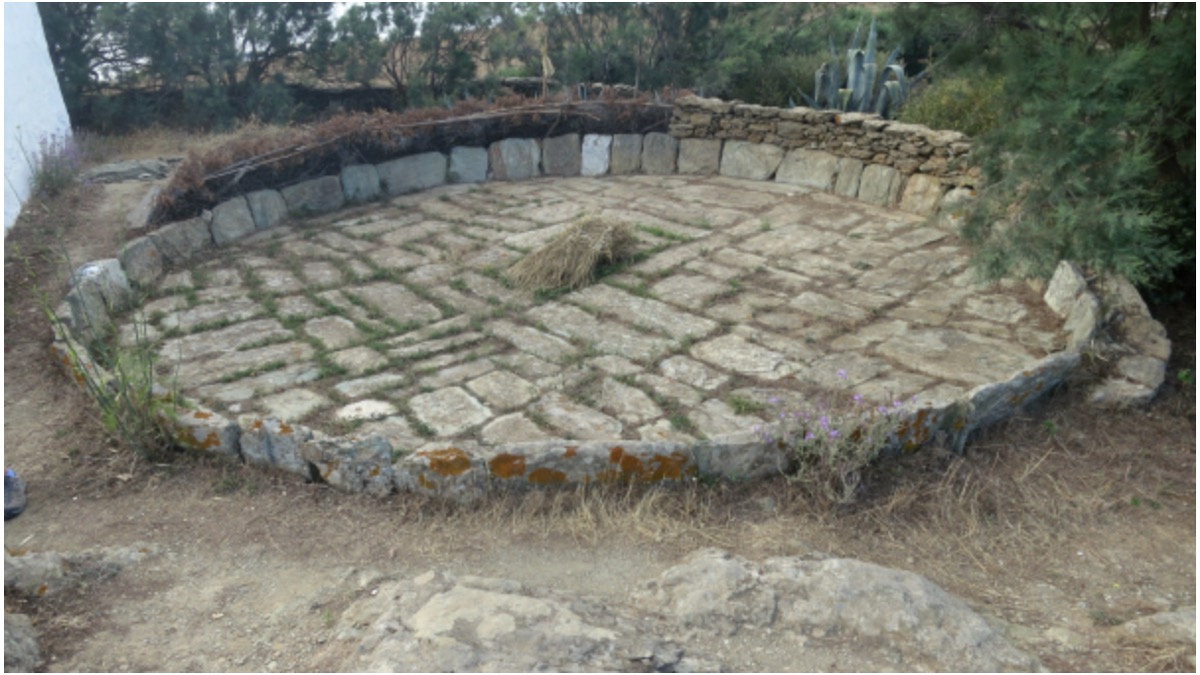
Typical Threshing Floor

The “floor” means “threshing floor” where the division of the wheat and the chaff takes place. The “fan” is a tool that is held in the harvester’s hand, which involves the throwing up/winnowing of the mixture of the collected harvested material into the air such that the wind carries away the chaff to the side (that is usually burned), while the desired wheat or barley(corn) drops to the floor for collecting into heaps and then storage vessels, usually placed in a barn. Threshing floors are generally located on hilltops where the wind blows most consistently.

Threshing floors have great spiritual significance in the Bible.

  1. It is where Ruth made her petition for redemption to Boaz in Ruth Chapter 3, “And now [is] not Boaz of our kindred, with whose maidens thou wast? Behold, he winnoweth barley to night in the threshingfloor.
  2. The Holy Temple in Jerusalem was built by King Solomon on the site of the threshing floor of Ornan the Jebusite, which King David purchased and had been told to erect an altar to God in 1 Chronicles 21:18, “Then the angel of the LORD commanded Gad to say to David, that David should go up, and set up an altar unto the LORD in the threshingfloor of Ornan the Jebusite.  And later in 2 Chronicles 3:1, we read, “Then Solomon began to build the house of the LORD at Jerusalem in mount Moriah, where [the LORD] appeared unto David his father, in the place that David had prepared in the threshingfloor of Ornan the Jebusite.

A much more detailed exposition on the meaning of the “Threshing Floor” can be found in the exposition of the Book of Ruth (and, the Lord Willing, in a future standalone post).

The Third Division: The Good and Bad Fish in the Net

Jesus spoke another parable that provided a third perspective on the great division of mankind. In Matthew 13:47-50, we read where Jesus said, “¶Again, the kingdom of heaven is like unto a net, that was cast into the sea, and gathered of every kind: Which, when it was full, they drew to shore, and sat down, and gathered the good into vessels, but cast the bad away. So shall it be at the end of the world: the angels shall come forth, and sever the wicked from among the just, And shall cast them into the furnace of fire: there shall be wailing and gnashing of teeth.

Note that this parable of Jesus was immediately followed by these two verses: Matthew 13:51&52, “¶Jesus saith unto them, Have ye understood all these things? They say unto him, Yea, Lord. ¶Then said he unto them, Therefore every scribe [which is] instructed unto the kingdom of heaven is like unto a man [that is] an householder, which bringeth forth out of his treasure [things] new and old.” The scribe and householder is the believer whose treasure includes the hidden things of God as found in both the Old and New Testaments concerning Jesus.

It might be useful to consider here how the “fish” are used by God to represent “people”. This was made clear when Jesus called Peter and his brother Andrew to follow Him and that He would make them “fishers of men” in Matthew 4:19, “And he saith unto them, Follow me, and I will make you fishers of men.” and Mark 1:17, “And Jesus said unto them, Come ye after me, and I will make you to become fishers of men.” Then there is Luke 5:1-10, where in the last verse we read, 324“And so [was] also James, and John, the sons of Zebedee, which were partners with Simon. And Jesus said unto Simon, Fear not; from henceforth thou shalt catch men.“ Therefore the fishes spiritually (via allegory), represent mankind, because Jesus clearly said that this is the case.

Then we are also present with the case where God records the historical account of Jesus appearing to the disciples (post-Resurrection) on the shore of the Sea of Galilee (“Sea of Tiberias“) as Peter along with named other disciples were fishing as we read in John 21:1-11, “¶After these things Jesus shewed himself again to the disciples at the sea of Tiberias; and on this wise shewed he [himself]. There were together Simon Peter, and Thomas called Didymus,  and Nathanael of Cana in Galilee, and the [sons] of Zebedee, and two other of his disciples. Simon Peter saith unto them, I go a fishing. They say unto him, We also go with thee. They went forth, and entered into a ship immediately; and that night they caught nothing. But when the morning was now come, Jesus stood on the shore: but the disciples knew not that it was Jesus. Then Jesus saith unto them, Children, have ye any meat? They answered him, No. ¶And he said unto them, Cast the net on the right side of the ship, and ye shall find. They cast therefore, and now they were not able to draw it for the multitude of fishes. ¶Therefore that disciple whom Jesus loved saith unto Peter, It is the Lord. Now when Simon Peter heard that it was the Lord, he girt [his] fisher’s coat [unto him], (for he was naked,) and did cast himself into the sea. And the other disciples came in a little ship; (for they were not far from land, but as it were two hundred cubits,) dragging the net with fishes. As soon then as they were come to land, they saw a fire of coals there, and fish laid thereon, and bread. Jesus saith unto them, Bring of the fish which ye have now caught. ¶Simon Peter went up, and drew the net to land full of great fishes, an hundred and fifty and three: and for all there were so many, yet was not the net broken.“ The disciples under the direction of Jesus caught a great multitude of fish (153 fish to be exact). We can infer therefore that these fish represent a lot of men.

NOTE: There is a reason that the number of caught fish in the net is specified as being exactly 153. 153 is a unique number which highlights the prime number “17”, which can be factored from it in two different ways. If we add 1 +2 +3 +4 +5…..up to and including +17, we find that the sum equals 153!  The Number 153 also breaks down like this:  3 x 3 x “17“. In a previous post on the meaning of Numbers in the Bible, it was shown how the number “3” represents “the Purpose or Will of God” and the number “17” (a prime number that cannot be divided any further) represents “Heaven” in the Bible. The number 17 is therefore uniquely highlighted in two different ways that no other number besides 153 will be capable of doing. We can see that the spiritual implication that God has incorporated into this historical account, and the insertion of this unique number, is that it was the Purpose and Will of God that the disciples, led by Peter, should become “fishers of men“, and they would be used of God to bring a great number of souls into Heaven in accord with Jesus’ declaration that is recorded in Matthew 4:19 and Mark 1:17.

Conclusion

The Great Division of all Mankind who have ever lived, and ever will live, will take place at the end of this world on Judgment Day. Judgment Day is when the harvest of souls occurs. Jesus specifically said in Matthew 13:49&50, “So shall it be at the end of the world: the angels shall come forth, and sever the wicked from among the just, And shall cast them into the furnace of fire: there shall be wailing and gnashing of teeth.

One part of mankind (represented by the sheep, the wheat, and the good fish) will enter into Heaven (God’s Green Pasture, the Great Harvest Home, and the vessels for good) and as a result of those people having King Jesus Christ’s Righteousness imputed to them while the other part of mankind (represented by the goats, the tares/weeds or chaff, and the bad fish) will stand naked before God in their unredeemed sinful state and be cast into the fires of Hell for Eternity.

Are you ready? If you are not ready, it may still be possible for you to cry out to God for mercy through the Person and Atoning Sacrificial Work of the Lord Jesus Christ, such that He might show mercy to you before that Great and Terrible Day of the Lord, Judgment Day. The LORD Jesus Christ is mankind’s ONLY Hope, and The ONLY Means of salvation from God’s just penalty for our sins. There is only one alternative, and that is to spend an eternity in Hell.

Psalm 96:13, “…Before the LORD: for he cometh, for he cometh to judge the earth: he shall judge the world with righteousness, and the people with his truth.

Joel 2:11, “And the LORD shall utter his voice before his army: for his camp [is] very great: for [he is] strong that executeth his word: for the day of the LORD [is] great and very terrible; and who can abide it?

 Jesus said in Matthew 5:6, “Blessed [are] they which do hunger and thirst after righteousness: for they shall be filled.” and we are told in 2 Peter 3:13, “Nevertheless we, according to his promise, look for new heavens and a new earth, wherein dwelleth righteousness.” The believers who seek after righteousness are seeking Jesus for their Salvation and will have Jesus’ righteousness imputed to them forever in the new heavens and a new earth.

Hosea 14:9, “Who [is] wise, and he shall understand these [things]? prudent, and he shall know them? for the ways of the LORD [are] right, and the just shall walk in them: but the transgressors shall fall therein.

POSTSCRIPT

Other verses to ponder concerning the issue of “Division“:

1) In Luke 12:51-53, Jesus was unequivocal in saying, “Suppose ye that I am come to give peace on earth? I tell you, Nay; but rather division: For from henceforth there shall be five in one house divided, three against two, and two against three. The father shall be divided against the son, and the son against the father; the mother against the daughter, and the daughter against the mother; the mother in law against her daughter in law, and the daughter in law against her mother in law.” (see also Matthew 10:34–39 )

2) Hebrews 4:12, “For the word of God [is] quick, and powerful, and sharper than any twoedged sword, piercing even to the dividing asunder of soul and spirit, and of the joints and marrow, and [is] a discerner of the thoughts and intents of the heart.

3) The Book of Remembrance: Malachi 3:16-18, “Then they that feared the LORD spake often one to another: and the LORD hearkened, and heard [it], and a book of remembrance was written before him for them that feared the LORD, and that thought upon his name. And they shall be mine, saith the LORD of hosts, in that day when I make up my jewels; and I will spare them, as a man spareth his own son that serveth him. Then shall ye return, and discern between the righteous and the wicked, between him that serveth God and him that serveth him not.

4) Dear reader, please think about this also. During the Crucifixion of the Lord, Jesus Christ, there was a thief on the right hand of Jesus, and a thief on the left hand. Matthew 27:38, “Then were there two thieves crucified with him, one on the right hand, and another on the left.” Likewise we read in Mark 15:27, “And with him they crucify two thieves; the one on his right hand, and the other on his left.” and in Luke 23:33, “And when they were come to the place, which is called Calvary, there they crucified him, and the malefactors, one on the right hand, and the other on the left.

But we also read later in Luke 23:39, “¶And one of the malefactors which were hanged railed on him, saying, If thou be Christ, save thyself and us. ¶But the other answering rebuked him, saying,  Dost not thou fear God, seeing thou art in the same condemnation? And we indeed justly; for we receive the due reward of our deeds: but this man hath done nothing amiss. And he said unto Jesus, Lord, remember me when thou comest into thy kingdom.¶ And Jesus said unto him, Verily I say unto thee, To day shalt thou be with me in paradise.

One was saved and one was not. Another clear division and separation!

Jesus’ Parables of the Two Great Feasts

October 11, 2024

Introduction

Two of Jesus’ parables have very similar themes. While each parable has unique aspects, they both deal with an powerful host inviting people to come in and attend a prepared feast, but for one reason or another the invited guests were generally not interested, made excuses, mocked the host, or in fact became hostile and violent to those who were sent to bid them to come. So let us first see what they say, and then next consider the spiritual implications that they hold for all of mankind.

Parable of the King’s Son’s Marriage Dinner (full text)

Matthew 22:1–14, “¶ And Jesus answered and spake unto them again by parables, and said, The kingdom of heaven is like unto a certain king, which made a marriage for his son, And sent forth his servants to call them that were bidden to the wedding: and they would not come. Again, he sent forth other servants, saying, Tell them which are bidden, Behold, I have prepared my dinner: my oxen and [my] fatlings [are] killed, and all things are ready: come unto the marriage. But they made light of it, and went their ways, one to his farm, another to his merchandise. And the remnant took his servants, and entreated [them] spitefully, and slew [them]. But when the king heard [thereof], he was wroth: and he sent forth his armies, and destroyed those murderers, and burned up their city. Then saith he to his servants, The wedding is ready, but they which were bidden were not worthy. Go ye therefore into the highways, and as many as ye shall find, bid to the marriage. So those servants went out into the highways, and gathered together all as many as they found, both bad and good: and the wedding was furnished with guests. ¶And when the king came in to see the guests, he saw there a man which had not on a wedding garment: And he saith unto him, Friend, how camest thou in hither not having a wedding garment? And he was speechless. Then said the king to the servants, Bind him hand and foot, and take him away, and cast [him] into outer darkness; there shall be weeping and gnashing of teeth.¶ For many are called, but few [are] chosen.

Parable of the Great Supper (full text)

Luke 14:15–24 , “¶Then said he unto him, A certain man made a great supper, and bade many: And sent his servant at supper time to say to them that were bidden, Come; for all things are now ready. And they all with one [consent] began to make excuse. The first said unto him, I have bought a piece of ground, and I must needs go and see it: I pray thee have me excused. And another said, I have bought five yoke of oxen, and I go to prove them: I pray thee have me excused. And another said, I have married a wife, and therefore I cannot come. So that servant came, and shewed his lord these things. Then the master of the house being angry said to his servant, Go out quickly into the streets and lanes of the city, and bring in hither the poor, and the maimed, and the halt, and the blind. And the servant said, Lord, it is done as thou hast commanded, and yet there is room. And the lord said unto the servant, Go out into the highways and hedges, and compel [them] to come in, that my house may be filled. For I say unto you, That none of those men which were bidden shall taste of my supper.

An Exposition of the Two Parables

In both parables, Jesus is instructing us that God the Father has ordained that His Beloved Son, the LORD Jesus Christ, as the Bridegroom, would have a Wedding and Marriage Feast, wherein the Church, the Body of Christ, the true Believers, from throughout all the world throughout all time would be the Bride, exactly as we are told in Revelation:

Revelation 19:7-9, “Let us be glad and rejoice, and give honour to him: for the marriage of the Lamb is come, and his wife hath made herself ready. And to her was granted that she should be arrayed in fine linen, clean and white: for the fine linen is the righteousness of saints. ¶And he saith unto me, Write, Blessed [are] they which are called unto the marriage supper of the Lamb. And he saith unto me, These are the true sayings of God.

Revelation 21:2, “And I John saw the holy city, new Jerusalem, coming down from God out of heaven, prepared as a bride adorned for her husband.

Revelation 21:9&10, “¶And there came unto me one of the seven angels which had the seven vials full of the seven last plagues, and talked with me, saying, Come hither, I will shew thee the bride, the Lamb’s wife. And he carried me away in the spirit to a great and high mountain, and shewed me that great city, the holy Jerusalem, descending out of heaven from God,

In both parables, invitations were sent out to an initial list of invitees, and that initial list of those bidden allegorically represented National Israel (the Nation within which Jesus was specifically speaking at the time). National Israel did not accept Jesus as the Messiah. They either scoffed at the idea that a “carpenter’s son”, a man from Nazareth and Galilee could possibly be the promised Messiah or they made excuses for not believing in Him. Then the witnesses of Jesus’ miracles were cast out of the synagogues, and the majority of National Israel, up to and including the High Priest, not only aided and abetted the execution of Jesus, but they joined in scourging and even stoning to death those messengers who later brought the Gospel of Salvation (who in fact were simply bidding them to come to Jesus as LORD God and King and to partake of that consummate wedding feast that would take place at the end of the world). God declared that they would be destroyed, and never enter into Heaven, and, as a result, that the Gospel would henceforth go out to all the Gentile world, bringing in everyone (including a remnant of National Israel saved by Grace) who hunger and thirst after righteousness. God the Father would draw them all to Jesus by The Holy Spirit through the “hearing” of the Word. And this all began at Pentecost in 33 AD after Jesus’ Atoning Sacrifice, Resurrection, and Ascension where He now sits at the Right Hand of God the Father.

The First Parable: “Ye Must be Born Again(John 3:7)

Beating and Killing the Servants/Messengers

The first part of the parable, where the “And the remnant took his servants, and entreated [them] spitefully, and slew [them]” can be related to the warnings to the chief priests and Pharisees of National Israel, and likened to Jesus’ Parable of the Vineyard Owner that we read about in Matthew 21:33-46, as well as Jesus’ more direct denunciation of the scribes and Pharisees as hypocrites in Matthew 23:29-39 for beating, imprisoning, and killing the prophets whom God had sent to them. [For more on this refusal to come to the wedding feast of the king, please see the Typology of Queen Vashti in the detailed exposition of the Book of Esther]

The Wedding Feast/Marriage Feast

Without any doubt this parable of Jesus in referring to the “marriage/wedding feast/dinner” points us directly back to Revelation 19:7-9, “Let us be glad and rejoice, and give honour to him: for the marriage of the Lamb is come, and his wife hath made herself ready. And to her was granted that she should be arrayed in fine linen, clean and white: for the fine linen is the righteousness of saints. ¶And he saith unto me, Write, Blessed [are] they which are called unto the marriage supper of the Lamb. And he saith unto me, These are the true sayings of God.

The Man Without a Wedding Garment

Interestingly, the first parable, Matthew 22:1–14, ended with a man who arrived at the wedding feast without a wedding garment. Not only was the man denied entry, but we read of his condemnation by the wrathful king, “Then said the the king to the servants, Bind him hand and foot, and take him away, and cast [him] into outer darkness; there shall be weeping and gnashing of teeth.

What happened there? What was the big deal? When we compare scripture with scripture it becomes clear what this part of the parable is about.

Wedding Garment“?

From Revelation 19:7-9 above God makes clear that the “wedding garment” represents the robe of Christ’s righteousness imputed to the believer that covers all his or her sins. “…arrayed in fine linen, clean and white: for the fine linen is the righteousness of saints.

And in order to have the robes of Christ’s Righteousness one has to be “born again”. In John 3:3, “Jesus answered and said unto him, Verily, verily, I say unto thee, Except a man be born again, he cannot see the kingdom of God.”

And that helps to explain why when the servants were told to “…Go ye therefore into the highways, and as many as ye shall find, bid to the marriage. So those servants went out into the highways, and gathered together all as many as they found, both bad and good: and the wedding was furnished with guests.” Those who are born again of the Holy Spirit are spiritually arrayed with that wedding garment are therefore made “good”, and those without a wedding garment remain “bad”.

And this also explains the meaning of “¶ For many are called, but few [are] chosen. Those who have the Wedding Garments are not just called, but they are also Chosen.  They must be the Elect of God.  God chooses, we do not.

Friend“?

Next, please note that the king addressed the man as “Friend“, from the original Greek word, ἑταῖρος (hetairos)G2083, which means “acquaintance” or “comrade” and most certainly implies close “familiarity”. But we should be careful to note that this word for “friend” is used sparingly in the Bible, only four times and only in the Book of Matthew (and each of the three times that it is found in the singular, it is also capitalized in the King James translation). And, with further scrutiny, we can see that this word translated in English as “Friend” does not have the same positive connotation that one might initially think, in fact just the opposite, it is quite negative.

The connotation is negative, because, most notably, this particular word that is translated as “Friend” just so happens to also be the exact same word that Jesus used in addressing Judas (upon being betrayed by Judas with a kiss) as we read in Matthew 26:48-50, ¶Now he (Judas) that betrayed him (Jesus) gave them a sign, saying, Whomsoever I shall kiss, that same is he: hold him fast. And forthwith he (Judas) came to Jesus, and said, Hail, master; and kissed him. ¶And Jesus said unto him, Friend (ἑταῖρος (hetairos))G2083, wherefore art thou come? Then came they, and laid hands on Jesus, and took him.” And also note how well that compares with Psalm 41:9, “Yea, mine own familiar friend (אִישׁ (‘îš))H376, in whom I trusted, which did eat of my bread, hath lifted up his heel against me.[[Note that this word in the original Hebrew, which is translated here as “friend” (אִישׁ (‘îš))H376, is almost always (more than one thousand times) translated in the Bible simply as “man“. So, although it was a bit misleading for the King James translators to have translated this Hebrew word into English as “friend”, it nonetheless certainly served God’s purpose to help the reader to relate to it as a prefigurement of Judas Iscariot’s betrayal of Jesus.]]

In English we have only one word for “friend”, but in the Greek there is clearly a distinction between the meanings of the two words found in the New Testament that have been both been translated into English as “friend”. The other word in the original Greek is φίλος (philos)G5384 that was translated into English as “friend” is found in the following verses (and these are just a small sample)”:

John 15:13-16, “Greater love hath no man than this, that a man lay down his life for his friends. G5384 Ye are my friends, G5384 if ye do whatsoever I command you. Henceforth I call you not servants; for the servant knoweth not what his lord doeth: but I have called you friends; G5384 for all things that I have heard of my Father I have made known unto you. Ye have not chosen me, but I have chosen you, and ordained you, that ye should go and bring forth fruit, and [that] your fruit should remain: that whatsoever ye shall ask of the Father in my name, he may give it you.

Remember in Matthew 7:21-23, where Jesus spoke regarding Judgment Day, “¶Not every one that saith unto me, Lord, Lord, shall enter into the kingdom of heaven; but he that doeth the will of my Father which is in heaven. Many will say to me in that day, Lord, Lord, have we not prophesied in thy name? and in thy name have cast out devils? and in thy name done many wonderful works? And then will I profess unto them, I never knew you: depart from me, ye that work iniquity.

Luke 6:46, “¶And why call ye me, Lord, Lord, and do not the things which I say?

Luke 13:23-28, “Then said one unto him, Lord, are there few that be saved? And he said unto them, Strive to enter in at the strait gate: for many, I say unto you, will seek to enter in, and shall not be able. When once the master of the house is risen up, and hath shut to the door, and ye begin to stand without, and to knock at the door, saying, Lord, Lord, open unto us; and he shall answer and say unto you, I know you not whence ye are: Then shall ye begin to say, We have eaten and drunk in thy presence, and thou hast taught in our streets. But he shall say, I tell you, I know you not whence ye are; depart from me, all ye workers of iniquity. There shall be weeping and gnashing of teeth, when ye shall see Abraham, and Isaac, and Jacob, and all the prophets, in the kingdom of God, and you [yourselves] thrust out.

Speaking of these “friends“, as described above in John 15:13…when we look back in the Old Testament at the original Hebrew word that is translated into English as “friends” by the King James translators in Zechariah 13:6, we can find something very interesting.  “And [one] shall say unto him, What are these wounds in thine hands? Then he shall answer, [Those] with which I was wounded (smitten) [in] the house of my friends.” In the original Hebrew, the word that is shown here as “friends” is the word, אָהַב (‘āhaḇ)H157, which means “beloved“. In the King James Bible, אָהַב (‘āhaḇ)H157 is translated in following manner: love (169x), lover(s) (19x), friend(s) (12x), beloved (5x), liketh (1x), lovely (1x), loving (1x). It is a very deep and intimate love. Therefore, this Messianic verse is telling us that Jesus is saying that He was wounded in the house of His “beloved“. Note how this is so very consistent with what we are told in Isaiah 53:5, “But he [was] wounded (desecrated) for our transgressions, [he was] bruised (broken) for our iniquities: the chastisement of our peace [was] upon him; and with his stripes we are healed.

That “man” is an allegorical representative of all those who take upon themselves the name of Jesus Christ, who go to a “Christian” church and are generally associated with the believers, and who are confident that their sins are covered and that they are therefore qualified to be welcomed into Heaven. However, in fact, they have never been Born Again by the Spirit“, and thus they have never been adorned with the robes of Christ’s Righteousness. They remain naked in their sins, and therefore still subject to God’s wrath, to be cast into Hell forever. The parable rightly ends with the statement, “¶For many are called, but few [are] chosen.

Many hear the call of the words of the Gospel of Salvation by Jesus Christ, and many go through the motions of what outwardly appear to be the hallmarks of being a Christian, but few are those who are really counted among the Elect of God. And only the Elect of God are internally born again by God’s Holy Spirit. Remember what Jesus said in John 3:5-8, “¶Jesus answered, Verily, verily, I say unto thee, Except a man be born of water and of the Spirit, he cannot enter into the kingdom of God. That which is born of the flesh is flesh; and that which is born of the Spirit is spirit. Marvel not that I said unto thee, Ye must be born again. The wind bloweth where it listeth, and thou hearest the sound thereof, but canst not tell whence it cometh, and whither it goeth: so is every one that is born of the Spirit.

This is also the same message that we read about in The Parable of the Ten Virgins, which makes clear that Jesus did NOT die to save “everyone” from their sins! Jesus only came to seek and save those whom God had chosen to save, those who are Born Again of the Spirit, those who God counts to be among the Elect of God, and those who are otherwise referred to as “the sheep” of the Flock of The Good Shepherd, The LORD Jesus Christ!

Another pertinent verse to ponder: Luke 12:45-48, “But and if that servant say in his heart, My lord delayeth his coming; and shall begin to beat the menservants and maidens, and to eat and drink, and to be drunken; The lord of that servant will come in a day when he looketh not for [him], and at an hour when he is not aware, and will cut him in sunder, and will appoint him his portion with the unbelievers. And that servant, which knew his lord’s will, and prepared not [himself], neither did according to his will, shall be beaten with many stripes. But he that knew not, and did commit things worthy of stripes, shall be beaten with few stripes. For unto whomsoever much is given, of him shall be much required: and to whom men have committed much, of him they will ask the more.”

We must pay particular attention to these words as they are identical to what we read was the fate of the unprofitable servant in Jesus’ Parable of the Talents as we read in Matthew 25:30, “And cast ye the unprofitable servant into outer darkness: there shall be weeping and gnashing of teeth.” Compare also with Matthew 13:49&50, “So shall it be at the end of the world: the angels shall come forth, and sever the wicked from among the just, And shall cast them into the furnace of fire: there shall be wailing and gnashing of teeth.” There is therefore no doubt that the man without the wedding garment and the unprofitable servant shared the exact same fate, and the description of that fate represents the torment that all who remain dead in trespasses and sins (the unsaved) will have to endure in Hell for all eternity. This is the reality Jesus was conveying in His parables, and which has the greatest import for all of humanity!

The Second Parable: No Excuses!

In the second parable, Luke 14:15–24 , instead of mocking the host, the original invitees to the “great supper” simply ignored the host’s sent servant (Jesus Himself) and made excuses “And they all with one [consent] began to make excuse.”  Three example excuses are provided, but then, when the host (allegorically representing God the Father) hears of it, he becomes angry. Again we see how the invitees who make excuses are used in the parable to, in the first instance, represent National Israel who were bidden first but refused to come (but more importantly, serve spiritually as a “Type” to represent all of mankind who reject The LORD Jesus Christ and His Gospel call). This is explained more clearly when we look at the role of Queen Vashti in the Historical Parable found in the Book of Esther.

However, as a result of that rejection by National Israel, that same invitation (the Gospel call to come to Jesus and His Passover and ultimately His Wedding Feast) would henceforth go out to all the Gentile world, bringing in everyone and anyone who, because of their natural sin-sick state, are made aware that they are spiritually poor, and the maimed, and the halt, and the blind. Remember in James 2:5, we read, “Hearken, my beloved brethren, Hath not God chosen the poor of this world rich in faith, and heirs of the kingdom which he hath promised to them that love him?” (The account of Ruth, a cursed Moabitess, provides us with a metaphor for someone who is spiritually a widow, a stranger, and poor; and the account of Mephibosheth provides us with a metaphor for someone who is spiritually lame (hence “maimed” and “halt“), and Hearing Ear and Seeing Eye explains what it means to be spiritually deaf and blind). Moreover all believers are commanded by Jesus in His Great Commission to go into “all the world” and preach the gospel to the Gentiles, as we read in Mark 16:15And he said unto them, Go ye into all the world, and preach the gospel to every creature.

God the Father would draw these desperate, but chosen, people to Jesus by The Holy Spirit through the “hearing” of the Word. And, also again, we see a similar fate for those who declined the supper invitation with excuses, whereupon the angry host declares, “That none of those men which were bidden shall taste of my supper.” Those who deny Jesus, and His Gospel Call, are doomed to endure the wrath of God for their sins for an eternity in Hell.

CONCLUSION

At one time or another, everyone, in some way or another, will be confronted with having to deal with the invitation to Come to Jesus for forgiveness of sins and to come to the great wedding feast in Heaven with Jesus, as prepared by God the Father. Everyone will have to respond by either “hearing” The Word of God and lovingly and joyfully responding to that invitation, or

  1. Make excuses because of each one’s love of this world, in opposition to God’s warning in 1 John 2:15, “Love not the world, neither the things [that are] in the world. If any man love the world, the love of the Father is not in him.”, and Matthew 10:37, where Jesus said, “He that loveth father or mother more than me is not worthy of me: and he that loveth son or daughter more than me is not worthy of me.” or…
  2. Dismissively mock Jesus and His Ambassadors, as we read in Matthew 27:41, “¶Likewise also the chief priests mocking [him], with the scribes and elderssaid, He saved others; himself he cannot save. If he be the King of Israel, let him now come down from the cross, and we will believe him. He trusted in God; let him deliver him now, if he will have him: for he said, I am the Son of God.” (and remember that these scribes and elders were those who “knew” what the scriptures said, but, because they were spiritually blind, they could not “know” Jesus, Who was the embodiment of those scriptures) and in Acts 2:13, at Pentecost, “¶Others mocking said, These men are full of new wine.“, or…
  3. Hate the messengers because they hate the message (they hate Jesus). Remember what Jesus said in John 15:18, “If the world hate you, ye know that it hated me before [it hated] you.” and John 15:19, “If ye were of the world, the world would love his own: but because ye are not of the world, but I have chosen you out of the world, therefore the world hateth you.” And remember that by God’s standard, that would make all of them “murderers” as we read in 1 John 3:15, “Whosoever hateth his brother is a murderer: and ye know that no murderer hath eternal life abiding in him.“)

In the end, on Judgment Day, these latter individuals will find out the Truth, but it will then be too late.

¶For many are called, but few [are] chosen.

POSTSCRIPT

National Israel Condemned?

The above exposition makes clear that Jesus was condemning National Israel for rejecting Him and the Gospel of Salvation by Grace through Him. Jesus spoke in parables to the multitudes for a reason, which is explained in a previous post on Parables. Moreover, there are many professing Christians and theologians who claim that God still has a special plan and place for National Israel in a future great awakening, in some type of New Dispensation. That is simply NOT TRUE! There is only ONE Gospel of Grace, which spans all of history, and it applies to both Jew and Gentile alike (the remnant of sinful mankind saved by Grace alone through faith), and it has always been the case and will always be the case right up until Judgment Day. How can this be assured?

The Bible is the source book of Truth. We have only to look back in the Bible, in the Old Testament Book of Esther, another Historical Parable, for confirmation. There in the beginning of that book, Chapter 1, verses 1-22, we find another instance of a banquet feast being held by a great king and his bidding of guests to attend.

Foremost of those bidden guests was Queen Vashti: A beautiful queen, the first wife of the king Ahasuerus.  When she was bidden by the king (by his “commandment”) to that great feast, she refused to come while holding her own feast for the women; so the king in his wrath decreed that she could never again come into his presence.  The king (who is an allegorical “Type” for God) also decreed, at the advice of his wise men, that her royal estate be given “to another that is better than she.” King Ahasuerus then sent letters to all his provinces to be published “to every people after their language” to find a replacement for Queen Vashti.

Esther was that replacement: A fair and beautiful maid, a virgin, (and an orphan, because “for she had neither mother or father”) who was brought up by Mordecai, her elder cousin (both being Benjamite Jews), and he “took for his own daughter“… “when her father and mother were dead“.)  Esther pleased king  Ahasuerus and “she obtained kindness of him.”  “And the king loved Esther above all the women, and she obtained grace and favour in his sight more than all the virgins; so that he set the royal crown upon her head, and made her queen instead of Vashti.

Please see Deuteronomy 31:16-18, because it lays the foundation for understanding why National Israel, as a people, fell under and have remained under God’s wrath and condemnation: “¶And the LORD said unto Moses, Behold, thou shalt sleep with thy fathers; and this people will rise up, and go a whoring after the gods of the strangers of the land, whither they go [to be] among them, and will forsake me, and break my covenant which I have made with them. Then my anger shall be kindled against them in that day, and I will forsake them, and I will hide my face from them, and they shall be devoured, and many evils and troubles shall befall them; so that they will say in that day, Are not these evils come upon us, because our God [is] not among us? And I will surely hide my face in that day for all the evils which they shall have wrought, in that they are turned unto other gods.” 

God provides additional commentary in Psalm 95:10&11 regarding the nation of Israel after their coming out of Egypt, “Forty years long was I grieved with [this] generation, and said, It [is] a people that do err in their heart, and they have not known my ways: Unto whom I sware in my wrath that they should not enter into my rest.

Going back to the parable of Matthew 22:1-14?  The “remnant”, that Jesus said was bidden to the wedding feast, but who refused to come and then slew the King’s servants (the Christians), was National Israel!  Like Vashti, National Israel acted rebelliously.  She refused to come when bidden to the Feast.  She was disobedient.  Anyone who takes the same action in response to God’s command to “Come unto me” will be cast out of the presence of God forever.  Nonetheless, there is another “remnant” of National Israel who God has chosen by Grace before the foundation of the world to be counted among God’s Elect.

[It has also been pointed out to this teacher, that Queen Vashti has attributes that can also be likened to the apostate “Christian” church (as opposed to the true eternal church of Jesus Christ), which in effect also refuses God’s command to come to His feast, because it is conducting its own feast in the house that otherwise belongs to God]

[Some may think that because National Israel was restored as a nation among nations again in 1948, with its capital established in Jerusalem in 1967, that this means that God brought this about to restore His relationship with National again. Absolutely NOT! Rather, it is because it is the fulfillment of Jesus proclamation concerning the “parable of the fig tree.” Matthew 24:32&33, “¶Now learn a parable of the fig tree; When his branch is yet tender, and putteth forth leaves, ye know that summer [is] nigh: So likewise ye, when ye shall see all these things, know that it is near, [even] at the doors.” The parable was provided in the context of determining the time of the end of the world. Note that it does not say that there would be any fruit. Let him who has ears hear. For more on this topic, please see “Will the Temple Ever Be Rebuilt?]

For additional corroboration please remember what we are told in:

  1. Romans 2:9-11, “Tribulation and anguish, upon every soul of man that doeth evil, of the Jew first, and also of the Gentile; But glory, honour, and peace, to every man that worketh good, to the Jew first, and also to the Gentile: For there is no respect of persons with God.
  2. Acts 10:34, “¶Then Peter opened [his] mouth, and said, Of a truth I perceive that God is no respecter of persons: But in every nation he that feareth him, and worketh righteousness, is accepted with him. The word which [God] sent unto the children of Israel, preaching peace by Jesus Christ: (he is Lord of all:)

Do you now see how closely this historical account from the Book of Esther so closely mimics and sheds new light upon Jesus’ parables of the two feasts? They are completely consistent!

May this and all the posts found on this website be a blessing to all who read them and may God grant those readers the ears to hear and the eyes to see.

God’s Hermeneutic Explained: 1 Corinthians, Chapter 2

October 10, 2024

Introduction: A Different Hermeneutic “Which the Holy Ghost Teacheth: Comparing Spiritual Things with Spiritual

1 Corinthians, Chapter 2, has a lot to say about “spiritual” understanding and interpretation of God’s Word as compared with that of unregenerate, natural man’s method of interpretation. This chapter outlines and explains GOD’S Hermeneutic…which is the key to Bible interpretation! That Hermeneutic, being entirely Spiritual, is that “which the Holy Ghost teachethcomparing spiritual things with spiritual” (holy scripture with holy scripture) precisely as Jesus revealed in the course of His explanation of The Parable of the Sower.

God, in speaking through the Apostle Paul in the first letter to the church in Corinth, emphasizes that there is a clear distinction between the “wisdom of men” and the “Wisdom of God.” This chapter shows us that the only possible means by which that gap can be closed is ONLY if God anoints an individual with His Holy Spirit, commensurate with Salvation by Grace, because of the intercessory Atoning Work and Sacrifice of the LORD Jesus Christ for the sinner’s sins. “Jesus Christ and Him Crucified“.

Any man who can read the Bible can easily tell you what the words in the Bible “say”, but only God, through His Holy Spirit, can reveal what the Word “means” for the purpose of the Salvation of the soul.

1 Corinthians 1:17, “For Christ sent me not to baptize, but to preach the gospel: not with wisdom of words, lest the cross of Christ should be made of none effect.”

Philippians 3:8, “Yea doubtless, and I count all things [but] loss for the excellency of the knowledge of Christ Jesus my Lord: for whom I have suffered the loss of all things, and do count them [but] dung, that I may win Christ,

2 Corinthians4:8, “[We are] troubled on every side, yet not distressed; we are perplexed, but not in despair; Persecuted, but not forsaken; cast down, but not destroyed;

Psalm 2:11, “Serve the LORD with fear, and rejoice with trembling.” and Philippians 2:12, “Wherefore, my beloved, as ye have always obeyed, not as in my presence only, but now much more in my absence, work out your own salvation with fear and trembling.

2 Peter 1:16, “¶For we have not followed cunningly devised fables, when we made known unto you the power and coming of our Lord Jesus Christ, but were eyewitnesses of his majesty.” (Please see the post “The Mount of Transfiguration“)

Romans 15:19, “Through mighty signs and wonders, by the power of the Spirit of God; so that from Jerusalem, and round about unto Illyricum, I have fully preached the gospel of Christ.

2 Corinthians 4:7, “¶But we have this treasure in earthen vessels, that the excellency of the power may be of God, and not of us.

Acts 20:27&28, “For I have not shunned to declare unto you all the counsel of God. Take heed therefore unto yourselves, and to all the flock, over the which the Holy Ghost hath made you overseers, to feed the church of God, which he hath purchased with his own blood.

Natural, fleshly, mankind is incapable of having the necessary wisdom of God to understand and discern the true meaning of God’s intent as found in His Word, as God’s Wisdom is only revealed to the saved soul as a Gift by the Power of God’s Holy Spirit. Please see this post: “Refutation of the Literal – Grammatical – Historical Hermeneutic“.

2 Corinthians 1:12, “¶For our rejoicing is this, the testimony of our conscience, that in simplicity and godly sincerity,  not with fleshly wisdom, but by the grace of God, we have had our conversation in the world, and more abundantly to you-ward.

The word “perfect” is τέλειος (teleios)G5046 , which in the original Greek does mean both “perfect” and “complete“, and is entirely consistent with Matthew 5:48, “Be ye therefore perfect (τέλειος (teleios)) G5046, even as your Father which is in heaven is perfect (τέλειος (teleios))G5046.”

Hebrews 12:22, “¶But ye are come unto mount Sion, and unto the city of the living God, the heavenly Jerusalem, and to an innumerable company of angels, To the general assembly and church of the firstborn, which are written in heaven, and to God the Judge of all, and to the spirits of just men made perfect (τέλειος (teleios))G5046,

Hebrews 5:14, “But strong meat belongeth to them that are of full age (τέλειος (teleios))G5046, [even] those who by reason of use have their senses exercised to discern both good and evil.

And the segue to this chapter are the last four verses of Chapter 1, 1 Corinthians 1:28-31, “And base things of the world, and things which are despised, hath God chosen, [yea], and things which are not, to bring to nought things that are: That no flesh should glory in his presence. But of him are ye in Christ Jesus, who of God is made unto us wisdom, and righteousness, and sanctification, and redemption: That, according as it is written, He that glorieth, let him glory in the Lord.” The last part of the last verse is repeated in 2 Corinthians 10:17, “But he that glorieth, let him glory in the Lord.

Wisdom

Regarding “wisdom” (σοφία (sophia))G4678 it is really referring to the Lord Jesus Christ, as we read in the preceding chapter in 1 Corinthians 1:30, “But of him are ye in Christ Jesus, who of God is made unto us wisdom, and righteousness, and sanctification, and redemption:”

Mystery

Ephesians 3:3-5, “How that by revelation he made known unto me the mystery (μυστήριον (mystērion))G3466; (as I wrote afore in few words, Whereby, when ye read, ye may understand my knowledge in the mystery (μυστήριον (mystērion))G3466 of Christ) Which in other ages was not made known unto the sons of men, as it is now revealed unto his holy apostles and prophets by the Spirit;

Remember when Jesus said to His disciples in Mark 4:11&12, “And he said unto them, Unto you it is given to know the mystery (μυστήριον (mystērion))G3466, of the kingdom of God: but unto them that are without, all [these] things are done in parables: That seeing they may see, and not perceive; and hearing they may hear, and not understand; lest at any time they should be converted, and [their] sins should be forgiven them.

Colossians 1:26-29, “[Even] the mystery (μυστήριον (mystērion))G3466 which hath been hid from ages and from generations, but now is made manifest to his saints: To whom God would make known what is the riches of the glory of this mystery (μυστήριον (mystērion))G3466 among the Gentiles; which is Christ in you, the hope of glory: Whom we preach, warning every man, and teaching every man in all wisdom; that we may present every man perfect (τέλειος (teleios)) G5046 in Christ Jesus: Whereunto I also labour, striving according to his working, which worketh in me mightily.”

And we must also remember that Jesus Is The Embodiment of the mystery, as we read in
Colossians 2:2&3, “That their hearts might be comforted, being knit together in love, and unto all riches of the full assurance of understanding, to the acknowledgement of the mystery (μυστήριον (mystērion))G3466 of God, and of the Father, and of Christ; In whom are hid all the treasures of wisdom and knowledge.

Moreover as we read in 1 Timothy 3:16, “And without controversy great is the mystery (μυστήριον (mystērion))G3466 of godliness: God was manifest in the flesh, justified in the Spirit, seen of angels, preached unto the Gentiles, believed on in the world, received up into glory.”

Hidden

Matthew 11:25, “At that time Jesus answered and said,I thank thee, O Father, Lord of heaven and earth, because thou hast hid (ἀποκρύπτω (apokryptō)G613 these things from the wise and prudent, and hast revealed them unto babes.

Ephesians 3:9, “And to make all [men] see what [is] the fellowship of the mystery (μυστήριον (mystērion))G3466, which from the beginning of the world hath been hid (ἀποκρύπτω (apokryptō)G613 in God, who created all things by Jesus Christ: To the intent that now unto the principalities and powers in heavenly [places] might be known by the church the manifold wisdom of God, According to the eternal purpose which he purposed in Christ Jesus our Lord:

Ordained

Not also that the original Greek word, προορίζω (proorizō)G4309, which is translated as “ordainedbefore, is the same word that is also translated as “predestinated” as we read in Romans 8:29&30, “For whom he did foreknow, he G4309 also did predestinate G4309 [to be] conformed to the image of his Son, that he might bethe firstborn among many brethren. Moreover whom he did predestinate, G4309them he also called: and whom he called, them he also justified: and whom he justified, them he also glorified.

All of this was predestined and foreordained before the world was even created!

Not everyone “understands”. To most people, the Word of God is hidden, because there are only a few who have been granted the “ears to hear and the eyes to see.” Please listen carefully to the words of Jesus’ joyful prayer to God The Father…

Matthew 11:25-27, “¶At that time Jesus answered and said, I thank thee, O Father, Lord of heaven and earth, because thou hast hid these things from the wise and prudent, and hast revealed them unto babes. Even so, Father: for so it seemed good in thy sight. All things are delivered unto me of my Father: and no man knoweth the Son, but the Father; neither knoweth any man the Father, save the Son, and he to whomsoever the Son will reveal [him.]

Similarly in Luke 10:21&22, “¶In that hour Jesus rejoiced in spirit, and said, I thank thee, O Father, Lord of heaven and earth, that thou hast hid these things from the wise and prudent, and hast revealed them unto babes: even so, Father; for so it seemed good in thy sight. All things are delivered to me of my Father: and no man knoweth who the Son is, but the Father; and who the Father is, but the Son, and [he] to whom the Son will reveal [him].

And please note carefully what Jesus said to His disciples “privately” in the very next two verses in Luke 10:23&24, ¶And he turned him unto [his] disciples, and said privately, Blessed are the eyes which see the things that ye see: For I tell you, that many prophets and kings have desired to see those things which ye see, and have not seen [them]; and to hear those things which ye hear, and have not heard [them].” The disciples (as “babes“) were able to see and hear, while to others, to the “wise and prudent” of the world, all these things remain “hid“. To them the Bible is a sealed book, and the knowledge of The Son and The Father is only revealed to the few to whom The Son chooses. As a result, there are very few who fully understand the profound significance of this hard teaching. Please see also the study on Isaiah Chapter 29: “A Book that is Sealed

And here the Apostle Paul is referring back to Isaiah 64:4, “For since the beginning of the world [men] have not heard, nor perceived by the ear, neither hath the eye seen, O God, beside thee, [what] he hath prepared for him that waiteth for him.

Hebrews 11:16, “But now they desire a better [country], that is, an heavenly: wherefore God is not ashamed to be called their God: for he hath prepared for them a city.

Jesus Spoke In Parables to the Multitudes, and Jesus Explained Why

Notice the juxtaposition of the words revealed and searcheth together. Proverbs 25:2, “[It is] the glory of God to conceal a thing: but the honour of kings [is] to search out a matter.” And God reveals those findings to the believers by His Holy Spirit. More details are in this post: Hidden Spiritual Gem #1 from the Bible: Proverbs 25:2 and the Hebrew Word “דָּבָר (dāḇār).

Also in Romans 8:26&27, “¶Likewise the Spirit also helpeth our infirmities: for we know not what we should pray for as we ought: but the Spirit itself maketh intercession for us with groanings which cannot be uttered. And he that searcheth G2045 the hearts knoweth what [is] the mind of the Spirit, because he maketh intercession for the saints according to [the will of] God.

God tells us plainly and specifically, in three passages in the Bible, why Jesus spoke in Parables (and because God ordained it, this fact is not widely known or discussed in our world because the carnal man finds it offensive):

  1. In Matthew 13:10-16 we read where the disciples questioned Jesus about His use of Parables, “And the disciples came, and said unto him, Why speakest thou unto them in parables? He (Jesus) answered and said unto them, Because it is given unto you to know the mysteries of the kingdom of heaven, but to them it is not given. For whosoever hath, to him shall be given, and he shall have more abundance: but whosoever hath not, from him shall be taken away even that he hath. Therefore speak I to them in parables: because they seeing see not; and hearing they hear not, neither do they understand. And in them is fulfilled the prophecy of Esaias (Isaiah 6:8-10), which saith, By hearing ye shall hear, and shall not understand; and seeing ye shall see, and shall not perceive: For this people’s heart is waxed gross, and their ears are dull of hearing, and their eyes they have closed; lest at any time they should see with their eyes, and hear with their ears, and should understand with their heart, and should be converted, and I should heal them. But blessed are your eyes, for they see: and your ears, for they hear. For verily I say unto you, That many prophets and righteous men have desired to see those things which ye see, and have not seen them; and to hear those things which ye hear, and have not heard them. But blessed [are] your eyes, for they see: and your ears, for they hear.” (Please see the Hearing Ear and the Seeing Eye)
  2. In Mark 4:10-12, “¶And when he was alone, they that were about him with the twelve asked of him the parable. And he (Jesus Christ speaking to His disciples) said unto them, Unto you it is given to know the mystery of the kingdom of God: but unto them that are without, all [these] things are done in parables:  That seeing they may see, and not perceive; and hearing they may hear, and not understand; lest at any time they should be converted, and [their] sins should be forgiven them.
  3. In Luke 8:9&10, we read , “And his disciples asked him, saying, What might this parable be? And he said, Unto you it is given to know the mysteries of the kingdom of God: but to others in parables; that seeing they might not see, and hearing they might not understand.

One has to wonder, “How this can be?“, given that God states so very clearly and plainly how He uses parables to veil the mystery of the kingdom of God from unbelieversThis makes absolutely no sense from the perspective of normal human reasoning, and it is contrary to everything the world tells you about Christianity. This is because the reality is that salvation depends entirely on the supernatural intercession of God as He sees fit (Yes, whether one likes it or not, salvation is of the LORD!). Moreover, Jesus openly explains two of His parables (The Parable of the Sower as found in Matthew 13:3-9Mark 4:3-9Luke 8:5-8) which anyone in the world can readily (physically) read in Matthew 13:10-16Mark 4:14-20Luke 8:11-15 (together with the companion “Parable of the Wheat and the Tares” as found in Matthew 13:24-30, which Jesus explained in Matthew 13:36-43.)

So then, even when a parable is explained perfectly to someone who is not one of God’s elect/chosen, that parable will still mean absolutely NOTHING to an unbeliever beyond merely the intellectual! That person may understand what the words say, but not what the words mean. That is why at the end of the Sower parable, Jesus said respectively in Matthew 13:9Mark 4:9Luke 8:8 “Who hath ears to hear, let him hear.” and “He that hath ears to hear, let him hear.” and “He that hath ears to hear, let him hear.

This appears on the surface, intellectually, to not make any sense, and thereby raises the question, how is this possible? The answer to this conundrum is that even if a parable is clearly explained to a person who remains an unbeliever (one whom God does not intend to “hear” or “see” or “perceive” or “understand” the meaning), then the salvation imbuing essence (The Holy Spirit) will not be manifest…and the Word of God will still remain completely veiled or hidden to that person and that person will remain in an unsaved state. That is what makes true Christianity so scary, and so offensive, to the carnal man or woman.

For more detail on the meaning of Parables, and Why Jesus always employed them in His teachings to the multitudes, please see these three very important posts: Jesus’ Parables, the Road to Emmaus, Proverbs 25:2 and The Doctrine of Salvation by Election:

Proverbs 20:27, “The spirit of man [is] the candle of the LORD, searching all the inward parts of the belly.

Note how this harmonizes with what we find in Hebrews 4:12, “For the word of God [is] quick (meaning that it is “alive“)and powerful, and sharper than any twoedged sword, piercing even to the dividing asunder of soul and spirit, and of the joints and marrow, and [is] a discerner of the thoughts and intents of the heart.“ and Ephesians 6:17, “And take the helmet of salvation, and the sword of the Spirit, which is the word of God:

And is not the Bible a “Spiritual Book? It was written entirely under the guidance and inspiration of God The Holy Spirit. Jesus made the connection between His Words and The Holy Spirit explicit in John 6:63, saying, “It is the spirit that quickeneth; the flesh profiteth nothing: the words that I speak unto you, [they] are spirit, and [they] are life.

Additional verses describing God’s Word as being synonymous with The Holy Spirit are found in 2 Samuel 23:2, “The Spirit of the LORD spake by me, and his word [was] in my tongue.” and 1 Corinthians 12:8, “For to one is given by the Spirit the word of wisdom; to another the word of knowledge by the same Spirit;

And let us not forget what as been discussed in before regarding the Hidden Spiritual Gems in the Bible…In Proverbs 25:2 (KJV) we find this extraordinary verse, “[It is] the glory of God to conceal a thing: but the honour of kings [is] to search out a matter.” If we look carefully at the text as it reads in the original Hebrew using an Interlinear Bible or Online concordance cross-reference like this: https://www.blueletterbible.org/kjv/pro/25/2/t_conc_653002, we find that it can also read like this…”[It is] the glory of God to conceal a word” (because it is from the Hebrew דָּבָר (dāḇār)H1697, a masculine noun): but the honour of kings[is] to search out a “word” (because the word that was translated into English as “matter” is also the same word found in the original Hebrew to be דָּבָר (dāḇār) H1697, which is translated more than eight hundred times in the Old Testament as “word.”)*.  It appears, therefore, that God is telling us that He is glorified by the concealing of The Word (Jesus Christ) in the Bible, and the believers are “honored” by being made able to search out The Word (Who is Jesus Christ) when reading the Bible.

Jeremiah 17:9&10, “The heart is deceitful above all [things], and desperately wicked: who can know it? I the LORD search the heart, [I] try the reins, even to give every man according to his ways, [and] according to the fruit of his doings.”

Romans 11:33, “¶O the depth of the riches both of the wisdom and knowledge of God! how unsearchable [are] his judgments, and his ways past finding out! For who hath known the mind of the Lord? or who hath been his counsellor?

Romans 8:15, “For ye have not received the spirit of bondage again to fear; but ye have received the Spirit of adoption, whereby we cry, Abba, Father.

Note that the original Greek word translated as “freely given“is  (χαρίζομαι (charizomai))G5483, which actually means “graciously granted and forgiven”. The original Greek word that is translated as “of” is (ὑπό (hypo))G5259, which actually means “beneath” as in “covered by”.

The only way that anyone can “know” God and understand the things that are given by grace is to be a true child of God, a new (born again) creature in Christ. Only those who are “covered by” God can truly know Him. This verse comes to mind, Psalm 91:4, “He (God) shall cover thee with his feathers, and under his wings shalt thou trust: his truth [shall be thy] shield and buckler.

The Holy Spirit, He Teaches the Believer

This verse encapsulates GOD’S Hermeneutic…and the key to Bible interpretation!

John 4:24, “God [is] a Spirit: and they that worship him must worship [him] in spirit and in truth.”

John 6:63, “It is the spirit that quickeneth; the flesh profiteth nothing: the words that I speak unto you, [they] are spirit, and [they] are life.”

Jesus made clear the following: John 14:26, “But the Comforter, [which is] the Holy Ghost, whom the Father will send in my name, he shall teach you all things, and bring all things to your remembrance, whatsoever I have said unto you.

John 15:26, “But when the Comforter is come, whom I will send unto you from the Father, [even] the Spirit of truth, which proceedeth from the Father, he shall testify of me:

John 16:7, “Nevertheless I tell you the truth; It is expedient for you that I go away: for if I go not away, the Comforter will not come unto you; but if I depart, I will send him unto you.

Key to this passage is “comparing spiritual things with spiritual things”…and given that the Bible is Holy, and entirely inspired by the Holy Ghost, the Spirit of God, then that statement is telling us that that we should be comparing Biblical scripture with Biblical scripture to gain God’s Wisdom (which is actually coming to know the Lord Jesus Christ Who is Wisdom1 Corinthians 1:30).

This is repeated and corroborated in 1 John 2:27, “But the anointing (χρῖσμα (chrisma))G5545 which ye have received of him abideth in you, and ye need not that any man teach you: but as the same anointing (χρῖσμα (chrisma))G5545 teacheth you of all things, and is truth, and is no lie, and even as it hath taught you, ye shall abide in him.“ The anointing is of the Holy Spirit Who God the Father sent to the believers to lead them into all truth, and that Truth Is Jesus. John 16:13, “Howbeit when he, the Spirit of truth, is come, he will guide you into all truth: for he shall not speak of himself; but whatsoever he shall hear, [that]shall he speak: and he will shew you things to come.” Note the consistency with John 14:26, “But the Comforter, [which is] the Holy Ghost, whom the Father will send in my name, he shall teach you all things, and bring all things to your remembrance, whatsoever I have said unto you.” and 1 John 2:20, “¶But ye have an unction (χρῖσμα (chrisma))G5545 from the Holy One, and ye know all things.” (Therefore “unction” also means “anointing”)

The Bible is its own interpreter, its own dictionary, its own Wikipedia! It is easy to think that a certain word or phrase has an obvious and clear meaning, but the issue is what does the Bible really mean by these words? The only correct answer to that question is to compare verses with other verses and see how the Bible defines its own terms. The Bible alone should limit our thinking about the words and phrases in the Bible. We must learn to abide by the Bible’s definitions and logic.

Anyone who claims to have knowledge from the Bible had better not be quoting men, but rather they had better be quoting Biblical scripture, alone…but even then, you, dear reader, had better be checking out what those preachers and teachers are quoting for yourself, from the Bible alone, as the Bereans did in the first century in Acts 17:10&11, and earnestly “searching the scriptures (the Bible) daily, whether those things were so.”

In 2 Peter 1:20&21, we are told, “Knowing this first, that no prophecy of the scripture is of any private interpretation.  For the prophecy came not in old time by the will of man: but holy men of God spake [as they were] moved (φέρω (pherō)) by the Holy Ghost.and in 2 Peter 2:1&2, “But there were false prophets also among the people, even as there shall be false teachers among you, who privily shall bring in damnable heresies, even denying the Lord that bought them, and bring upon themselves swift destruction.  And many shall follow their pernicious ways; by reason of whom the way of truth shall be evil spoken of.” 

Note: The original Greek word translated as “moved” is (φέρω (pherō)), which also means “borne” or “carried along”.

These latter verses are saying that if anyone gives forth an interpretation out of their own intellect or from the carnal minds of others that have taught them, they are false teachers and the truth is not in them.  (Even more ominous, they will receive the greater condemnation from God for that sin.)  But how are we to know which interpretation is out of a man’s mind as opposed to what God is really saying?  God provides us the answer, out of His Word, the Bible, as follows:

The Bible Is a Spiritual Book!

And we know from 2 Samuel 23:1&2, “¶Now these [be] the last words of David. David the son of Jesse said, and the man [who was] raised up on high, the anointed of the God of Jacob, and the sweet psalmist of Israel, said, The spirit of the LORD spake by me, and his word [was] in my tongue.”  Clearly the word of God, the Bible, is spiritual, as it was written under the direction of the Holy Spirit.  So if we want to learn the true meaning of any verse, then we need to compare scripture with scripture (spiritual things with spiritual).  Furthermore, any revelation of truth from God’s word (which can only come through the use of this methodology) is solely the work of the Holy Spirit.  That is why in 1 John 2:27 we read, “But the anointing (χρῖσμα (chrisma))G5545 (of the Holy Spirit) which ye have received of him abideth in you, and ye need not that any man teach you: but as the same anointing (χρῖσμα (chrisma))G5545 teacheth you of all things, and is truth, and is no lie, and even as it hath taught you, ye shall abide in him.”  This is entirely consistent with what we read in John 16:13, “Howbeit when he, the Spirit of truth, is come, he will guide you into all truth: for he shall not speak of himself; but whatsoever he shall hear, [that] shall he speak: and he will shew you things to come.

And we should also bear in mind: 1 John 5:7, “For there are three that bear record in heaven, the Father, the Word, and the Holy Ghost: and these three are one.

Man’s Wisdom is Foolishness

1 Corinthians 3:18-21, “¶Let no man deceive himself. If any man among you seemeth to be wise in this world, let him become a fool, that he may be wise. For the wisdom of this world is foolishness with God. For it is written, He taketh the wise in their own craftiness. And again, The Lord knoweth the thoughts of the wise, that they are vain. Therefore let no man glory in men. For all things are yours;

This is extremely important! The natural man is NOT anointed with God’s Holy Spirit and without Him, it is impossible for the natural man to begin to grasp any saving understanding of what God is teaching the believers who have been given, by God, the Anointing of The Holy Spirit. This gets us back again to the Hearing Ear and the Seeing Eye and also again to “Why Did Jesus Speak in Parables?

Note that the original Greek word for “know” is γινώσκω (ginōskō)G1097, which can also mean “perceive” or “understand“, and the original Greek word for “discerned” is (ἀνακρίνω (anakrinō))G350, which can also mean “examined” “scrutinized” or “judged”.

Mark 4:11&12, “And he (Jesus) said unto them, Unto you it is given to know the mystery of the kingdom of God: but unto them that are without, all [these] things are done in parables: That seeing they may see, and not perceive; and hearing they may hear, and not understand; lest at any time they should be converted, and [their] sins should be forgiven them.” Please see “The Doctrine of Election“.

Matthew 16:23, “¶But he (Jesus) turned, and said unto Peter, Get thee behind me, Satan: thou art an offence unto me: for thou savourest not the things that be of God, but those that be of men. Peter was thinking like a typical natural man, “carnally”, and not “spiritually”, as a child of God should.

1 Corinthians 1:18-25, “¶For the preaching of the cross is to them that perish foolishness; but unto us which are saved it is the power of God. For it is written, I will destroy the wisdom of the wise, and will bring to nothing the understanding of the prudent. ¶Where [is] the wise? where [is] the scribe? where is the disputer of this world? hath not God made foolish the wisdom of this world? For after that in the wisdom of God the world by wisdom knew not God, it pleased God by the foolishness of preaching to save them that believe. For the Jews require a sign, and the Greeks seek after wisdom: But we preach Christ crucified, unto the Jews a stumblingblock, and unto the Greeks foolishness; But unto them which are called, both Jews and Greeks, Christ the power of God, and the wisdom of God. Because the foolishness of God is wiser than men; and the weakness of God is stronger than men.

Where is Wisdom Found?

In Job 28 we read of Job’s “parable” (Yes, Job spoke in a “parable”, see: Job 27:1 and Job 29:1) regarding where Wisdom can be found…Job 28:12 &13, raises the question, “But where shall wisdom be found? and where [is]the place of understanding? Man knoweth not the price thereof; neither is it found in the land of the living.” This is reiterated in Job 28:20&21,”Whence then cometh wisdom? and where [is] the place of understanding? Seeing it is hid from the eyes of all living, and kept close from the fowls of the air.”

Psalm 103:20, “Bless the LORD, ye his angels, that excel in strength, that do his commandments, hearkening unto the voice of his word.

Matthew 15:8&9, “This people draweth nigh unto me with their mouth, and honoureth me with [their] lips; but their heart is far from me. But in vain they do worship me, teaching [for] doctrines the commandments of men.

1 Timothy 6:20, “O Timothy, keep that which is committed to thy trust, avoiding profane [and] vain babblings, and oppositions of science falsely so called:”

Jude 1:19, “These be they who separate themselves, sensual, having not the Spirit.

Back again to 1 Corinthians 2:6, “¶Howbeit we speak wisdom (σοφία (sophia))G4678 among them that are perfect (τέλειος (teleios))G5046: yet not the wisdom (σοφία (sophia))G4678 of this world, nor of the princes of this world, that come to nought:

The word translated “judgeth” and “judged” is from the same original Greek word ἀνακρίνω (anakrinō)G350 which also means to examine, investigate, scrutinize, search, and “discern” (please see again above in the previous verse, 1 Corinthians 2:14).

Philippians 1:9, “¶And this I pray, that your love may abound yet more and more in knowledge and [in] all judgment (αἴσθησις (aisthēsis))G144;” Note: The original Greek word translated as “judgment” is (αἴσθησις (aisthēsis))G144, which can also be translated as “discernment“.

Ecclesiastes 8:5&6, “Whoso keepeth the commandment shall feel no evil thing: and a wise man’s heart discerneth both time and judgment. Because to every purpose there is time and judgment, therefore the misery of man [is] great upon him.” Note that the original Hebrew word that is here translated as “discerneth” is יָדַע (yāḏaʿ)H3045, which has also been translated into English by the King James translators variously as: know (645x), known (105x), knowledge (19x), perceive (18x), shew (17x), tell (8x), wist (7x), understand (7x), certainly (7x), acknowledge (6x), acquaintance (6x), consider (6x), declare (6x), teach (5x), miscellaneous (85x).

Also consider what we find in Ecclesiastes 3:14&15, “I know that, whatsoever God doeth, it shall be for ever: nothing can be put to it, nor any thing taken from it: and God doeth [it], that [men] should fear before him. That which hath been is now; and that which is to be hath already been; and God requireth that which is past. ¶ And moreover I saw under the sun the place of judgment, [that] wickedness [was] there; and the place of righteousness, [that] iniquity [was] there. ¶ I said in mine heart, God shall judge the righteous and the wicked: for [there is] a time there for every purpose and for every work.

1John 4:1, “¶Beloved, believe not every spirit, but try the spirits whether they are of God: because many false prophets are gone out into the world.

Job 15:8, “Hast thou heard the secret of God? and dost thou restrain wisdom to thyself?

John 15:15, “Henceforth I call you not servants; for the servant knoweth not what his lord doeth: but I have called you friends; for all things that I have heard of my Father I have made known unto you.

So we could also say that, only the believer (the child of God) is one to whom God has graciously given His Holy Spirit and “the mind of Christ.”

Conclusion

So the big question now is, are you, dear reader, a child of God? Do you yearn to more completely know, love and obey the Lord Jesus Christ as your Savior. Do you clearly see that only Jesus is the means by which a sinner can be saved from the just penalty for sin…or are the revelations of God just so much foolishness?

Let us all hearken to ALL the words that are found written by the same Apostle Paul to the Thessalonians in  2 Thessalonians Chapter 2, verses 1-17, particularly this warning 2 Thessalonians 2:10-12, “And with all deceivableness of unrighteousness in them that perish; because they received not the love of the truth, that they might be saved. And for this cause God shall send them strong delusion, that they should believe a lie: That they all might be damned who believed not the truth, but had pleasure in unrighteousness.

However, these verses are followed immediately thereafter with words of comfort for the Believers.

2 Thessalonians 2:13-17, “¶But we are bound to give thanks alway to God for you, brethren beloved of the Lord, because God hath from the beginning chosen you to salvation through sanctification of the Spirit and belief of the truth: Whereunto he called you by our gospel, to the obtaining of the glory of our Lord Jesus Christ. Therefore, brethren, stand fast, and hold the traditions which ye have been taught, whether by word, or our epistle. ¶Now our Lord Jesus Christ himself, and God, even our Father,  which hath loved us, and hath given [us] everlasting consolation and good hope through grace, Comfort your hearts, and stablish you in every good word  and work.

Postscript

We should also take a moment to consider the fact that God increases (adds to) a believer’s wisdom and knowledge and understanding of the scriptures. A believer is already accounted as having been given wisdom and knowledge and understanding by God through the anointing of God’s Holy Spirit when that person becomes saved.

The believer is who Jesus was speaking of in Mark 4:21-25, “And he said unto them, Is a candle brought to be put under a bushel, or under a bed? and not to be set on a candlestick? For there is nothing hid, which shall not be manifested; neither was any thing kept secret, but that it should come abroad. If any man have ears to hear, let him hear.¶And he said unto them, Take heed what ye hear: with what measure ye mete, it shall be measured to you: and unto you that hear shall more be given. For he that hath, to him shall be given: and he that hath not, from him shall be taken even that which he hath.” and also in Luke 8:16-18, “¶No man, when he hath lighted a candle, covereth it with a vessel, or putteth [it] under a bed; but setteth [it] on a candlestick, that they which enter in may see the light (φῶς (phōs))G5457.For nothing is secret, that shall not be made manifest; neither [any thing] hid, that shall not be known and come abroad. Take heed therefore how ye hear: for whosoever hath, to him shall be given; and whosoever hath not, from him shall be taken even that which he seemeth to have.

And that word “seemeth” is from the original Greek word δοκέω (dokeō)G1380, which is better translated as “thinks”. Many people “think” that they are right with God, by taking upon them the name of Jesus Christ (hence “Christians”) for their salvation, but sadly they are not truly saved by grace through faith in Jesus Christ Alone.

The souls of the lost sinners who become saved are to glorify God by sharing the Light of Gospel of Salvation so that more lost sinners might be found.

Jesus Christ is the Light

Here we are told that if we have been enlightened φωτίζω (phōtizō)G5461 by the Holy Spirit with the Light φωτισμός (phōtismos)G5462 of Christ dwelling in us, that Light (φῶς (phōs))G5457 will shine forth. These verses help to underscore this point:

  • Genesis 1:3&4, “¶And God said, Let there be light (אוֹר (‘ôr))H216: and there was light (אוֹר (‘ôr))H216. And God saw the light (אוֹר(‘ôr))H216, that [it was] good: and God divided the light (אוֹר (‘ôr))H216 from the darkness.
  • John 1:4&5,” In him (Jesus, The Word) was life; and the life was the light (φῶς (phōs)) G5457 of men. And the light (φῶς (phōs))G5457 shineth in darkness; and the darkness comprehended it not.
  • John 8:12, “Then spake Jesus again unto them, saying, I am the light (φῶς (phōs))G5457 of the world: he that followeth me shall not walk in darkness, but shall have the light (φῶς (phōs))G5457 of life“.
  • John 9:5, Jesus said, “As long as I am in the world, I am the light (φῶς (phōs))G5457 of the world.”
  • Matthew 5:14-16, “Ye are the light (φῶς (phōs))G5457 of the world. A city that is set on an hill cannot be hid. Neither do men light a candle, and put it under a bushel, but on a candlestick; and it giveth light (λάμπω (lampō))G2989 unto all that are in the house. Let your light (φῶς (phōs))G5457 so shine before men, that they may see your good works, and glorify your Father which is in heaven.”
  • Luke 2:32, “A light (φῶς (phōs)) G5457 to lighten (ἀποκάλυψις(apokalypsis))G602 (reveal to) the Gentiles, and the glory of thy people Israel.
  • 2 Corinthians 4:3&4, “But if our gospel be hid, it is hid to them that are lost: In whom the god of this world hath blinded the minds of them which believe not, lest the light (φωτισμός (phōtismos))G5462 of the glorious gospel of Christ, who is the image of God, should shine unto them.
  • 2 Corinthians 4:6, “For God, who commanded the light (φῶς (phōs))G5457 to shine out of darkness, hath shined in our hearts, to [give] the light φωτισμός (phōtismos)G5462 of the knowledge of the glory of God in the face of Jesus Christ.”
  • 2 Timothy 1:10, “But is now made manifest by the appearing of our Saviour Jesus Christ, who hath abolished death, and hath brought life and immortality to light (φωτίζω (phōtizō))G5461 through the gospel:
  • 1 John 1:7, “But if we walk in the light (φῶς (phōs)G5457, as he is in the light (φῶς (phōs))G5457we have fellowship one with another, and the blood of Jesus Christ his Son cleanseth us from all sin.

Only those with hearing ears will hear, and those who have will be given more

Remember again back in Matthew 13:10-13, “¶And the disciples came, and said unto him, Why speakest thou unto them in parables? ¶He answered and said unto them, Because it is given unto you to know the mysteries of the kingdom of heaven, but to them it is not given. For whosoever hath, to him shall be given, and he shall have more abundance: but whosoever hath not, from him shall be taken away even that he hath. Therefore speak I to them in parables: because they seeing see not; and hearing they hear not, neither do they understand.” So then, in effect, those who are hearers will be the ones to “hear”.

And let us take particular note of the re-iterated point about those who have, being given more, and those who have not, losing what they have. Whosoever “hath” (e.g., a believer has wisdom, knowledge, and understanding) even more shall be given, but whoever “hath not” (e.g. the unsaved does not have wisdom, knowledge, and understanding), even that which that person “seemeth” (or thinks) to have will be taken away. This statement is beyond profound, and quite ominous too, and yet it is entirely consistent with our Holy and Perfect God and His Equity. Commensurately, it is therefore also entirely consistent with all the other scriptures in the Bible, particularly with what we have all just read and pondered from 2 Corinthians, Chapter 2.

And please note how closely this point correlates with what we read back in the Old Testament in Daniel 2:20-22, “¶Daniel answered and said, Blessed be the name of God for ever and ever: for wisdom and might are his: And he changeth the times and the seasons: he removeth kings, and setteth up kings: he giveth wisdom unto the wise, and knowledge to them that know understanding: He revealeth the deep and secret things: he knoweth what [is] in the darkness, and the light dwelleth with him.” God gives wisdom to those who are already wise, and knowledge to those who already have understanding. God reveals the deep and secret things that are hidden within the scriptures to the believer! Hallelujah! Praise God from Whom all blessings flow!

Remember what we are also later told in Daniel 2:28-30 [being aware that the word in Hebrew is רָז (rāz)H7328, which means “to conceal” or “secret” and is taken from Aramaic, and therefore only appears in the Book of Daniel]: “But there is a God in heaven that revealeth secrets (רָז (rāz))H7328, and maketh known to the king Nebuchadnezzar what shall be in the latter days. Thy dream, and the visions of thy head upon thy bed, are these; As for thee, O king, thy thoughts came [into thy mind] upon thy bed, what should come to pass hereafter: and he that revealeth secrets (רָז (rāz))H7328 maketh known to thee what shall come to pass. But as for me, this secret (רָז (rāz))H7328 is not revealed to me for [any] wisdom that I have more than any living, but for [their] sakes that shall make known the interpretation to the king, and that thou mightest know the thoughts of thy heart.” Anyone who has ever been granted the privilege of spiritual understanding of the Bible, God’s Holy Word and by it the knowledge of The Father and The Son, will readily assent to this declaration by Daniel.

Finally, We must also remember what Jesus said in Luke 12:48, “But he that knew not, and did commit things worthy of stripes, shall be beaten with few [stripes]. For unto whomsoever much is given, of him shall be much required: and to whom men have committed much, of him they will ask the more.” The more wisdom and understanding God graciously grants a person from His Word, the greater the responsibility that person will have to use it to His Glory! Which brings to mind Romans 12:1, “I beseech you therefore, brethren, by the mercies of God, that ye present your bodies a living sacrifice, holy, acceptable unto God, [which is] your reasonable service.

The Valley of Dry Bones: Ezekiel’s Prophetic Vision

October 9, 2024

Introduction

In Ezekiel chapter 37 we are introduced to a unique vision that the prophet Ezekiel was given by God, which is not yet fully understood by many professing believers today. This teacher has noted that some have been instructed that the dry bones prophecy of Ezekiel 37 only has to do with a future literal National Israel, consisting of believing Jews, who will at some future time be gathered together in Israel when, according to their belief, Jesus will return to establish a physical Millennial Kingdom on this earth, headquartered in literal physical Jerusalem. This is not only an incorrect understanding, it is, in fact, a lie!

The Ezekiel prophecy is in reality not only a marvelous picture of the resurrection of the soul upon salvation, but also points to the fulfillment of the believer’s salvation, the resurrection of each believer’s body on the last day. There is a wonderful connection of the first and second resurrections by the language used in Ezekiel.

The Vision of the Valley of Dry Bones

Let us now read the account in full as translated from the original Hebrew by the King James translators to see what is being said along with God’s explanation of what the vision means.

Ezekiel 37:1-10, “¶The hand of the LORD was upon me, and carried me out in the spirit of the LORD, and set me down in the midst of the valley which [was] full of bones, And caused me to pass by them round about: and, behold, [there were] very many in the open valley; and, lo, [they were] very dry. And he said unto me, Son of man, can these bones live? And I answered, O Lord GOD, thou knowest. ¶Again he said unto me, Prophesy upon these bones, and say unto them, O ye dry bones, hear the word of the LORD. Thus saith the Lord GOD unto these bones; Behold, I will cause breath to enter into you, and ye shall live: And I will lay sinews upon you, and will bring up flesh upon you, and cover you with skin, and put breath in you, and ye shall live; and ye shall know that I [am] the LORD. ¶So I prophesied as I was commanded: and as I prophesied, there was a noise, and behold a shaking, and the bones came together, bone to his bone. And when I beheld, lo, the sinews and the flesh came up upon them, and the skin covered them above: but [there was] no breath in them.¶ Then said he unto me, Prophesy unto the wind, prophesy, son of man, and say to the wind, Thus saith the LordGOD; Come from the four winds, O breath, and breathe upon these slain, that they may live. So I prophesied as he commanded me, and the breath came into them, and they lived, and stood up upon their feet, an exceeding great army.

The Vision Explained

Ezekiel 37:11-14, “¶Then he said unto me, Son of man, these bones are the whole house of Israel: behold, they say, Our bones are dried, and our hope is lost: we are cut off for our parts. Therefore prophesy and say unto them, Thus saith the Lord GOD; Behold, O my people, I will open your graves, and cause you to come up out of your graves, and bring you into the land of Israel. And ye shall know that I [am] the LORD, when I have opened your graves, O my people, and brought you up out of your graves, And shall put my spirit in you, and ye shall live, and I shall place you in your own land: then shall ye know that I the LORD have spoken [it], and performed [it], saith the LORD.

Looking Closer for Understanding

We need to review the sequence of events to provide us with a context. The first thing that should be understood is that given this is a vision obtained via the prophet Ezekiel having been ‘carried out in the spirit of the LORD‘. So we can clearly see that this is a “spiritual” event that would unfold before him. It is not a literal event, but a prophetic spiritual event, and hence it must be viewed as a parable, as is the case with other spiritual events found in the Bible. We are also provided with insights from God to help us interpret this parable, but even then, the true meaning can be missed if the words are taken at only face value (in only a literal sense).

That said, we see that Ezekiel is placed in a valley of dry bones. The remains of the many dead are not only dead peoples’ bones, they are dry bones, “very dry” bones. God asked Ezekiel if the bones could “live”, and Ezekiel rightly replied, “O Lord GOD, thou knowest.

We next read that Ezekiel is commanded by God to “Prophesy upon these bones, and say unto them, O ye dry bones, hear the word of the LORD.” The Word of God is the Gospel of Salvation through The Person and Work of the LORDJesus Christ. Jesus Christ is the Word made flesh (John 1:14), and His Words are Life as we read in John 6:63, “It is the spirit that quickeneth; the flesh profiteth nothing: the words that I speak unto you, [they] are spirit, and [they] are life.” So Ezekiel took upon the role of serving as a “preacher”, faithfully proclaiming the Word of God to a spiritually dead world (which has been the case ever since the Fall of Adam). Looking around the world today you can see billions of walking dead, although they are all physically alive, the vast majority are spiritually dead. Then there are those who are indeed physically dead, but who died as believers (although their souls are in Heaven already 2 Corinthians 5:8 ), who constitute the true Eternal Israel of God who are awaiting the Resurrection of their physical bodies to be reunited with their souls as Glorified spiritual bodies on the last day when Jesus returns from Heaven on the clouds of Glory (surrounded by His Saints).

Remember what we are told in 2 Corinthians 2:14-17, “¶Now thanks [be] unto God, which always causeth us to triumph in Christ, and maketh manifest the savour of his knowledge by us in every place. For we are unto God a sweet savour of Christ, in them that are saved, and in them that perish. To the one [we are] the savour of death unto death; and to the other the savour of life unto life. And who [is] sufficient for these things? For we are not as many, which corrupt the word of God: but as of sincerity, but as of God, in the sight of God speak we in Christ.

The next thing we read is that God tells Ezekiel to proclaim His Word, “Behold, I will cause breath to enter into you, and ye shall live: And I will lay sinews upon you, and will bring up flesh upon you, and cover you with skin, and put breath in you, and ye shall live; and ye shall know that I [am] the LORD.”

Then Ezekiel did as he was commanded and he proclaimed those words and there was a great shaking and the bodies reassembled and were physically complete, “but [there was] no breath in them.” The bodies were still physically dead bodies. So then God said to Ezekiel, “Prophesy unto the wind, prophesy, son of man, and say to the wind, Thus saith the Lord GOD; Come from the four winds, O breath, and breathe upon these slain, that they may live.” We next read that again Ezekiel did as he was commanded by God and “the breath came into them, and they lived, and stood up upon their feet, an exceeding great army.

God’s Explanation

God next explains to Ezekiel that these bones represent the bones of His people, “The whole house of Israel.” We read in Ezekiel 37:11-24 “…these bones are the whole house of Israel: behold, they say, Our bones are dried, and our hope is lost: we are cut off for our parts. So God commanded Ezekiel to prophesy, “Thus saith the Lord GOD; Behold, O my people, I will open your graves, and cause you to come up out of your graves, and bring you into the land of Israel. And ye shall know that I [am] the LORD, when I have opened your graves, O my people, and brought you up out of your graves, And shall put my spirit in you, and ye shall live, and I shall place you in your own land: then shall ye know that I the LORD have spoken [it], and performed [it], saith the LORD.

National Israel in Ezekiel’s day certainly appeared to be totally doomed in despair being in bondage. They thought their hope was gone and that they had been cut off forever. And we know for a fact that National Israel was indeed temporally “revived“, and restored to its own land after the awful seventy years in captivity as we read in Ezra 9:9, “For we [were] bondmen; yet our God hath not forsaken us in our bondage, but hath extended mercy unto us in the sight of the kings of Persia, to give us a reviving, to set up the house of our God, and to repair the desolations thereof, and to give us a wall in Judah and in Jerusalem.”

Nonetheless, that revival of National Israel was established by God for the purpose of serving as an earthly precedent “Sign” and “Type” for the future spiritual revival of the Eternal Israel of God, the Church of Jesus Christ, that will be both eternal and heavenly. And the earthly restoration of National Israel was absolutely necessary in order to herald the birth of The LORD Jesus Christ in Bethlehem at the time appointed, as was precisely prophesied in Daniel Chapter 9.

However, there are many professing Christians and theologians who claim that God still has a special plan and place for National Israel in a future great awakening, in some type of New Dispensation (and which is being widely taught in many “Christian” churches today).

So then, was God only referring to the National Israel of the Old Testament being prepared for some future earthly kingdom on this sin cursed earth ?, or, rather, is God talking about a future revival of a combination of a remnant taken from National Israel saved by Grace, along with the Gentiles similarly saved by Grace from out of the entire world, primarily during the New Testament era prepared to live forever in the New Jerusalem in “new heavens and a new earth, wherein dwelleth righteousness.“(2 Peter 3:13)? All of which we been done in accordance with God’s Will through the Person and Work of The Son of God, Jesus Christ, by His Atoning Sacrifice for sin.

It can only be the latter! There are NOT two different dispensations, there is only One Dispensation! There is only ONE Gospel of Grace, which spans all of history and applies to both Jew and Gentile alike (the remnant of sinful mankind saved by Grace alone through faith), and it has always been the case and will always be the case right up until Judgment Day.

God indicated that this would be the case many Old Testament passages like Malachi 1:11, “For from the rising of the sun even unto the going down of the same my name [shall be] great among the Gentiles; and in every place incense [shall be] offered unto my name, and a pure offering: for my name [shall be] great among the heathen, saith the LORD of hosts.” This point was also expounded upon in Romans 11:25, “For I would not, brethren, that ye should be ignorant of this mystery, lest ye should be wise in your own conceits; that blindness in part is happened to Israel, until the fulness of the Gentiles be come in.

The people of God, for which physical National Israel previously served as a “Type” was always intended to be superseded in “Substance” by the spiritual Eternal Israel that has, is, and will be all those who are “born again” by God’s Holy Spirit. God’s Holy Spirit “quickens” (makes alive) and truly “revives” the believer, and makes that otherwise completely dead soul to “Live” forever with Jesus Christ, our LORD God and Savior!

Being Born Again?

Everyone who lives, or has ever lived or will ever live is “spiritually” dead in trespasses and sins. There for to have “newness of life“, a person has to be born again, not physically, but spiritually! Jesus made this clear in John 3:3, “Jesus answered and said unto him, Verily, verily, I say unto thee, Except a man be born again, he cannot see the kingdom of God.” and in John 3:7, “Marvel not that I said unto thee, Ye must be born again.” Then God expanded on this point in 1 Peter 1:3, “¶Blessed [be] the God and Father of our Lord Jesus Christ, which according to his abundant mercy hath begotten us again unto a lively hope by the resurrection of Jesus Christ from the dead, To an inheritance incorruptible, and undefiled, and that fadeth not away, reserved in heaven for you, Who are kept by the power of God through faith unto salvation ready to be revealed in the last time.” and later in 1 Peter 1:23, Being born again, not of corruptible seed, but of incorruptible, by the word of God, which liveth and abideth for ever.

The Holy Spirit, Likened to the Wind, Is The Breath of Eternal Life

Looking back again at Ezekiel 37:9&10, we saw where God told Ezekiel to “Prophesy unto the wind, prophesy, son of man, and say to the wind, Thus saith the Lord GOD; Come from the four winds, O breath, and breathe upon these slain, that they may live. So I prophesied as he commanded me, and the breath came into them, and they lived, and stood up upon their feet, an exceeding great army.” Does this not match precisely with what Jesus said in John 3:7&8, “Marvel not that I said unto thee, Ye must be born again. The wind bloweth where it listeth, and thou hearest the sound thereof, but canst not tell whence it cometh, and whither it goeth: so is every one that is born of the Spirit.

To prophesy is to preach the Gospel of Salvation through Jesus Christ. And we also know that Romans 10:17, “So then faith [cometh] by hearing, and hearing by the word of God.

We also read in Romans 6:4, “Therefore we are buried with him by baptism into death: that like as Christ was raised up from the dead by the glory of the Father, even so we also should walk in newness of life.” (and please read Romans 6:5-23 to see the full context and meaning).

The Death and Resurrection of Lazarus Provides Another Metaphor

The resurrection from the dead of the man named Lazarus is another interesting Historical Parable in that it is a real historical account that also has a spiritual implication. The account is quite detailed as we find it in John 11:1-44,

¶Now a certain [man] was sick, [named]Lazarusof Bethany, the town of Mary and her sister Martha. (It was [that] Mary which anointed the Lord with ointment, and wiped his feet with her hair, whose brother Lazarus was sick.)Therefore his sisters sent unto him, saying, Lord, behold, he whom thou lovest is sick. ¶ When Jesus heard [that], he said, This sickness is not unto death, but for the glory of God, that the Son of God might be glorified thereby. ¶ Now Jesus loved Martha, and her sister, and Lazarus. When he had heard therefore that he was sick, he abode two days still in the same place where he was. Then after that saith he to [his] disciples, Let us go into Judaea again. ¶[His] disciples say unto him, Master, the Jews of late sought to stone thee; and goest thou thither again? ¶ Jesus answered, Are there not twelve hours in the day? If any man walk in the day, he stumbleth not, because he seeth the light of this world. But if a man walk in the night, he stumbleth, because there is no light in him. These things said he: and after that he saith unto them, Our friend Lazarus sleepeth; but I go, that I may awake him out of sleep. ¶Then said his disciples, Lord, if he sleep, he shall do well. Howbeit Jesus spake of his death: but they thought that he had spoken of taking of rest in sleep. ¶Then said Jesus unto them plainly, Lazarus is dead. And I am glad for your sakes that I was not there, to the intent ye may believe; nevertheless let us go unto him. ¶Then said Thomas, which is called Didymus, unto his fellow disciples, Let us also go, that we may die with him.¶Then when Jesus came, he found that he had [lain] in the grave four days already. Now Bethany was nigh unto Jerusalem, about fifteen furlongs off: And many of the Jews came to Martha and Mary, to comfort them concerning their brother. ¶Then Martha, as soon as she heard that Jesus was coming, went and met him: but Mary sat [still] in the house.Then said Martha unto Jesus, Lord, if thou hadst been here, my brother had not died. But I know, that even now, whatsoever thou wilt ask of God, God will give [it] thee.¶Jesus saith unto her, Thy brother shall rise again. ¶Martha saith unto him, I know that he shall rise again in the resurrection at the last day.¶Jesus said unto her, I am the resurrection, and the life: he that believeth in me, though he were dead, yet shall he live: And whosoever liveth and believeth in me shall never die. Believest thou this? ¶She saith unto him, Yea, Lord: I believe that thou art the Christ, the Son of God, which should come into the world. ¶And when she had so said, she went her way, and called Mary her sister secretly, saying, The Master is come, and calleth for thee. As soon as she heard [that], she arose quickly, and came unto him. Now Jesus was not yet come into the town, but was in that place where Martha met him. The Jews then which were with her in the house, and comforted her, when they saw Mary, that she rose up hastily and went out, followed her, saying, She goeth unto the grave to weep there. ¶Then when Mary was come where Jesus was, and saw him, she fell down at his feet, saying unto him, Lord, if thou hadst been here, my brother had not died. ¶When Jesus therefore saw her weeping, and the Jews also weeping which came with her, he groaned in the spirit, and was troubled, And said, Where have ye laid him? They said unto him, Lord, come and see. ¶Jesus wept. Then said the Jews, Behold how he loved him! ¶And some of them said, Could not this man, which opened the eyes of the blind, have caused that even this man should not have died? ¶Jesus therefore again groaning in himself cometh to the grave. It was a cave, and a stone lay upon it. Jesus said, Take ye away the stone. Martha, the sister of him that was dead, saith unto him, Lord, by this time he stinketh: for he hath been [dead ]four days. ¶Jesus saith unto her, Said I not unto thee, that, if thou wouldest believe, thou shouldest see the glory of God? Then they took away the stone from the place where the dead was laid. And Jesus lifted up [his] eyes, and said, Father, I thank thee that thou hast heard me. And I knew that thou hearest me always: but because of the people which stand by I said [it], that they may believe that thou hast sent me. And when he thus had spoken, he cried with a loud voice, Lazarus, come forth. And he that was dead came forthbound hand and foot with graveclothes: and his face was bound about with a napkin. Jesus saith unto them, Loose him, and let him go.

This historical parable was orchestrated by God to establish Jesus’s Authority as the Son of God, Who had the power to resurrect and bring life to the dead. Lazarus served as a “Type” of all believers, who are dead in trespasses and sins just like the dry bones. Every human being who has ever lived though “physically alive” was by nature “spiritually dead” because of the Fall of Adam. Remember that Lazarus was not “asleep”, but he was truly “dead”, having been in the tomb for four days, and his body was expected at that point to be only a rotting copse that “stinketh“. Jesus spoke loudly, and called Lazarus by name to come forth, and Lazarus arose from the dead in the grave. Note that in this resurrection model, Lazarus could not have heard anything because he was “dead”. However, Jesus empowered Lazarus to “hear” when He called Lazarus to “come forth“. We can also see how this fits in perfect harmony with what Jesus taught in both John 6:44, “No man can come to me, except the Father which hath sent me draw him: and I will raise him up at the last day.” and John 6:65, “And he said, Therefore said I unto you, that no man can come unto me, except it were given unto him of my Father.” Jesus was showing us that salvation is All of God. Salvation is of the Lord! (Jonah 2:9).

Note also the harmony with what we find in Psalm 65:4, “Blessed [is the man whom] thou choosest, and causest to approach [unto thee, that] he may dwell in thy courts: we shall be satisfied with the goodness of thy house, [even] of thy holy temple.

An Exceeding Great Army

The last words of Ezekiel’s vision were “an exceeding great army”. When Jesus returns on the Clouds of Glory on the Last Day, Judgment Day, Jesus will be accompanied by all of His Saints who had physically died but their souls went to Heaven. We know this directly in 1 Thessalonians 3:13, “To the end he may stablish your hearts unblameable in holiness before God, even our Father, at the coming of our Lord Jesus Christ with all his saints.” Also in 1 Thessalonians 4:14, “For if we believe that Jesus died and rose again, even so them also which sleep in Jesus will God bring with him.”

Remember also what we find in the clearly Messianic verses of Zechariah 14:4&5, where the verses end by declaring that on Judgment Day, Jesus will come with all of His saints with Him, “and the LORD my God shall come, [and] all the saints with thee.”

But there are many other clear statements like Jude 1:14&15, regarding Judgment Day “…Behold, the Lord cometh with ten thousands of his saints.To execute judgment upon all, and to convince all that are ungodly among them of all their ungodly deeds which they have ungodly committed, and of all their hard [speeches] which ungodly sinners have spoken against him.“). Finally, in similar fashion, we read in 2 Thessalonians 1:7-10, we read, “And to you who are troubled rest with us, when the Lord Jesus shall be revealed from heaven with his mighty angels, In flaming fire taking vengeance on them that know not God, and that obey not the gospel of our Lord Jesus Christ: Who shall be punished with everlasting destruction from the presence of the Lord, and from the glory of his power; When he shall come to be glorified in his saints, and to be admired in all them that believe (because our testimony among you was believed) in that day.

For more on this please see: “The Believers (The “Saints”) Will Be With Jesus in Bringing Judgment on Judgment Day!” 

Conclusion

In John 5:25, Jesus made extremely clear the following, “Verily, verily, I say unto you, The hour is coming, and now is, when the dead shall hear the voice of the Son of God: and they that hear shall live. For as the Father hath life in himself; so hath he given to the Son to have life in himself; And hath given him authority to execute judgment also, because he is the Son of man. Marvel not at this: for the hour is coming, in the which all that are in the graves shall hear his voice, And shall come forth; they that have done good, unto the resurrection of life; and they that have done evil, unto the resurrection of damnation.

Jesus was not talking about restoring National Israel to life, but rather all those comprising the eternal Israel who would believe on him and truly “hear” the voice of the Son of God, Jesus Christ, Himself.

But then a few verses later, Jesus speaks of the “physically dead” in John 5:28&29, “Marvel not at this: for the hour is coming, in the which all that are in the graves shall hear his voice, And shall come forth; they that have done good, unto the resurrection of life; and they that have done evil, unto the resurrection of damnation.“ Please review this post, “The Hearing Ear and the Seeing Eye“.

God speaks of all those who are in the grave who, upon “hearing the voice” of the son of God, will come forth just like the army of revived dead bodies having the breath of life breathed into them after “hearing” the words of God prophesied to them exactly as foretold in Ezekiels vision that we read about in Ezekiel Chapter 37. On the other hand, those who are resurrected from the dead who had not earlier been granted the “ears to hear” the Gospel call, will be under Judgment unto damnation.

Remember what we are told by God by the hand of the Apostle Paul in Hebrews 4:7, “Again, he limiteth a certain day, saying in David, To day, after so long a time; as it is said, To day if ye will hear his voice, harden not your hearts.”  The Apostle Paul was referring back to Psalm 95:7&8, “For he [is] our God; and we [are] the people of his pasture, and the sheep of his hand. To day if ye will hear his voiceHarden not your heart, as in the provocation, [and] as [in] the day of temptation in the wilderness:

And let us all remember what God The Father said to the Apostles Peter, James, and John on The Mount of Transfiguration, in Matthew 17:5, “¶While he yet spake, behold, a bright cloud overshadowed them: and behold a voice out of the cloud, which said, This is my beloved Son, in whom I am well pleased; hear ye him.

One more thing…When we look at the last few verses of Luke 16 we see the parable of the rich man in Hell crying out to Abraham (while holding Lazarus) in Heaven to send messengers to his brothers who haven’t died yet so that they could be warned to repent and avoid Hell, we read the following:  “Abraham saith unto him, They have Moses and the prophets; let them hear them. And he (the rich man in Hell) said, Nay, father Abraham: but if one went unto them from the dead, they will repent. And he (Abraham) said unto him, If they hear not Moses and the prophets, neither will they be persuaded, though one rose from the dead.” The one rose from the dead was not just Lazarus, it was The LORD Jesus Christ!  And then we are reminded again of Matthew 17:5, “While he yet spake, behold, a bright cloud overshadowed them: and behold a voice out of the cloud, which said, This is my beloved Son, in whom I am well pleased; hear ye him.”!!!

God has set a “certain day”, Judgment Day, when His people would enter into that eternal rest. It is the Gospel Dispensation. Not the “rest” provided in a temporal “Type”, but that which is provided in reality for eternity. 

2 Corinthians 6:2, “(For he saith, I have heard thee in a time accepted, and in the day of salvation have I succoured thee: behold, now [is] the accepted time; behold, now [is] the day of salvation.)

The reality, and not the “Type”, will manifest itself when Jesus returns on Judgment Day.

Hidden Spiritual Gem #8 from the Bible: ‘Esther’ Phonetically Means ‘Concealed’ in Hebrew

October 2, 2024

Esther is a Book of Concealment and Hidden Truth for the Believer

Many Bible students are aware that there is not one direct/explicit reference to God to be found anywhere in the Book of Esther. God has deliberately concealed Himself within the text, and, moreover, in the process, God has also deliberately concealed the Gospel of God’s Magnificent Salvation Plan, wrought by the Person and Work of the Lord Jesus Christ, as well. In fact, the entire Book of Esther concerns ‘concealment’.

It has often been succinctly stated that the Old Testament is the New Testament CONCEALED, and the New Testament is the Old Testament REVEALED…because the whole Bible is really only all about Jesus Christ and God’s Magnificent Salvation Plan through Him!  (It has also been said, correctly, that the Old Testament is the New Testament CONTAINED, and that the New Testament is the Old Testament EXPLAINED.) The expositional studies found on the Bereansearching website provide substantiation for the above claim.

The Apostle Paul was inspired to write in 2 Timothy 1:9-11, “Who (God) hath saved us, and called [us] with an holy calling, not according to our works, but according to his own purpose and grace, which was given us in Christ Jesus before the world began, But is now made manifest by the appearing of our Saviour Jesus Christ, who hath abolished death, and hath brought life and immortality to light through the gospel: Whereunto I am appointed a preacher, and an apostle, and a teacher of the Gentiles.” The word translated here as “manifest” here in the original Greek is φανερόω (phanero)G5319, which means ‘to make visible or known what has been hidden or unknown‘.

God Concealed in the Book of Esther His Magnificent Salvation Plan Through The Person and Work of the Lord Jesus Christ from Creation into Eternity, but Now Reveals It to the Believers in the New Testament Era by His Holy Spirit

Perhaps the most important of God’s purposes for crafting the Book of Esther was to convey (albeit in a concealed manner) most, if not all, of the key elements of God’s magnificent salvation plan in one short (ten chapter) account.  

The Message of the Book of Esther is the same Gospel Message that can be found everywhere else in the Bible as it focuses on the Person and Work of the LORD Jesus Christ. The only difference is that, each time Jesus is found in the Bible, we can learn more about Him and God’s Gospel plan through Him (which glorifies God in the process).  However, to truly “see” Jesus (to believe with our hearts and not just our minds), we must have our “spiritual eyes” opened by God.  Given that this can be the case, then another purpose for God having provided us with the Book of Esther is that it will edify and strengthen the faith of the saints (the elect of God, the believers). Please see this post for more background and expansion on these points: The Book of Esther: A Summary Christian Commentary and Outline. [In brief, Mordecai serves as an allegorical representative of The LORD Jesus Christ (God as Savior), while Queen Esther serves as an allegorical representative of the Body of Believers, The Bride of Christ (from both Jews (the remnant) and Gentiles; who comprise the true “Jews”, the eternal Israel of God)]. Moreover Esther replaced Vashti, the former queen, who serves as an allegorical representative of National Israel.

Just as significantly, the Book of Esther is also a book of “Prophecy“! It points to the Person and Work of Jesus establishing the New Covenant to offer a way of escape from the demands of God’s Law under the Old Covenant, and the New Testament era that followed. It also culminates with a picture of Judgment Day at the end of creation, and the transition into eternity in Heaven that will follow for all who are counted among the people of Jesus… and the eternal death and destruction in Hell for all those who are not.

Esther’s Very Name Highlights ‘Concealment

It is not widely known that the very name ‘Esther’ underscores this point. Although ‘Esther’, the Jewish orphan made queen in Persia (as found in the Book of Esther) was born with a Hebrew name, הֲדַסָה (hăḏasâ)H1919 that was translated in the King James translation as “Hadassah“, which means “Myrtle” (in the feminine form that is found only once in the Bible, in Esther 2:7) because it is derived from the the Hebrew word הֲדַס (hăḏas)H1918, a masculine noun, meaning “myrtle (tree)”.

The masculine version of myrtle (הֲדַס (hăḏas)H1918) is found six times in the Bible, and each time the myrtle tree is always cast in a positive light. In Isaiah 55:13, the myrtle tree is juxtaposed with a brier; and in Isaiah 41:19 it is a green tree planted by God in what had been a wilderness. It can be concluded from these two verses that the myrtle tree is a representation of the believers, where in the wilderness (the world) thorns (unsaved people) flourish, God raises up myrtle trees (the believers); in Nehemiah 8:15, branches from the myrtle tree are to be used in the construction of the Succoth booths (representing a Heavenly abode), and then in Zechariah, myrtle trees are found three times Zechariah 1:8, Zechariah 1:10, Zechariah 1:11, where a horseman is seen in a vision walking among myrtle trees and Zechariah is told by the horseman, “These [are they] whom the LORD hath sent to walk to and fro through the earth. ¶And they answered the angel of the LORD that stood among the myrtle trees, and said, We have walked to and fro through the earth, and, behold, all the earth sitteth still, and is at rest.” This was during the seventy year period, which God had foretold by the prophet Jeremiah in Jeremiah 29:10&11 (see also 2 Chronicles 36:21) whereby God would cause the land to have its Sabbaths (rest) while the Jews were in captivity, but that God would later restore Jerusalem and also spoke “good words [and] comfortable words” (Zechariah 1:13).

The “myrtle tree” is most likely the aromatic common myrtle (M. communis) is native to the Mediterranean region and the Middle East. This evergreen tree is said “to grow more than 5 meters, or about 16.5 feet, high. The opposite leaves are thick and lustrous, with many small, translucent, oil-bearing glands. The solitary white flowers, about 1.8 cm (about 0.7 inch) long, are borne on short stalks. The fruit is a purplish black, many-seeded berry. Myrtol, a volatile oil found in most parts of the plant, was formerly used as an antiseptic and tonic.”

changing her name from Hadassah (Jewish) to Esther (Persian), it would have certainly helped her to “hide” or “conceal” her Jewish identity from potential enemies like Haman.

However, ‘Esther’ is Hadassah’s Persian name, which in Hebrew is אֶסְתֵּר(’es·têr)H635 and just happens to be, phonetically, very similar to the Hebrew word אֶסָּתֵ֑ר (’es·sā·ṯêr)H5641. That word is a variant/derivation of the Hebrew root word, סָתַר (sāṯar)H5641, which means “to hide” or “to conceal”, or “to close-up”, and is found twice in this particular form in the Bible in Genesis 4:14 (translated in English as “shall I be hid;“) and also in Job 13:20 (translated as “then will I not hide“); as well as another variant of the same Hebrew word אַסְתִּיר (’as·tîr)H5641, which is used only once in this particular form in the Bible, in Deuteronomy 31:18, where we read, “And I wilsurely H5641 hide H5641 my face in that day for all the evils which they shall have wrought, in that they are turned unto other gods.” (Note also that the word “hide” was doubled, and hence was translated as “surely hide”). In this later usage, God was specifically telling Moses in Deuteronomy 31:16-22 that in the future the people of Israel would commit spiritual adultery, by worshipping other gods, at which point God would “hide/conceal” Himself from National Israel as a result. (It is therefore all the more ironic that, derived from this forewarned concealment of God’s Face, a Jewish tradition has arisen, such that hiding one’s face (wearing a mask) is considered proper when the Jews celebrate the day of Esther/The Feast Purim.)

We should also remember what Joseph said to the good Pharaoh concerning the Pharaoh’s two dreams, which together had the same meaning in Genesis 41:32, “And for that the dream was doubled unto Pharaoh twice; [it is] because the thing [is] established by God, and God will shortly bring it to pass.

So then, we can see that the name Esther is actually a cross-cultural “homophone”, in that…in Persian, ‘Esther’ is generally accepted as meaningStar“, but in Hebrew, ‘Esther phonetically meansConcealed“. At a minimum, one could say that, by changing her name from Hadassah (Jewish) to Esther (Persian), it would have certainly helped her to hide” or “conceal” her Jewish identity from potential enemies like Haman. While Esther’s name provides us with an interesting play on words (“pun”), we will soon learn from this study that there is far more hidden in the Book of Esther (by God) than just Esther’s Jewish identity.  Please see An Exposition of The Book of Esther from which this short post is excerpted.

God Has Hidden Gems in the Bible for Believers

And we should all remember what God tells us in Proverbs 25:2 (KJV). There we find this extraordinary verse, “[It is] the glory of God to conceal a thing: but the honour of kings [is] to search out a matter.” If we look carefully at the text as it reads in the original Hebrew using an Interlinear Bible or Online cross-reference like this one available online, then we find that it can also read like this… ”[It is] the glory of God to conceal a “word” (because it is from the Hebrew דָּבָר (dāḇār)H1697, a masculine noun): but the honour of kings [is] to search out a “word” (because the word that was translated into English as “matter” is also the same word found in the original Hebrew to be דָּבָר (dāḇār)H1697, which is translated more than eight hundred times in the Old Testament as “word.”).  It appears, therefore, that God is telling us that He is glorified by the concealing of The Word (Jesus Christ) in the Bible, and the believers are “honored” by being made able to search out The Word (Who is Jesus Christ) when reading the Bible. And as we will see, God has not only “concealed” Jesus Christ within the Book of Esther, but, in our day, God has graciously also allowed the believers to “search out” Jesus Christ from the Book of Esther. More on this here, and when we remember Jesus’ own testimony along the Road to Emmaus.

Searching the Scriptures for Hid Treasures (Proverbs 2:4)

In Proverbs 2:1-6, we read the following, “My son, if thou wilt receive my words, and hide my commandments with thee; So that thou incline thine ear unto wisdom, and apply thine heart tounderstandingYea, if thou criest after knowledge, [and] liftest up thy voice for understanding; If thou seekest her as silver, and searchest for her as [for] hid treasuresThen shalt thou understand the fear of the LORD, and find the knowledge God. For the LORD giveth wisdom: out of his mouth [cometh] knowledge and understanding.”

Anyone earnestly seeking for truth in the Bible must ultimately come to the Person and Work of Jesus Christ, for Jesus is, according to John 14:6, “the way, the truth and the life.”  In John 5:39, we read where Jesus was admonishing the Jews and said, “Search the scriptures (only the Old Testament in that day); for in them ye think ye have eternal life: and they are they which testify of me.”(The “me” being Jesus Christ Himself!) For additional proof that Jesus Is to be the focus of our “searching”, please see the study on the Road to Emmaus. [And while this teacher is hesitant to point to the works of others, it is HIGHLY RECOMMENDED that you read the short evening devotional “Search the Scriptures“(Expositing upon John 5:39, “Search the scriptures; for in them ye think ye have eternal life: and they are they which testify of me.“) by Charles Spurgeon, circa 1868] 

The Word of God Is Holy, as God Is Holy, and Sacrosanct. The Word, the Bible, is to be viewed as One and the Same with Jesus Christ, because Jesus Is The Word made flesh as we read in John 1:14. For more detail on how the Bible is uniquely and magnificently crafted by God to convey Himself to us in written form, please see the Bible Study Guide

There are many “hidden gems” within the Bible, which can easily be glossed over in general or casual reading. This is because God has deliberately Spiritually interwoven “hid treasures” within the various passages, which God Is Willing to reveal, and allow His children to discover, all in accordance with God’s predetermined plan and timing. And ultimately, every one of those “hid treasures” points us to God’s Beloved Son, Jesus Christ, and glorifies God in the process, as well as honoring the believers, because those “hid treasures” draw the believers ever closer to the Lord Jesus Christ, their Savior. The believers are thereby provided comfort, edification, encouragement, and strengthened faith. Most importantly they teach the “Wisdom” of God as we read in 1 Corinthians 2:13, “Which things also we speak, not in the words which man’s wisdom teachethbut which the Holy Ghost teacheth; comparing spiritual things with spiritual.”

For additional evidence that this is reality and not fiction please see the other linked posts above and this one too: Searching the Bible for Hid Treasures.

Conclusion

When we look around the world today and pass people on the street, it is impossible for anyone to discern by outward appearance who is a true believing Christian.  Only God knows the heart.  And just as Esther’s identity as a Jew (representing the eternal Jews who form the Bride of Christ) was concealed, but was eventually revealed, so too will the Bride of Christ remain hidden from the world until the end of time when Jesus comes back on the clouds of Glory to gather His Bride to the Wedding Feast (while also condemning the unsaved of the world in Judgment).

This post has provided just one example how God has magnificently crafted history, and the recording of it, to convey important spiritual truth that is hidden/concealed and interwoven within the tapestry of the Biblical text. Esther’ name represents just another unique way how this can be shown to be the case. However, the primary purpose for interweaving the Person and Work of the LORD Jesus Christ within and throughout the Scriptures is that this reality must be spiritually discerned by the indwelling Power of God, The Holy Spirit. Proverbs 25:2 makes clear that God’s stated purpose for such concealment of His Word within the scriptures is that it brings ‘glory’ God to do so, while also granting ‘honor’ to the believers who are led to search out God’s Word (Who Is Jesus). “[It is] the glory of God to conceal a thing (‘word’): but the honour of kings [is] to search out a matter (‘word’).

Please ponder these verses carefully:

  1. 1 Corinthians 2:14, “But the natural man receiveth not the things of the Spirit of God: for they are foolishness unto him: neither can he know [them], because they are spiritually discerned.
  2. 2 Thessalonians 2:6-12, “And now ye know what withholdeth that he might be revealed in his time. For the mystery of iniquity doth already work: only he who now letteth [will] let, until he be taken out of the way. And then shall that Wicked be revealed, whom the Lord shall consume with the spirit of his mouth, and shall destroy with the brightness of his coming: Even [him], whose coming is after the working of Satan with all power and signs and lying wonders, And with all deceivableness of unrighteousness in them that perish; because they received not the love of the truth, that they might be saved. And for this cause God shall send them strong delusion, that they should believe a lie: That they all might be damned who believed not the truth, but had pleasure in unrighteousness.

Jesus also taught the following concerning the Kingdom of Heaven, which Jesus compared to ‘hid treasure’ that is only attainable through the Person and Work of the LORD Jesus Christ. Matthew 13:44, “¶Again, the kingdom of heaven is like unto treasure hid in a field; the which when a man hath found, he hideth, and for joy thereof goeth and selleth all that he hath, and buyeth that field. ¶Again, the kingdom of heaven is like unto a merchant man, seeking goodly pearls: Who, when he had found one pearl of great price, went and sold all that he had, and bought it.” Once someone has found The LORD Jesus Christ as his or her Savior, he or she will have found the Kingdom of Heaven!

It is this teacher’s hope and prayer that the reader will have been Gifted by God the Spiritual Enlightenment (The Hearing Ear and Seeing Eye) to have a much greater appreciation that the Bible is indeed the Word of God, and begin to more fully grasp that the Bible was indeed supernaturally crafted perfectly by God the Holy Spirit… and, more importantly, that the reader can have a greater understanding of the implications that it holds regarding the destiny of everyone’s eternal soul. IF not, then please cry out to God while you still can, repent of your sins whatever they are, and make peace with God through His Dear Son, The Lord Jesus Christ, because Jesus is the Way, the Truth, and the life! The entire Bible Testifies of Jesus!

Postscript: But what about National Israel? Why is it that the Jews (as a corporate body) do not understand the hidden meaning of Esther?

It is indisputable that the Book of Esther is indeed about the miraculous physical deliverance of the Jews of National Israel (the physical descendants of the patriarchs from the first, Abraham, through Isaac and Jacob and David).  However, it is more importantly about the miraculous eternal “spiritualdeliverance of the true “Jews”, the body of believers, the eternal Israel, which is the Church of Jesus Christ (those who are of the faith of Abraham, which include a remnant of both National Israel and the Gentile nations – – Romans 2:28–29; Romans 4:13–16; Galatians 3:26–29).   Because the Book of Esther has both an earthly/historical meaning and a heavenly/eternal spiritual meaning, it is an “Historical Parable“, which involves significant use of “allegories” and “types“.

The true spiritual meaning of the Book of Esther, being ordained and crafted by God as an Historical Parable, has remained “hidden“, “concealed” and “closed up” to the Jews (and all unbelievers) to this very day! God has hidden His Face from National Israel exactly as He prophesied in Deuteronomy 31:18 and we see confirmed in John 12:35-41, “¶Then Jesus said unto them, Yet a little while is the light with you. Walk while ye have the light, lest darkness come upon you: for he that walketh in darkness knoweth not whither he goeth. While ye have light, believe in the light, that ye may be the children of light. These things spake Jesus, and departed, and did hide himself from them. ¶ But though he had done so many miracles before them, yet they believed not on him: That the saying of Esaias (Isaiah) the prophet might be fulfilled, which he spake, Lord, who hath believed our report? (referencing Isaiah 53:1and to whom hath the arm of the Lord been revealed? ¶Therefore they could not believe, because that Esaias (Isaiah) said again, He hath blinded their eyes, and hardened their heart; that they should not see with [their] eyes, nor understand with [their] heart, and be converted, and I should heal them. These things said Esaias, when he saw his glory, and spake of him.“(in Isaiah 6:1

The above was referring specifically back to Isaiah 6:9&10, “¶And he said, Go, and tell this people, Hear ye indeed, but understand not; and see ye indeed, but perceive not. Make the heart of this people fat, and make their ears heavy, and shut their eyes; lest they see with their eyes, and hear with their ears, and understand with their heart, and convert, and be healed.

Romans 11:7, “What then? Israel hath not obtained that which he seeketh for; but the election hath obtained it, and the rest were blinded.”

2 Corinthians 3:14-16, “But their minds were blindedfor until this day remaineth the same vail untaken away in the reading of the old testament; which [vail] is done away in Christ. But even unto this day, when Moses is read, the vail is upon their heart. Nevertheless when it shall turn to the Lord, the vail shall be taken away.

2 Corinthians 4:3-6, “But if our gospel be hid, it is hid to them that are lost: In whom the god of this world hath blinded the minds of them which believe not, lest the light of the glorious gospel of Christ, who is the image of God, should shine unto them. For we preach not ourselves, but Christ Jesus the Lord; and ourselves your servants for Jesus’ sake. For God, who commanded the light to shine out of darkness, hath shined in our hearts, to [give] the light of the knowledge of the glory of God in the face of Jesus Christ.

To help more fully grasp the importance of the above scriptures, please review the study on “The Hearing Ear and the Seeing Eye“.