Posted tagged ‘Christianity’

Spiritual Exposition of the Book of Esther, Chapter 4

March 23, 2025

Introduction

This post is the fourth of what will hopefully be ten posts in total to provide verse-by-verse expositions of each of the ten chapters of the Book of Esther. The reader should fully understand that these studies are solely intended to show the many spiritually hidden aspects of God’s Magnificent Salvation Plan, which God has intricately interwoven within the historical account of the Book of Esther. The key to understanding the true meaning of the Book of Esther is to see that the whole book is an Historical Parable, which prophetically points us to the Person and Work of Jesus Christ, Who Is The Only Lord, God, and Savior. Moreover the book is one of concealment (“Esther” in Hebrew means “concealment”) that spans from Old Testament National Israel, to the future fulfillment of the feasts of Passover and Pentecost in the New Testament era, and a “preview” of the yet to be Judgment Day and beyond into eternity in the New Heavens and the New Earth. We can also see key personages of the Bible throughout this book by those who serve as “Types” to each represent 1) God the Father, 2) National Israel, 3) the Lord Jesus Christ, 4) Eternal Israel, 5) The Holy Spirit, and 6) the Devil. A summary overview Christian commentary of the Book of Esther is Here (which also includes a link to a much more comprehensive study).

The Spiritual Theme of Esther Chapter 4: The Atonement of Jesus Christ (Esther 4:1) followed by “three days and nights” of fasting, and petitioning God the Father in Jesus’ Name.

The very first thing that a student of the Bible, who is a worshiper of the Lord Jesus Christ and child of God should have come to mind is: Matthew 27:50, “Jesus, when he had cried again with a loud voice, yielded up the ghost.” (see also Mark 15:34&37 and Luke 23:46)

A close look at Esther 4:1 will reveal a beautiful summation of the atonement of Jesus Christ, the One Who “perceived all” that God’s Law decrees.  Jesus knew that He must come as the sin bearer to redeem His people and so He humbled Himself (typified by Mordecai’s putting on of sackcloth with ashes), as the king of Nineveh did in Jonah 3:6, “For word came unto the king of Nineveh, and he arose from his throne, and he laid his robe from him, and covered [him] with sackcloth, and sat in ashes.”  Jesus humbled Himself by taking on a human body of low estate to become the sin bearer of all who would believe on Him. 

Incidentally, if we look at Psalms 69:11, in this clearly Messianic Psalm that, “I made sackcloth also my garmentand I became a proverb (parable) to them.”  Please remember that Psalm 69 so particularly reveals the details of Christ’s atonement on the cross.  As a result it is the most frequently quoted Psalm referring to Jesus Christ in the New Testament, including that by Jesus Himself.  In Psalms 69:4, “They that hate me without a cause are more than the hairs of mine head: they that would destroy me, [being] mine enemies wrongfully, are mighty: then I restored [that] which I took not away.”  Compare this with John 15:24 &25, “If I had not done among them the works which none other man did, they had not had sin: but now have they both seen and hated both me and my Father.  But [this cometh to pass], that the word might be fulfilled that is written in their law, They hated me without a cause.” 

In Psalms 69:21 we also read that, “They gave me also gall for my meat; and in my thirst they gave me vinegar to drink.”  That verse Messianically describes what happened to Jesus while He was hanging on the cross, as we find in Matthew 27:34, “They gave him vinegar to drink mingled with gall: and when he had tasted [thereof], he would not drink.”  Also in John 19:28-30 we read, “After this, Jesus knowing that all things were now accomplished, that the scripture might be fulfilled, saith, I thirst.  Now there was set a vessel full of vinegar: and they filled a spunge with vinegar, and put [it] upon hyssop, and put [it] to his mouth.  When Jesus therefore had received the vinegar, he said, It is finished: and he bowed his head, and gave up the ghost.”  In verse 9 we find, Psalm 69:9, “For the zeal of thine house hath eaten me up; and the reproaches of them that reproached thee are fallen upon me.”  Compare this with John 2:17 “And his disciples remembered that it was written, The zeal of thine house hath eaten me up.” and Romans 15:3, “For even Christ pleased not himself; but, as it is written, The reproaches of them that reproached thee fell on me.

If Jesus had not provided a substitutionary atonement for His people, the “Jews,” the Law would demand that they would perish on Judgment Day at the end of the age (typified by the end of the year in Esther).  When Jesus died on the cross in Jerusalem, Jesus completed that work and, like Mordecai, gave out a “loud and bitter cry” as we read Matthew 27:46, “And about the ninth hour Jesus cried with a loud voicesaying, Eli, Eli, lama sabachthani? that is to say, My God, my God, why hast thou forsaken me?”  

We should also remember what God says in Lev 13:45 regarding the leprous (unclean) person, “¶And the leper in whom the plague [is], his clothes shall be rent, and his head bare, and he shall put a covering upon his upper lip, and shall cry, Unclean, unclean.” Jesus had to become unclean (as though He was leprous) that the believers might become clean. Praise God, Oh what a Savior! (Please see also Jesus’ Cleansing of the Ten Lepers)

NOTE to the reader…The wicked who are the enemies of Jesus, as Haman was to Mordecai, will suffer the fate that we read of in Psalm 69:22-24, “Let their table become a snare before them: and [that which should have been] for [their] welfare, [let it become] a trap. Let their eyes be darkened, that they see not; and make their loins continually to shake. Pour out thine indignation upon them, and let thy wrathful anger take hold of them.” Haman’s decree and gallows, with which Haman had hoped to destroy Mordecai, became his own means of destruction.

No unclean thing can come into the presence of God in Heaven. Just as Mordecai was cloaked in sackcloth and ashes, Jesus was made naked, bearing the sins of God’s Elect, and was taken outside the walls and city gates of Jerusalem to be crucified.

The decree by God of the future coming of Judgment Day because of sin (disobedience to God’s Commandments) has gone out into the entire world, and wherever it is heard, those people understand that “the wages of sin [is] death” (Romans 6:23) and they mourn in their hearts over their sin knowing that have come under God’s eternal wrath and judgment.

James 4:7-10, “¶Submit yourselves therefore to God. Resist the devil, and he will flee from you. Draw nigh to God, and he will draw nigh to you. Cleanse [your] hands, [ye] sinners; and purify [your] hearts, [ye] double minded. Be afflicted, and mourn, and weep: let your laughter be turned to mourning, and your joy to heaviness. Humble yourselves in the sight of the Lord, and he shall lift you up.

Notice also the parallels between the actions of Esther (as a type for the Church) and Mordecai in Esther 4:4, “So Esther’s maids and her chamberlains came and told [it] her. Then was the queen exceedingly grieved; and she sent raiment to clothe Mordecai, and to take away his sackcloth from him: but he received [it] not.”with that of Peter (as another “type” of the Church) and Jesus when Peter attempted to physically defend Jesus and keep Him from His atoning work.  In John 18:10&11 we read, “Then Simon Peter having a sword drew it, and smote the high priest’s servant, and cut off his right ear. The servant’s name was Malchus.  Then said Jesus unto Peter, Put up thy sword into the sheath: the cup which my Father hath given me, shall I not drink it?

That cup was the cup of God’s wrath for sin that Jesus had to drink and suffer for the sins of His Elect!

And we should also consider another case where Jesus refused any attempt to relieve his suffering on the cross during The Atonement in Matthew 27:34, “They gave him vinegar to drink mingled with gall: and when he had tasted [thereof], he would not drink.

Again, we see another of the king’s chamberlains, who like Hegai/Hege earlier, was a eunuch in charge of the women, just as The Holy Spirit watches over and protects Jesus’ Church, and prepares the believers to come into the presence of the King, God Almighty in Heaven.

Hatach: We are first introduced to Hatach here in Esther Chapter 4.  There we see him as the vehicle of communication between Esther and Mordecai in verses 4&5 and between Mordecai and Esther in verses 9&10. It is also interesting to note that Hatach (הֲתָךְ hăṯāḵ reportedly means “Verily” (hence “Truth“)   or possibly also “Gift” ), and is also a proper masculine noun. Both attributes are clearly used in the Bible as representations of the Holy Ghost/Holy Spirit. See for example: for “Truth”; John 14:17John 15:26John 16:13 and for “Gift”; Act 2:38Act 10:45Hebrews 6:4. It was through him that Esther communed with Mordecai “to know what it [was], and why it [was]” and thereby learned the details of Haman’s plot against the Jews. Hatach was serving in the role of an intercessory communicant!

If we therefore consider that, if Esther represents the eternal Church (the believers) and Mordecai is an allegorical prefigurement of the Lord Jesus Christ, then it would seem quite reasonable to view Hatach, like Hegai earlier, as another “Type” representing God, The Holy Ghost/Holy Spirit.  Most particularly so, because Jesus said, in John 16:13, “Howbeit when he, the Spirit of truth, is come, he will guide you into all truth: for he shall not speak of himself; but whatsoever he shall hear, that shall he speak: and he will shew you things to come.” The Holy Spirit communicates to us The Truth, and we know that Jesus is the Truth (John 14:6). We also know that Salvation is a Gift, for in Romans 6:23, “For the wages of sin is death; but the gift of God is eternal life through Jesus Christ our Lord.” and Hebrews 6:4 says, “For it is impossible for those who were once enlightened, and have tasted of the heavenly gift, and were made partakers of the Holy Ghost,…” and in John 14:16-18, “And I will pray the Father, and he shall give you another Comforter, that he may abide with you for ever; [Even] the Spirit of truth; whom the world cannot receive, because it seeth him not, neither knoweth him: but ye know him; for he dwelleth with you, and shall be in youI will not leave you comfortless: I will come to you.”

We can now more clearly see that both Hegai and Hatach served an important role in ensuring the deliverance of the Jews through preparation and intercession, just as the Holy Spirit Works in the preparation, sanctification, and intercession for the believers.

There is more that the Bible has to say regarding The Personage of The Holy Spirit/Holy Ghost. In addition to the above, we have this in John 3:5-8, “¶Jesus answered, Verily, verily, I say unto thee, Except a man be born of water and [of] the Spirit, he cannot enter into the kingdom of God. That which is born of the flesh is flesh; and that which is born of the Spirit is spirit. Marvel not that I said unto thee, Ye must be born again.The wind bloweth where it listeth, and thou hearest the sound thereof, but canst not tell whence it cometh, and whither it goeth: so is every one that is born of the Spirit.” 

We are also instructed concerning the anointing, sealing, and being given “the earnest” of the Spirit, God’s Holy Spirit, by Whom we are sealed to the day of redemption as we read in 2 Corinthians 1:21&22, “Now he which stablisheth us with you in Christ, and hath anointed us, [is] God; Who hath also sealed us, and given the earnest of the Spirit in our hearts.” and Ephesians 1:13&14, “In whom ye also [trusted], after that ye heard the word of truth, the gospel of your salvation: in whom also after that ye believed, ye were sealed with that holy Spirit of promise, Which is the earnest of our inheritance until the redemption of the purchased possession, unto the praise of his glory.

But the Holy Spirit is also a “Go-Between” the Church and Jesus Christ. The Holy Spirit petitions, and He intercedes with, the Lord God on behalf of the believers as we read in Romans 8:26, “Likewise the Spirit also helpeth our infirmities: for we know not what we should pray for as we ought: but the Spirit itself maketh intercession for us with groanings which cannot be uttered.“. The Holy Spirit also teaches the believers about Jesus through His Word as we read in John 16:13, “Howbeit when he, the Spirit of truth, is come, he will guide you into all truth: for he shall not speak of himself; but whatsoever he shall hear, [that] shall he speak: and he will shew you things to come.

And so it is in this case between Esther and Mordecai, Hatach is that go-between and conveys the truth of the matter from Mordecai to Esther.

This is at least somewhat reminiscent of what we read in Luke 22:43, where an angel from heaven met with Jesus in the Garden of Gethsemane during the Atonement, “And there appeared an angel unto him from heaven, strengthening him.” The word for angel is from the original Greek word, ἄγγελος (angelos)G32, which means “a messenger, envoy, one who is sent, an angel, a messenger from God.”

This is a more difficult passage to relate to Jesus’ Atonement, but we do know that the devil did not only want to destroy Jesus, but all of the people of Jesus.

Here we see that Esther is first made aware of the first decree (representative of the Law of God promising that Judgment Day is coming at the end of time for sinners). At this point, in the temporal historical account, there is only Judgment in view, with no hope of the people (the Jews) except for intercession pleading for mercy from the king on their behalf.

This is somewhat reminiscent of the fact that Jesus’ Great Commission was that all the believers should take the Gospel message of Salvation to the world and petition the Father in Heaven that the Gospel would go forth triumphantly, bringing in a great multitude of people who would otherwise be destroyed apart from Divine intervention.

God’s Holy Spirit teaches us that we are in trouble with God, and that we are all under God’s wrath, and that Judgment Day is soon coming, and our only hope is to cry out to God the Father for Salvation in Jesus’ Name, as there is no other way.

Now here we see are provided evidence that Esther is afraid, and she is essentially stating the reality that no one can come into the presence of God apart from first being bidden by God.

Esther is stating a truth directly from the Gospel as we read, where Jesus specifically stated, twice for emphasis, the following in John 6:44, “No man can come to me, except the Father which hath sent me draw him: and I will raise him up at the last day.” and John 6:65, “And he said, Therefore said I unto you, thano man can come unto me, except it were given unto him of my Father.“ And we also know that  Matthew 22:14, “For many are called, but few [are] chosen.” So we can see that the conundrum that Esther faced is the same that every believer faces. The believer is both called and chosen, but does not know that for certain that it is a fact unless he or she heeds the command to “come” as we read in Isaiah 55:3, “Incline your ear, and come unto me: hear, and your soul shall live; and I will make an everlasting covenant with you, [even] the sure mercies of David.” And we also know that, ultimately, 2 Corinthians 5:7, “(For we walk by faith, not by sight:)”. Hebrews 4:16, “Let us therefore come boldly unto the throne of grace, that we may obtain mercy, and find grace to help in time of need.

Mordecai heard and understood Esther’s predicament.

Mordecai was saying in effect that, just because she is the queen, she will still not escape the judgment that is decreed, because she is still a Jew by ancestry.

This is somewhat reminiscent of what we learn from Jesus in His Parable of the Talents. We cannot be afraid or we will be destroyed just like the unprofitable servant in that Parable.

Isaiah 51:12&13, “I, [even] I, am he that comforteth you: who [art] thou, that thou shouldest be afraid of a man [that] shall die, and of the son of man [which] shall be made as grass; And forgettest the LORD thy maker, that hath stretched forth the heavens, and laid the foundations of the earth; and hast feared continually every day because of the fury of the oppressor, as if he were ready to destroy? and where [is] the fury of the oppressor?

Here we seen Mordecai (an allegorical “Type” of Jesus) conveying to Esther (an allegorical “Type” of the Believers) by Hatach (an allegorical “Type” of the Holy Spirit), “For if thou altogether holdest thy peace at this time, then shall there enlargement and deliverance arise to the Jews from another place; but thou and thy father’s house shall be destroyed: and who knoweth whether thou art come to the kingdom for such a time as this?”  By implication, if Esther had not faithfully taken up the instruction to go forth to the king as Mordecai had commanded, she would have been destroyed as a wicked and unprofitable servant. And note what kind of destruction is reserved for the wicked and unprofitable servant as we read in Mark’s version, “And cast ye the unprofitable servant into outer darkness: there shall be weeping and gnashing of teeth.”   We know from elsewhere in the Bible that outer darkness is equated to Hell.  Hell is for the unsaved sinners who reject Jesus and His Gospel message as found in the Bible. Jesus is equated by God with God’s Word, the Bible, and hence rejecting God’s Word is rejecting Jesus.

Moreover, God warns us very clearly.  There is no reason to be “afraid” of what mankind might say or do to us when we stand up for the Truth through the sharing of the Gospel of Jesus Christ, but rather we should fear (show reverence and obedience) to God.  In Matthew 10:28, Jesus proclaimed, “And fear not them which kill the body, but are not able to kill the soul: but rather fear him which is able to destroy both soul and body in hell.”  That latter “him” is God Himself! 

We know from Psalm 27:1[[A Psalm of David.]] The LORD is my light and my salvation; whom shall I fear? the LORD [is] the strength of my life; of whom shall I be afraid?” and Romans 8:31What shall we then say to these things? If God be for us, who [can be] against us?”

We must be willing to also die, if it were to become necessary to remain faithful in preaching the Gospel of Salvation in Jesus Christ. However, even if we continue to live, we must do so in keeping with Romans 12:1, “I beseech you therefore, brethren, by the mercies of God, that ye present your bodies a living sacrifice, holy, acceptable unto God, [which is] your reasonable service.

God gives us a glimpse of how God views those who are “afraid“. To God, those who are afraid are like the “slothful” person in Proverbs 22:13, “The slothful (עָצֵל (ʿāṣēl))H6102 [man] saith, [There is] a lion without, I shall be slain in the streets..“, and again in Proverbs 26:13, “The slothful (עָצֵל (ʿāṣēl))H6102 [man] saith, [There is] a lion in the way; a lion [is] in the streets“.

Moreover, if we read and ponder what we find in Mark 8:38, “Whosoever therefore shall be ashamed of me and of my words in this adulterous and sinful generation; of him also shall the Son of man be ashamed, when he cometh in the glory of his Father with the holy angels.“, then we will see that being “afraid” is much as being “ashamed” of Jesus and His Words, the Word of God.

And for additional proof, note what the Apostle Paul wrote in Romans 1:16, “For I am not ashamed of the gospel of Christ: for it is the power of God unto salvation to every one that believeth; to the Jew first, and also to the Greek.” and in 2 Timothy 1:12, “For the which cause I also suffer these things: nevertheless I am not ashamed: for I know whom I have believed, and am persuaded that he is able to keep that which I have committed unto him against that day.”

The Believer, rather than be afraid, slothful, or ashamed, should welcome every opportunity to say just as the prophet Isaiah said, “Here am I; send me” in Isaiah 6:8, “¶Also I heard the voice of the Lord, saying, Whom shall I send, and who will go for us? Then said I, Here [am] I; send me.

Esther Plans to Intercede

Esther made petition to Mordecai via the intermediary, Hatach, the following:

Note that there is no specific reference to prayer and supplications to God in this verse, as it only mentions communal “fasting”.

Note that we had already compared Mordecai putting on sackcloth and sitting in ashes, and giving out a loud and bitter cry, which foreshadowed the suffering Atonement of Jesus Christ on the cross.  But now we can see mention of a period of three days. It is clearly reminiscent of the three days and three night period of Jesus’ Atoning Sacrifice (His death, burial, and torment in Hell for the equivalent of Eternity)…beginning with Jesus’ agony in the Garden of Gethsemane on Thursday night (Passover evening) until His Resurrection on Sunday, Easter morning, which was on the third day, 1 Corinthians 15:4 “For I delivered unto you first of all that which I also received, how that Christ died for our sins according to the scriptures;And that he was buried, and that he rose again the third day according to the scriptures:

We see many references to “Three days (and three nights)” in the Bible. Some of the more prominent ones include:

  1. Jonah 1:17, “Now the LORD had prepared a great fish to swallow up Jonah. And Jonah was in the belly of the fish three days and three nights.
  2. Matthew 12:40, “For as Jonas was three days and three nights in the whale’s belly; so shall the Son of man be three days and three nights in the heart of the earth.
  3. Nehemiah 2:11, “¶ So I (Nehemiah) came to Jerusalem, and was there three days.
  4. Exodus 3:18, “And they shall hearken to thy voice: and thou shalt come, thou and the elders of Israel, unto the king of Egypt, and ye shall say unto him, The LORD God of the Hebrews hath met with us: and now let us go, we beseech thee, three days‘ journey into the wilderness, that we may sacrifice to the LORD our God.
  5. Exodus 5:3, “And they said, The God of the Hebrews hath met with us: let us go, we pray thee, three days‘ journey into the desert, and sacrifice unto the LORD our God; lest he fall upon us with pestilence, or with the sword.
  6. Exodus 8:27, “We will go three days‘ journey into the wilderness, and sacrifice to the LORD our God, as he shall command us.”
  7. Jonah 3:3, “So Jonah arose, and went unto Nineveh, according to the word of the LORD. Now Nineveh was an exceeding great city of three days‘ journey.

Finally, we see that Esther resigned herself to the reality that “If I perish, I perish.” But are we not told that the believers should come boldly unto the throne room of grace as we read in Hebrews 4:16, “Let us therefore come boldly unto the throne of grace, that we may obtain mercy, and find grace to help in time of need.” This is exactly what Esther was told to do by Mordecai, and she knew that was exactly what she had to do to obtain mercy and to find Regal help in that desperate time of need. There simply was no other way.

Other verses to consider are these words from Jesus:

Matthew 16:25, “For whosoever will save his life shall lose it: and whosoever will lose his life for my sake shall find it.

Mark 8:35, “For whosoever will save his life shall lose it; but whosoever shall lose his life for my sake and the gospel’s, the same shall save it.

Luke 9:24, “For whosoever will save his life shall lose it: but whosoever will lose his life for my sake, the same shall save it.

(More on this in Esther Chapter 5.)

We should also consider what we find in Psalm 119:58, “I intreated thy (God’s) favour with [my] whole heart: be merciful unto me according to thy word.

Finally, should not all believers take to heart the admonition penned by the Apostle Paul in 1 Corinthians 10:13, “There hath no temptation taken you but such as is common to man: but God [is] faithful, who will not suffer you to be tempted above that ye are able; but will with the temptation also make a way to escape, that ye may be able to bear [it].”

This verse is a bit difficult to understand from a spiritual perspective, as it does suggest that Esther “commanded” Mordecai (as opposed to “requesting”), such that Moredecai appears to hierarchically “obey” Esther. Even from an historical earthly viewpoint this appears somewhat strange, as Mordecai was Esther’s male elder, and Mordecai served in the office of her deceased father.

However, we also know the following which might be relevant from the spiritual perspective

  1. Philippians 4:6&7, “¶Be careful for nothing; but in every thing by prayer and supplication with thanksgiving let your requests be made known unto God. And the peace of God, which passeth all understanding, shall keep your hearts and minds through Christ Jesus.
  2. Jesus said John 14:13&14, “And whatsoever ye shall ask in my name, that will I do, that the Father may be glorified in the Son. If ye shall ask any thing in my name, I will do [it].
  3. Matthew 7:7&8, “¶ Ask, and it shall be given you; seek, and ye shall find; knock, and it shall be opened unto you: For every one that asketh receiveth; and he that seeketh findeth; and to him that knocketh it shall be opened.” and similarly in Luke 11:9&10, “¶ And I say unto you, Ask, and it shall be given you; seek, and ye shall find; knock, and it shall be opened unto you. For every one that asketh receiveth; and he that seeketh findeth; and to him that knocketh it shall be opened.

The Holy Trinity: One God in Three Persons (Comprehending the Incomprehensible)

March 10, 2025
This is from the King James Version. Most other English translations do not read this way (drawing from different source texts), with the result being that they only provide something like: “For there are three that testify:”

Introduction

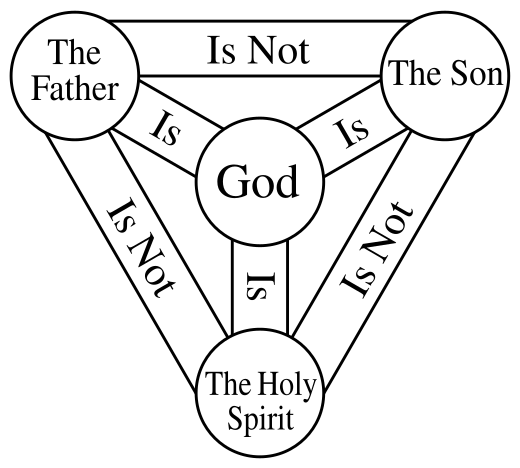
This post aims to clarify the profound mystery of God as revealed from His Holy Word (the Bible): One God, yet a Triune God. God Almighty is a single Divine Being, unified in essence and purpose, yet manifested in three distinct Personages—1) The Father, 2) The Son (The Lord Jesus Christ, The Word), and 3) The Holy Ghost/Holy Spirit. This “Trinity in Unity” is a great, incomprehensible mystery, yet Scripture affirms its truth, making it accessible to our finite minds to the extent we can accept it by faith.

Through numerous Bible studies, this teacher has sought to edify believers and glorify God, emphasizing that the entire Bible points to the Person and Atoning Work of the Lord Jesus Christ. For example, please see the post titled Exalting the Person and Work of the Lord Jesus Christ: The Key of Knowledge for Unlocking the Mystery of the Bible. These studies, rooted in Old Testament allegories, types, and shadows, reveal God’s magnificent Salvation plan for His Glory. By God’s mercy and the Holy Spirit’s guidance, this teaching aims to bless readers worldwide and draw them closer to Him, particularly as Jesus’ Triumphant Return and Judgment Day draws nigh.

As Proverbs 25:2 states: [It is] the glory of God to conceal a thing: but the honour of kings [is] to search out a matter. God conceals various aspects of Jesus within the Scriptures—for His glory, while believers are honored by searching them out.


God as One and Triune: Biblical Evidence

The Trinity Defined

Though the word “Trinity” is absent from Scripture, the doctrine emerges from numerous verses that collectively reveal God as a Triune Being—three Personages working indivisibly as One. Here’s the biblical foundation:

  1. Plurality from the Beginning
    • Genesis 1:1, In the beginning God (אֱלֹהִים, ‘ĕlōhîm))H430 created the heaven and the earth.
    • Genesis 1:26 And God said, Let us make man in our image, after our likeness…
      The Hebrew word ‘ĕlōhîm (a plural noun) and the plural pronoun “us” suggest plurality within God’s unity, hinting at the Trinity from the outset (see also Isaiah 6:8).
  2. Jesus’ Great Commission Affirms the Three Persons as Co-Equal in Authority
    • Matthew 28:19, “Go ye therefore, and teach all nations, baptizing them in the name of the Father, and of the Son, and of the Holy Ghost…”
  3. Unity Underscored
    • 1 John 5:7, For there are three that bear record in heaven, the Father, the Word, and the Holy Ghost: and these three are one. Jesus is the Word made flesh as we read in John 1:14, “And the Word was made flesh, and dwelt among us, (and we beheld his glory, the glory as of the only begotten of the Father,) full of grace and truth.”
  4. The Three Persons Collaborate and Coordinate
    • Ephesians 2:18, “For through him [Christ] we both have access by one Spirit unto the Father.
  5. Each Person’s Role is Distinct Yet Harmonious
    • 1 Peter 1:2, Elect according to the foreknowledge of God the Father, through sanctification of the Spirit, unto obedience and sprinkling of the blood of Jesus Christ:…

Indivisible Unity in Diversity

Despite the three Personages, God remains One. Ephesians 4:6 declares: One God and Father of all, who is above all, and through all, and in you all.” John 10:30 reinforces this: I and my Father are one., as does Colossians 2:9, For in him (Jesus) dwelleth all the fulness of the Godhead bodily. And ye are complete in him, which is the head of all principality and power:

The Mystery of Isaiah 9:6

Isaiah 9:6 presents a striking enigma: For unto us a child is born, unto us a son is given: and the government shall be upon his shoulder: and his name shall be called Wonderful, Counsellor, The mighty God, The everlasting Father, The Prince of Peace. This prophecy of Jesus, the Son, also calls Him “The everlasting Father.Colossians 1:15-20 clarifies: Jesus is the image of the invisible God,” by Whom all things were created, consist, and are reconciled as we read here,

¶Who is the image of the invisible God, the firstborn of every creature: For by him were all things created, that are in heaven, and that are in earth, visible and invisible, whether [they be] thrones, or dominions, or principalities, or powers: all things were created by him, and for him: And he is before all things, and by him all things consist. And he is the head of the body, the church: who is the beginning, the firstborn from the dead; that in [all things] he might have the preeminence. ¶For it pleased [the Father] that in him should all fulness dwell; And, having made peace through the blood of his cross, by him to reconcile all things unto himself; by him, [I say], whether [they be] things in earth, or things in heaven.

1 Timothy 1:17, “Now unto the King eternal, immortal, invisible, the only wise God, [be] honour and glory for ever and ever. Amen.


The Significance of Three: A Biblical Pattern

Why Three?

We must first recognize the fact that Numbers Found in the Bible Can Convey Spiritual Concepts.

The number three (“3“), as in the Trinity represents God’s sovereign will and testimony. As a prime number, it signifies indivisibility and completeness. Ecclesiastes 4:12 illustrates: …a threefold cord is not quickly broken.” and Deuteronomy 19:15, establishes a basis for truth with at the mouth of two witnesses, or at the mouth of three witnesses, shall the matter be established. The Trinity—Father, Son (The Word), and Holy Spirit—embodies this perfect, unbreakable triune unity as we read again in 1 John 5:7, “For there are three that bear record in heaven, the Father, the Word (The Son), and the Holy Ghost: and these three are one.

Threes in Jesus’ Earthly Ministry

The number three recurs in Jesus’ atoning sacrifice, fulfilling God’s Will and Purpose:

These patterns underscore the Trinity’s role in redemption.


The Three Persons of the Godhead

Each Person of the Holy Trinity is fully God, yet each Person fulfills a distinct role while remaining indivisible.

1. God The Father

  • Role: The ultimate source and initiator of creation, salvation, and judgment.
  • Scripture:
    • John 3:16&17, “For God so loved the world, that he gave his only begotten Son, that whosoever believeth in him should not perish, but have everlasting life. For God sent not his Son into the world to condemn the world; but that the world through him might be saved.
    • Romans 15:6, “That ye may with one mind [and] one mouth glorify God, even the Father of our Lord Jesus Christ.”
    • 1 Corinthians 8:6, “But to us [there is but] one God, the Father, of whom are all things, and we in him; and one Lord Jesus Christ, by whom [are] all things, and we by him.
    • Revelation 4:11, “Thou art worthy, O Lord, to receive glory and honour and power: for thou hast created all things, and for thy pleasure they are and were created.
  • Attributes: Known as the “Ancient of Days” (Daniel 7:22, Daniel 7:13), seated on the throne (Revelation 4:2&3), worthy of glory and honor (1 Chronicles 29:10-13).

2. God The Son, Jesus Christ (The Word)

  • Role: The Savior, Creator, and Obedient Son, executing the Father’s Will.
  • Scripture:
    • Matthew 1:21, “And she (Mary) shall bring forth a son, and thou shalt call his name JESUS: for he shall save his people from their sins.” 
    • John 1:1-3,: “¶In the beginning was the Word, and the Word was with God, and the Word was God. The same was in the beginning with God. All things were made by him; and without him was not any thing made that was made.
    • John 1:14, ¶And the Word was made flesh, and dwelt among us, (and we beheld his glory, the glory as of the only begotten of the Father,) full of grace and truth.
    • Hebrews 1:8: But unto the Son [he saith], Thy throne, O God, [is] for ever and ever…
    • In the Garden of Gethsemane where Jesus prayed to the Father in Luke 22:42, “Saying, Father, if thou be willing, remove this cup from me: nevertheless not my will, but thine, be done.”
    • Philippians 2:8, “And being found in fashion as a man, he humbled himself, and became obedient unto death, even the death of the cross.
  • Attributes: The Creator (John 1:3), The Lamb slain (Revelation 5:12 and Revelation 13:8), “KING OF KINGS, AND LORD OF LORDS” (Revelation 19:16), The Good Shepherd (Psalm 23:1-6), and revealer of The Father (John 14:9).

3. God The Holy Spirit

  • Role: The means of God’s work—creating, empowering, regenerating, teaching, and interceding for the saints.
  • Scripture:
    • Genesis 1:2, “And the earth was without form, and void; and darkness [was] upon the face of the deep. And the Spirit of God moved upon the face of the waters.
    • John 16:13-15, “Howbeit when he, the Spirit of truth, is come, he will guide you into all truth: for he shall not speak of himself; but whatsoever he shall hear, [that] shall he speak: and he will shew you things to come. He (The Holy Spirit) shall glorify me: for he shall receive of mine, and shall shew [it] unto you. All things that the Father hath are mine: therefore said I, that he shall take of mine, and shall shew [it] unto you.
    • Romans 8:26 we read, “Likewise the Spirit also helpeth our infirmities: for we know not what we should pray for as we ought: but the Spirit itself maketh intercession for us with groanings which cannot be uttered.
    • Titus 3:5&6, “Not by works of righteousness which we have done, but according to his mercy he saved us, by the washing of regeneration, and renewing of the Holy Ghost; Which he shed on us abundantly through Jesus Christ our Saviour;
    • When we pray, we pray in The Spirit/The Holy Ghost, as we read in, “Praying always with all prayer and supplication in the Spirit, and watching thereunto with all perseverance and supplication for all saints;” and Jude 20&21, “But ye, beloved, building up yourselves on your most holy faith, praying in the Holy Ghost, Keep yourselves in the love of God, looking for the mercy of our Lord Jesus Christ unto eternal life.” 
  • Attributes: The Comforter (John 14:26), Spirit of Truth (John 14:17, 1 John 4:6) indwelling believers (1 Corinthians 3:16), and testifying of Jesus Christ (John 15:26).

Implicit Hierarchy

Scripture suggests a functional subordination:

  1. Jesus Christ, The Son, submits to Our Father in Heaven as we read in John 5:19, “Then answered Jesus and said unto them, Verily, verily, I say unto you, The Son can do nothing of himself, but what he seeth the Father do: for what things soever he doeth, these also doeth the Son likewise.” and, perhaps more importantly, we read in John 14:28, “Ye have heard how I said unto you, I go away, and come [again] unto you. If ye loved me, ye would rejoice, because I said, I go unto the Father: for my Father is greater than I.
  2. The Holy Spirit proceeds from The Father with Jesus’ involvement as we read where Jesus said in John 15:26, “¶But when the Comforter is come, whom I will send unto you from the Father, [even] the Spirit of truth, which proceedeth from the Father, he shall testify of me:”. Yet, this does not diminish their equality in Deity, it only reflects their differing roles within the Godhead’s intimate Unity.

The Indivisible Trinity

The three Persons are inseparable. Jesus declares in John 14:9, “…he that hath seen me hath seen the Father; and in John 10:30, “I and [my] Father are one.” The Holy Spirit sent by the Father glorifies the Son, who reveals the Father, forming a perfect unity. As 1 Corinthians 13:12 notes, “For now we see through a glass, darkly; but then face to face: now I know in part; but then shall I know even as also I am known.“, our understanding remains partial until we see God face-to-face.


Conclusion

The Trinity defies complete human comprehension because God’s infinite nature surpasses our finite minds. The Bible affirms that the Father is God, the Son is God, and the Holy Spirit is God—three Persons, one essential God Being. This mystery invites faith, not full explanation. As we search the Scriptures, we honor God by uncovering His concealed glory, trusting His revelation until the saints know Him fully in eternity.


The Duty of a Christian Is to Share The Word of God Faithfully in Truth (and Not Error)

March 7, 2025

Introduction

This is just a short post of key verses exhorting and admonishing the saints to be faithful in their individual Ambassadorships in witnessing, preaching, and teaching for the Lord Jesus Christ.

The believing servant of the Lord Jesus Christ has a responsibility to not only share the Gospel of Salvation with the world (as is explained in Jesus’ Parable of the Talents), but to do it faithfully, and not as a false prophet whom Jesus described in Matthew 24:24.

Jeremiah 23:28, “…he that hath my word, let him speak my word faithfully

 Proverbs 14:5, “A faithful witness will not lie: but a false witness will utter lies.

We should emulate our Master, The Lord Jesus Christ, Who we read of in Revelation 1:5, “And from Jesus Christ, [who is] the faithful witness, [and] the first begotten of the dead, and the prince of the kings of the earth. Unto him that loved us, and washed us from our sins in his own blood, And hath made us kings and priests unto God and his Father; to him [be] glory and dominion for ever and ever. Amen.

2 Corinthians 2:17, ”For we are not as many, which corrupt the word of God: but as of sincerity, but as of God, in the sight of God speak we in Christ.”

In 1 Peter 4:11 we read“If any man speak, let him speak as the oracles of Godif any man minister, let him do it as of the ability which God giveth: that God in all things may be glorified through Jesus Christ, to whom be praise and dominion for ever and ever. Amen”.

Psalm 68:11, “The Lord gave the word: great [was] the company of those that published בָּשַׂר (bāśar)H1319 [it].” In this case, the original Hebrew word for ‘publish’ is better understood as “delivering a message” or “preached” the Word.

Mark 13:10, “And the gospel must first be published among all nations.

Mark 16:15, “And he said unto them, Go ye into all the world, and preach the gospel to every creature.

1 Timothy 4:13, “Till I come, give attendance to reading, to exhortation, to doctrine.”

2 Timothy 2:15&16, “Study to shew thyself approved unto God, a workman that needeth not to be ashamed, rightly dividing the word of truth. But shun profane [and] vain babblings: for they will increase unto more ungodliness.

1 Timothy 6:20&21, “¶O Timothy, keep that which is committed to thy trust, avoiding profane [and] vain babblings, and oppositions of science falsely so called: Which some professing have erred concerning the faith. Grace [be] with thee. Amen.

2 Corinthians 5:20, “¶Now then we are ambassadors for Christ, as though God did beseech you by us: we pray [you] in Christ’s stead, be ye reconciled to God. For he hath made him [to be] sin for us, who knew no sin; that we might be made the righteousness of God in him.

 2 Corinthians 4:1-7, “¶Therefore seeing we have this ministry, as we have received mercy, we faint not; But have renounced the hidden things of dishonesty, not walking in craftiness, nor handling the word of God deceitfully; but by manifestation of the truth commending ourselves to every man’s conscience in the sight of God. But if our gospel be hid, it is hid to them that are lost: In whom the god of this world hath blinded the minds of them which believe not, lest the light of the glorious gospel of Christ, who is the image of God, should shine unto them. For we preach not ourselves, but Christ Jesus the Lord; and ourselves your servants for Jesus’ sake. For God, who commanded the light to shine out of darkness, hath shined in our hearts, to [give] the light of the knowledge of the glory of God in the face of Jesus Christ. ¶But we have this treasure in earthen vessels, that the excellency of the power may be of God, and not of us.

The Apostle Paul was moved to instruct the believers to follow this exhortation that we read in Colossians 1:25-29, “Whereof I am made a minister, according to the dispensation of God which is given to me for you, to fulfil the word of God; [Even] the mystery which hath been hid from ages and from generations, but now is made manifest to his saints: To whom God would make known what [is] the riches of the glory of this mystery among the Gentiles; which is Christ in you, the hope of glory: Whom we preach, warning every man, and teaching every man in all wisdom; that we may present every man perfect in Christ Jesus: Whereunto I also labour, striving according to his working, which worketh in me mightily.

Ephesians 4:11-16, “¶And he gave some, apostles; and some, prophets; and some, evangelists; and some, pastors and teachers; For the perfecting of the saints, for the work of the ministry, for the edifying of the body of Christ Till we all come in the unity of the faith, and of the knowledge of the Son of God, unto a perfect man, unto the measure of the stature of the fulness of Christ: That we [henceforth] be no more children, tossed to and fro, and carried about with every wind of doctrine, by the sleight of men, [and] cunning craftiness, whereby they lie in wait to deceive; But speaking the truth in love, may grow up into him in all things, which is the head, [even] Christ: From whom the whole body fitly joined together and compacted by that which every joint supplieth, according to the effectual working in the measure of every part, maketh increase of the body unto the edifying of itself in love.

 1 John 4:1, “¶Beloved, believe not every spirit, but try the spirits whether they are of God: because many false prophets are gone out into the world. Hereby know ye the Spirit of God: Every spirit that confesseth that Jesus Christ is come in the flesh is of God: And every spirit that confesseth not that Jesus Christ is come in the flesh is not of God: and this is that [spirit] of antichrist, whereof ye have heard that it should come; and even now already is it in the world. ¶Ye are of God, little children, and have overcome them: because greater is he that is in you, than he that is in the world. They are of the world: therefore speak they of the world, and the world heareth them. We are of God: he that knoweth God heareth us; he that is not of God heareth not us. Hereby know we the spirit of truth, and the spirit of error.

Jeremiah 3:15, “And I will give you pastors according to mine heart, which shall feed you with knowledge and understanding.

Finally we read in Acts 1:8, Jesus said after His Resurrection and just before His Ascension, “But ye shall receive power, after that the Holy Ghost is come upon you: and ye shall be witnesses unto me both in Jerusalem, and in all Judaea, and in Samaria, and unto the uttermost part of the earth.” and Matthew 28:19&20, as Jesus said, “Go ye therefore, and teach all nations, baptizing them in the name of the Father, and of the Son, and of the Holy Ghost: Teaching them to observe all things whatsoever I have commanded you: and, lo, I am with you alway, [even] unto the end of the world. Amen.

Postscript: Wisdom is the Principal Thing

Proverbs 4:7 states, “Wisdom [is] the principal thing; [therefore] get wisdom: and with all thy getting get understanding.” Wisdom is ultimately knowing and loving the Lord Jesus Christ.

In Proverbs 2:1-6, God provides this instruction to the believer to search out wisdom as “hid treasures“, “My son, if thou wilt receive my words, and hide my commandments with thee; So that thou incline thine ear unto wisdom, and apply thine heart to understandingYea, if thou criest after knowledge, [and] liftest up thy voice for understanding; If thou seekest her as silver, and searchest for her as [for] hid treasuresThen shalt thou understand the fear of the LORD, and find the knowledge God. For the LORD giveth wisdom: out of his mouth [cometh] knowledge and understanding.”

The Apostle Paul declared that he determined to know one thing, Jesus Christ and him crucified in 1 Corinthians 2:1&2, “¶And I, brethren, when I came to you, came not with excellency of speech or of wisdom, declaring unto you the testimony of God. For I determined not to know any thing among you, save Jesus Christ, and him crucified.” Also, Jesus Christ is made unto us, wisdom (and righteousness, sanctification and redemption) as we read in 1 Corinthians 1:30&31, “But of him are ye in Christ Jesus, who of God is made unto us wisdom, and righteousness, and sanctification, and redemption: That, according as it is written, He that glorieth, let him glory in the Lord.

Jeremiah 29:13, “And ye shall seek me, and find [me], when ye shall search for me with all your heart.

Proverbs 25:2, “[It is] the glory of God to conceal a thing (Word): but the honour of kings [is] to search out a matter (Word).” Please see this Post.

A Word to the Wise: The Benefits of Using the King James Bible

March 2, 2025

Bible

Introduction

The purpose of this post is to set forth an explanation of why this teacher relies solely on the Authorized King James Version (KJV) of the Bible versus other more modern English translations. This will not be a long or exhaustive post because the intent is not to argue or make demands, but simply to make a few points for the readership of this blog (and Bible students in general) to see the logic behind this teacher’s preference to rely solely on the King James English Translation of the Bible. It should also be noted that all of the KJV Bible verses incorporated within all of the the studies found on the Bereansearching website are live linked to the https://www.blueletterbible.org website under (KJV).

Key Points to Consider

  1. The Authorized King James Version is NOT copyrighted! All other translations are copyrighted and therefore used to generate profits for the publishers from God’s Holy Word. Think about that!
  2. The King James Translators were devout Christian scholars and their commitment, integrity, and solemnity of duty, and reverence for the Word is clear in their Dedicatory letter to the King James (King James had the power over life and death in England at the time). These were not mere academicians and theologians, but rather true God fearing men. Moreover, this teacher believes that few men have been so guided by God in their Biblical understanding than were the King James translators.
  3. The King James translators provided a means to alert the reader to the fact that some words and phrases have been added for clarity of understanding through italicization. This feature is not found in any other English translations.
  4. The KJV translation employs the words “you” (singular) and “ye” (plural) which provides additional clarity rather than the all encompassing modern use of the word “you”. Also the use of “Thou”, “Thy” and “Thine”, are more reverent to the ear than “You”, “Your”, and “Yours” when addressing Almighty God. For example, Psalm 119:105, “NUN. Thy word is a lamp unto my feet, and a light unto my path.” All other translations fall like a dull thud on the ear.
  5. The KJV properly addresses gender as God ordained, and is therefore not “gender-neutral” as are some of the modern translations (which are not really translations, but are really nothing more than “interpretations”).
  6. And who would presume and/or dare to think for one moment that they could possibly improve upon the KJV translation of Hebrews 11:1, “¶Now faith is the substance of things hoped for, the evidence of things not seen.“? And what about the 23rd Psalm? Could that Psalm possibly have the same sweet blessing to the ear and heart in any other English translation? You be the judge!
  7. Almost none of the modern English translations correctly translate some key verses in the Bible
    • In the KJV, Genesis 22:8 reads, “And Abraham said, My son, God will provide himself a lamb for a burnt offering: so they went both of them together.” Almost every other translation reads like this: “Abraham said, God will provide for himself the lamb  for a burnt offering, my son. So they went both of them together.” Do you see the difference? No, God did not just go get a lamb “for himself“, God (Jesus Christ) was Himself The Lamb for a burnt offering! As we read in John 1:29, “¶The next day John seeth Jesus coming unto him,  and saith, Behold the Lamb of God, which taketh away the sin of the world.” and in Galatians 1:3-5, “¶Grace [be] to you and peace from God the Father, and [from] our Lord Jesus Christ, Who gave himself for our sins, that he might deliver us from this present evil world, according to the will of God and our Father: To whom [be] glory for ever and ever. Amen.This is a key scriptural and spiritual point that is entirely lost in the other English translations!
    • In the KJV, Galatians 2:16, reads as follows: “Knowing that a man is not justified by the works of the law, but by the faith of Jesus Christ, even we have believed in Jesus Christ, that we might be justified by the faith of Christ, and not by the works of the law: for by the works of the law shall no flesh be justified.” Almost every other modern English translation reads as follows: “yet we know that a person is not justified by works of the law but through faith in Jesus Christ, so we also have believed in Christ Jesus, in order to be justified by faith in Christ and not by works of the law, because by works of the law no one will be justified.” Think about that! The other English translations have it completely wrong, it is the Faith “of” Jesus Christ, NOTin” Jesus Christ that saves someone! Man cannot save himself…to suggest otherwise is a false free will gospel!
    • This verse does not even exist in most modern English translations: 1 John 5:7, “For there are three that bear record in heaven, the Father, the Word, and the Holy Ghost: and these three are one.” All that you will find is simply this truncated phrase: “For there are three that testify:
    • Another verse that is missing from most modern English translations is Acts 8:37, “¶And Philip said, If thou believest with all thine heart, thou mayest. And he answered and said, I believe that Jesus Christ is the Son of God.” The basis for its exclusion is because, “Some Greek manuscripts exclude this verse.” The ESV, which omits verse 37, states in a “footnote” to verse 36: “Some manuscripts add all or most of verse 37.”

The Bible Student Must Still “Search the Scriptures

Now this is not to say that the King James Version is “perfect”, but rather that the King James Version is the best available English translation above all others.

When reading the Bible, particularly an English translation (as is found on the Bereansearching.com website…using the King James Version), it is easy to breeze through, and not realize the depth of the riches of the words as can be found when looking at the original Hebrew and Greek words. Moreover, it is easy to miss the context and cross-correlations that might be found where the exact same word in the original Hebrew can be translated in an entirely different way, and thereby miss important connections that God had placed there.

This study is intended to provide a brief tutorial on how important it is to view key words in the Bible within the broader context of the entire Bible…bearing in mind that the Old Testament is translated into English from the original Hebrew, while New Testament is translated from the original Greek and Aramaic. Additional insights on the importance of such word studies can be found in these previous posts that focus upon some of the “hidden spiritual gems” that can be found through the conduct of similar efforts regarding Judges 4:6Ruth 3:9, Psalm 37:37Psalm 119:18, and 2 Kings 14:25. May all these studies serve to edify and strengthen the faith of the Saints, the believers in the Lord Jesus Christ.

Three other important examples where a better translation by the King James translators could have helped with spiritual understanding are explained in these three posts where this teacher has endeavored to diligently “search the scriptures”:

  1. Proverbs 25:2
  2. The “pitch” used to waterproof Noah’s Ark
  3. Nehemiah “viewed” the walls of Jerusalem

In any case, NONE of the other English translations provide any suggestion of a correct understanding of the finer Biblical points found in those studies.

And it should also be noted that the https://www.blueletterbible.org website provides all the necessary tools to “search out” the originally intended word meanings from the original Hebrew and Greek, to come to the same conclusions as this teacher. The findings are all academically reproducible to anyone who takes the time to search them out.

While this teacher recommends the King James English translation, it must be acknowledged that, yes, it is written in the “Old English” style, and as a result, can create some confusion, as some words in the Old English have significantly different meanings in today’s modern English. For example, when in the 23rd Psalm we read shall not “want“, it does not mean shall not “desire“, but rather means “shall not lack (anything)”. The word “prevent” does not mean “to inhibit“, but rather means “to go before. Such differences are a bit strange at first, but are easily understood when read in context and with regular reading.

May this post be a helpful aid to the serious student of the Bible.

POSTSCRIPT: The Great Theological Divide Over Manuscripts

We should also take note of the fact that there is a great foundational divide regarding the early Biblical manuscripts. The Textus Receptus (Latin for “Received Text”) is a Greek New Testament compendium that provided the textual base for the vernacular translations of the Reformation Period (like the Geneva Bible and the King James Version). It is substantially different from the more recent, generally more well accepted, Nestle Aland translation based on the “Alexandrian Text” (or the other newer translations based on what is known “Majority Text”). Modern textual criticism of the Textus Receptus claims that the newer translations use physically “older” manuscripts (which do not read the same as 1 John 5:7), yet those older manuscripts have a lot of disagreements between themselves (And therefore the case can also be made that, although those manuscripts are “older” than the Textus Receptus, they were not valid because of their inconsistencies and hence judged by many as unreliable.)

Among the arguments against the King James Version (KJV) translation, which used the Textus Receptus, is that somehow the translators “added“ verses. For example, the copyrighted English Standard Version (ESV) Bible relies on the “Alexandrian Text”, with one result being that the Book of Mark ends with verse 8 rather than continuing to verse 20 as is found in the King James Version. A footnote is added to the ESV at verse 9 as follows:

ESV Footnotes

(16:9) “Some manuscripts end the book with 16:8; others include verses 9–20 immediately after verse 8. At least one manuscript inserts additional material after verse 14; some manuscripts include after verse 8 the following: But they reported briefly to Peter and those with him all that they had been told. And after this, Jesus himself sent out by means of them, from east to west, the sacred and imperishable proclamation of eternal salvation. These manuscripts then continue with verses 9–20″

It is most notable that the KJV of Mark ends in complete harmony with the other three Gospels covering Jesus’ appearance to Mary Magdalene, to the two disciples on the Road to Emmaus, and ending with Jesus’ Great Commission.

On the other hand, arguments have been made suggesting that the scribes of the later copies (Alexandrian Text) omitted verses in the course of making those copies. Given the case that can be made regarding the commitment, sobriety, and declared God fearing understanding of the King James translators, we must trust that God guided those men, such that they did not add or subtract anything in the Scriptures. Except for some of the more fundamental conservative churches, along with a few scattered independent churches, most churches do not use the King James Version of the Bible today. Many church leaders today feel that the King James English is too outdated for our modern world, and to employ the KJV is to make a pastor or teacher appear as a ‘theological dinosaur’.

For anyone interested in pursuing this topic further, a well written treatise by Edward F Hills on the pertinence and validity of the KJV translation is available online for free here: “The King James Version Defended“. One short excerpt from that book:

The Protestant Reformers and the Living Word of God
The Protestant Reformers understood the fact that in the Bible, “God reveals HIMSELF, not mere information concerning Himself. To them the Bible was no mere book of doctrine but the revelation of the living God.

A Spiritual Exposition of the Book of Esther, Chapter 3

March 1, 2025
Esther Chapter 3, verse 1, in the Original Hebrew

Introduction

This post is the third of what will hopefully be ten posts in total to provide verse-by-verse expositions of each of the ten chapters of the Book of Esther. The reader should fully understand that these studies are solely intended to show the many spiritually hidden aspects of God’s Magnificent Salvation Plan, which God has intricately interwoven within the historical account of the Book of Esther. The key to understanding the true meaning of the Book of Esther is to see that the whole book is an Historical Parable, which prophetically points us to the Person and Work of Jesus Christ, Who Is The Only Lord, God, and Savior. Moreover the book is one of concealment (“Esther” in Hebrew means “concealment”) that spans from Old Testament National Israel, to the future fulfillment of the feasts of Passover and Pentecost in the New Testament era, and a “preview” of the yet to be Judgment Day and beyond into eternity in the New Heavens and the New Earth. We can also see key personages of the Bible throughout this book by those who serve as “Types” to each represent 1) God the Father, 2) National Israel, 3) the Lord Jesus Christ, 4) Eternal Israel, 5) The Holy Spirit, and 6) the Devil. A summary overview Christian commentary of the Book of Esther is Here (which also includes a link to a much more comprehensive study).

The Spiritual Theme of Esther Chapter 3: Satan Acquires Dominion Over This Creation by Right of Conquest Immediately Upon the Fall of Adam (Esther 3:1 and Esther 8:5)  Please see Romans 6:23.

  • The “Law” is Given , The Temptation of Christ,  Satan Seeks to Destroy Jesus and All of His People, by Accusing the People for Being Sinners…For Their Not Keeping the King’s Laws/Commandments (Esther 3:6-8), Please see: Revelation 12:10

Introduction of Prince Haman

The introductory phrase, “After all these things“, replicates what is found in the first verse of Chapter 2. However, in this case, we would seem to have to understand that it is something that followed, and which was also evidently a direct result of, what we had just read about at the end of Esther Chapter 2. That something would have to have been related to the thwarted insurrection attempt against the king.

This verse provides us with the name of a newly exalted prince of the king, prince Haman. The verse tells us that Haman was the son of Hammedatha and that he was an Agagite. From this verse we can learn a lot about this person, but for the purposes of this verse by verse study we can confidently state that Haman, as an Agagite, was also an Amalekite: and hence he was a Vessel “Unto Dishonour” and an unmistakeable portrait of the Devil. This teacher highly recommends that the reader now review the very detailed spiritual character study on Haman that is found here: “The Devil in Disguise“. That study shows that a very strong correlation can be made between Haman and the Devil, because of at least three distinct factors:

  1. Haman’s personality traits and named attributes
  2. The meaning of Haman’s name
  3. Haman’s ancestral lineage and its Biblical spiritual implications

If we consider the spiritual implications we would have to conclude that the ascendency of Haman is consistent with Satan Acquiring Dominion Over This Creation by Right of Conquest Immediately Upon the Fall of Adam. 

Irrespective of the fact that king Ahasuerus acknowledged that Haman was a chief prince in the kingdom, the important point of this verse is that Mordecai was the only one who did NOT bow or show any reverence to Haman. What does this remind us of? Yes, the devil wanted Jesus to reverence him in and Jesus rebuked the devil for it (see more below after verse 6).

Remember also  Psalm 15:4 tells us that a child of God has these attributes, “In whose eyes a vile person is contemned; but he honoureth them that fear the LORD. [He that] sweareth to [his own] hurt, and changeth not.

This verse is a bit reminiscent of what occurred in the life of Jesus that we read about in Mark 12:13-17 (see also Matthew 22:15–22Luke 20:20–26 ), “¶And they send unto him certain of the Pharisees and of the Herodians, to catch him in [his] words. And when they were come, they say unto him, Master, we know that thou art true, and carest for no man: for thou regardest not the person of men, butteachest the way of God in truth: Is it lawful to give tribute to Caesar, or not? Shall we give, or shall we not give? But he, knowing their hypocrisy, said unto them, Why tempt ye me? bring me a penny, that I may see [it]. And they brought [it]. And he saith unto them, Whose [is] this image and superscription? And  they said unto him, Caesar’s. ¶And Jesus answering said unto them, Render to Caesar the things that are Caesar’s, and to God the things that are God’s. And they marvelled at him.

At this point it is safe to say that when the king’s servants questioned Mordecai for his defiance of the king’s decree, Mordecai evidently told them He worshipped only the Lord God of Israel and admitted in the process that he was therefore a Jew. Moreover, Mordecai would likely have quoted scripture (just as Jesus did in Matthew 4:10) referring to Deuteronomy 6:13, “Thou shalt fear the LORD thy God, and serve him, and shalt swear by his name.” and Deuteronomy 10:20, “Thou shalt fear the LORD thy God; him shalt thou serve, and to him shalt thou cleave, and swear by his name.

These informants were talebearers working mischief, typical of reprobates. We are told the following concerning such people:

  1. Proverbs 11:13, “A talebearer revealeth secrets: but he that is of a faithful spirit concealeth the matter.”
  2. Proverbs 18:8, “The words of a talebearer are as wounds, and they go down into the innermost parts of the belly.
  3. Proverbs 20:19, “He that goeth about as a talebearer revealeth secrets: therefore meddle not with him that flattereth with his lips.”
  4. Proverbs 26:20, “Where no wood is, [there] the fire goeth out: so where [there is] no talebearer, the strife ceaseth.
  5. Proverbs 26:22, “The words of a talebearer [are] as wounds, and they go down into the innermost parts of the belly.

Mordecai Refuses to Reverence Haman, So Haman Seeks to Destroy Both Mordecai and All the Jews

The Bible specifically warns about man’s wrath in:

  1. Proverbs 14:29, “[He that is] slow to wrath (חֵמָה (ḥēmâ))H2534 [is] of great understanding: but [he that is] hasty of spirit exalteth folly.
  2. Proverbs 19:19, “A man of great wrath (חֵמָה (ḥēmâ))H2534shall suffer punishment: for if thou deliver [him], yet thou must do it again.
  3. Proverbs 21:24, “Proud [and] haughty scorner [is] his name, who dealeth in proud wrath (חֵמָה (ḥēmâ))H2534 .
  4. Proverbs 27:4, “Wrath (חֵמָה (ḥēmâ))H2534 [is] cruel, and anger [is] outrageous; but who [is] able to stand before envy?

In Esther 3:5&6, we read, “And when Haman saw that Mordecai bowed not, nor did him reverence, then was Haman full of wrath (חֵמָה (ḥēmâ))H2534. And he thought scorn to lay hands on Mordecai alone; for they had shewed him the people of Mordecai: wherefore Haman sought to destroy all the Jews that [were] throughout the whole kingdom of Ahasuerus, [even] the people of Mordecai.

This was a tipping point in the historical narrative of the Book of Esther. Haman’s pride led him to hate Mordecai and desire to murder Mordecai. Notably, Haman was not only being wrathful and hate filled, but in his pride he was in complete rebellion to God and His Word, particularly when we think of these verses of Hannah’s “Song of Thanksgiving” (for her son Samuel) in 1 Samuel 2:2&3, “[There is] none holy as the LORD: for [there is] none beside thee: neither [is there] any rock like our God. Talk no more so exceeding proudly; let [not] arrogancy come out of your mouth: for the LORD [is] a God of knowledge, and by him actions are weighed.” Also 1 Samuel 2:6-9, “The LORD killeth, and maketh alive: he bringeth down to the grave, and bringeth up. The LORD maketh poor, and maketh rich: he bringeth low, and lifteth up. He raiseth up the poor out of the dust, [and] lifteth up the beggar from the dunghill, to set [them] among princes, and to make them inherit the throne of glory: for the pillars of the earth [are] the LORD’S, and he hath set the world upon them. He will keep the feet of his saints, and the wicked shall be silent in darkness; for by strength shall no man prevail.

This historical account is also quite similar what we know what was the situation that found in Matthew 4:8-10, where the devil, having been given the power by God to rule this world upon the Fall of Adam, desired for Jesus to also “fall down and worship” him, to which Jesus answered, “Get thee hence, Satan: for it is written, Thou shalt worship the Lord thy God, and him only shalt thou serve.(Please see also Mark 1:12&13Luke 4:1–13 .)

The devil wrathfully hates God, and not only desired to kill Jesus, but to also continues seeking to kill all of those who believe in Jesus, those who are the true Christians.  In 1 Peter 5:8,  we are told to “Be sober, be vigilant; because your adversary the devil, as a roaring lion, walketh about, seeking whom he may devour:

It should also be noted that the word for “wrath” that is used to describe the hate that filled Haman against Mordecai is חֵמָה (ḥēmâ))H2534 in the original Hebrew, which has been translated into English by the King James Translators variously as: fury (67x), wrath (34x), poison (6x), furious (4x), displeasure (3x), rage (2x), anger (1x), bottles (1x), furious (with H1167) (1x), furiously (1x), heat (1x), indignation (1x), wrathful (1x), wroth (1x). And, for the record, it is also the same word used to describe the “wrath” of King Ahasuerus that was “appeased” against Queen Vashti and “pacified” against Haman that we see in Esther 2:1, and Esther 7:7 together with Esther 7:10.

Casting the Lot to Determine the Timing of “Judgment Day(Both Temporally and Spiritually)

In Esther 3:7, we read the following “In the first month, that [is] , the month Nisan, in the twelfth year of king Ahasuerus, they cast Pur, that is, the lot(גּוֹרָל (gôrāl))H1486, before Haman from day to day, and from month to month, [to] the twelfth [month], that [is], the month Adar.” Now we need to remember what God tells us in two places in the Bible. 

  1. First, in Proverbs 16:33, “The lot (גּוֹרָל (gôrāl))H1486 is cast into the lap; but the whole disposing thereof [is] of the LORD.” This means that even though Haman cast the lot, God is still in charge of how it turns out. 
  2. Then in Isaiah 34:17, “And he hath cast the lot(גּוֹרָל (gôrāl))H1486 for them, and his hand hath divided it unto them by line: they shall possess it for ever, from generation to generation shall they dwell therein.” The “he” is God Almighty, and “them/they” are all those consigned to Hell (a land of brimstone and burning pitch Isaiah 34:9) on Judgment Day (“the day of the LORD’S vengeance” Isaiah 34:8 when the smoke of their torment goes up for ever. Isaiah 34:10 and Revelation 14:11).

All of Isaiah chapter 34 is a warning from God to the entire world of the Judgment Day to come, and that God warns us that none of His Words will fail that are found in the Bible, Which book God tells us all to “read”, as we find in the preceding verse to the one above, “Isaiah 34:16, “Seek ye out of the book of the LORD, and read: no one of these shall fail, none shall want her mate: for my mouth it hath commanded, and his spirit it hath gathered them.

Haman’s Plot Against the Jews

Here we read where Haman, as the chief of the princes with him, because of His pride, reports to the king in this verse, that there is a people that is scattered throughout the kingdom who do not keep the kings laws and the king should not suffer them to live.  Interestingly, part of Haman’s argument was that this certain people (the Jews) had laws that were different from the local laws of the Medes and the Persians. This was actually a true statement in the sense that the Jews followed the Mosaic Laws (dietary, cleanliness, sacrifices to the True God, etc.). However, there is another way of looking at this. If we think of that statement from a spiritual perspective, it could be that everyone by nature does not keep the Law of God Almighty (no one keeps the Law of God perfectly) and pretty much since the Fall of Adam, everybody (by nature) does that which is right in his or her own eyes.

Haman even offered a great sum of silver to bring about the people’s destruction in verse Esther 3:11, “And the king said unto Haman, The silver [is] given to thee, the people also, to do with them as it seemeth good to thee.”  Then in Esther 3:12 we read, “¶ Then were the king’s scribes called on the thirteenth day of the first month, and there was written according to all that Haman had commanded unto the king’s lieutenants, and to the governors that were over every province, and to the rulers of every people of every province according to the writing thereof, and [to] every people after their language; in the name of king Ahasuerus was it written, and sealed with the king’s ring.”  The Bible, the extant Law of God, has gone out to all the earth and it makes clear in Romans 6:23, “For the wages of sin [is] death;” We would all remain condemned to Hell according to the Law of God (apart from the Mercy and Grace of God).

Isn’t it an interesting “coincidence” that when God gave the commandment (the Law) to Adam and Eve to not eat of the fruit of the tree of the knowledge of good and evil, and despite God telling them that the day they ate of it that they would die, that the serpent (Satan) effectively had caused them to not “keep the King’s law.”  Is it not also true that, until the cross, Satan was allowed to come before God (see Job 1:6 & 7) to be the accuser of the believers for not perfectly keeping the Law of God, for in Revelation 12:10 we read, “And I heard a loud voice saying in heaven, Now is come salvation, and strength, and the kingdom of our God, and the power of his Christ: for the accuser of our brethren is cast down, which accused them before our God day and night.”  Note also that the not only was Judgment Day in view when God gave the first commandment, i.e. Romans 6:23, “For the wages of sin [is] death;” but in the second part of that verse is the decreed way of escape by God’s grace that we read about in Esther 8:9, “the gift of God [is] eternal life through Jesus Christ our Lord., but God allowed Satan to have dominion over this whole creation by right of conquest.  That is why Jesus said in John 18:3, ¶”Jesus answered, My kingdom is not of this world: if my kingdom were of this world, then would my servants fight, that I should not be delivered to the Jews: but now is my kingdom not from hence.

Regarding Haman’s offer of “ten thousand talents of silver” is indicative of what we read in Psalm 116:15, “Precious in the sight of the LORD [is] the death of his saints.” The number 10,000 is 10X10X10X10 or ten to the fourth power. The number ten is representative (which can also be manifest as 100, 1000, or 10,000s) is most representative of the concept of “Completeness“, “Totality“, and “Fulfillment“. The number four (“4“) represents “Earthly”, “Global”, and “Universal“, something having an impact on the entire world, and can also apply all the way to the end of time. For more on the spiritual implications of numbers in the Bible, particularly the numbers ten and four, please see this post: Numbers in the Bible Can Convey Spiritual Concepts.

Spiritually speaking, it is hard to fully correlate this verse with what we know of the interactions between the devil and God, but we do know that the devil had been given dominion over this world by God until the cross, as we read in Matthew 4:8&9, “¶Again, the devil taketh him (Jesus) up into an exceeding high mountain, and sheweth him all the kingdoms of the world, and the glory of them; And saith unto him, All these things will I give thee, if thou wilt fall down and worship me.” How could the devil make such an offer unless he had that dominion over this world at that time?

It is also notable what is found in Revelation 9:11, “And they had a king over them, [which is] the angel of the bottomless pit, whose name in the Hebrew tongue [is] Abaddon (Ἀβαδδών (abaddōnn)G3 , meaning “Destruction”), but in the Greek tongue hath [his] name Apollyon ( Ἀπολλύων (apollyōn)G623 , meaning “Destroyer”).

The king’s ring is a sign of authority and dominion.

God did not take any spoil from the devil. God simply allowed the devil to have earthly dominion until the cross.

Under the Law, the Wages of Sin Is Death and Total Destruction

Because of the Fall of Adam in the Garden of Eden, God decreed that man would die (but it was not just physical death, but spiritual and eternal death and destruction in Hell). And the warnings against disobedience to God’s commandments, and the just penalty for disobedience that will be meted out to all mankind on Judgment Day (at the end of the world) have been sent throughout the entire planet in every language through the publication and distribution of the most widely dispersed publication on earth, the Holy Bible.

How is Judgment Day in View?

It can be easily missed in casual reading, but there are a number of potential time clues that God has provided in this one verse. First we must recognize that The End of the Year is When Judgment Day Comes and Eternity Begins. 

In the Book of Esther, the first decree went forth into all the great kingdom of Ahasuerus to be carried out in the end of the year on the 13th day of the twelfth month, Adar.  Isn’t it interesting that just as it is obvious that the twelfth month in the Book of Esther can be equated to the end of the year, God Himself defines the “end of the year” to a time of harvest.  In Exodus 23:16 we read, “And the feast of harvest, the firstfruits of thy labours, which thou hast sown in the field: and the feast of ingathering, [which is] in the end of the year, when thou hast gathered in thy labours out of the field.”  Remember that Jesus said in Matthew 13:39 that, “the harvest is in the end of the world.”  The harvest that is equated to “the end of the world” refers to the completion of the final harvest wherein the believers’ souls, the “wheat,” are gathered into God’s barn, while the unsaved, the “tares,” are gathered together and taken out to be burned as we read in Matthew 13:30, “Let both grow together until the harvest: and in the time of harvest I will say to the reapers, Gather ye together first the tares, and bind them in bundles to burn them: but gather the wheat into my barn.”   At the end of time, the last Trump should herald the end of this creation and the transition to eternity wherein the true “Jews” (Christians from all nations, kindreds, people, and tongues) will celebrate the eternal Jubilee brought about by the atoning sacrifice of Jesus Christ in the new Heavens and the new Earth in the presence of Almighty God.

Why the “Thirteenth” Day?

The reader should, by now, be aware that numbers in the Bible can convey spiritual concepts. The number 13 is a particularly interesting number in the Bible from several vantage points.

The number thirteen (“13“) is a prime number that represents “Completion” or “Super Fullness” (quite possibly with implications for the end of time, thus the “completion and super fullness of time”).

This is particularly important when we consider that the Biblical calendar of history, as provided by God using patriarchal genealogies, strongly suggests that it had been 11000 years from creation to the coming of Jesus. And given that it is now two thousand years since Jesus was on earth, creation must be very close to being 13000 years old in our day (see the “Numbers” post how the calendar can be Biblically determined).

Have you ever realized that the walls of Jericho fell only after National Israel circumnavigated (compassed) the city thirteen timesMoreover, that event was a prefigurement of Judgment Day!  Joshua 6:2-5, “And the LORD said unto Joshua, See, I have given into thine hand Jericho, and the king thereof, [and] the mighty men of valour. And ye shall compass the city, all [ye] men of war, [and] go round about the city once. Thus shalt thou do six days. And seven priests shall bear before the ark seven trumpets of rams’ horns: and the seventh day ye shall compass the city seven times, and the priests shall blow with the trumpets. And it shall come to pass, that when they make a long [blast] with the ram’s horn, [and] when ye hear the sound of the trumpet, all the people shall shout with a great shout; and the wall of the city shall fall down flat, and the people shall ascend up every man straight before him.

Given that we are very close to Judgment Day, and that this creation is very close to being slightly more than 13,000 years old (please see the two charts in the Postscript to the study of Numbers), could it be that we have been given another time clue in Esther that is telling us that the end of the year (Judgment Day) is linked (both literally and spiritually) with the number 13, as we find in both the Fall of Jericho and in the Book of Esther? Time will tell.

In Joseph’s second dream, thirteen celestial objects (the sun, moon, and eleven stars) bow down to him in Genesis 37:9&10. His brothers and father quickly interpreted the dreams to mean they would one day be under Joseph’s authority. This dream (together with the first dream in Genesis 37:6-8) effectively became reality in Genesis 42:6and Genesis 42:9 . And we should also remember that at the end of time, according to Philippians 2:10, “That at the name of Jesus every knee should bow, of [things] in heaven, and [things] in earth, and [things] under the earth;And [that] every tongue should confess that Jesus Christ [is] Lord, to the glory of God the Father.“ Seth, in the original Hebrew (שֵׁת (šēṯ))H8352 meaning “compensation” or “substitute”), the third son of Adam, was born to Adam when Adam was 130 (13 X10) years oldGenesis 5:3, “And Adam lived an hundred and thirty years, and begat [a son] in his own likeness, after his image; and called his name (קָרָא (qārā’)H7121שֵׁם (šēm)H8034Seth:

The warning of Judgment Day at the end of this age has been made clear to everyone by way of the publication of God’s Word, the Bible.

To be “ready against that day” is a direct reference to being ready for Judgment Day as we read in Matthew 24:44, “Therefore be ye also ready: for in such an hour as ye think not the Son of man cometh.” It should also be noted that we read the same phrase in Esther 8:13, following the second decree proclaimed in the king’s name under Mordecai’s authority, “The copy of the writing for a commandment to be given in every province [was] published unto all people, and that the Jews should be ready against that day to avenge themselves on their enemies.

Again we should remember that, until the cross, Satan was allowed to come before God in Heaven (see Job 1:6 & 7) to be the accuser of the believers for not perfectly keeping the Law of God, for in Revelation 12:10 we read, “And I heard a loud voice saying in heaven, Now is come salvation, and strength, and the kingdom of our God, and the power of his Christ: for the accuser of our brethren is cast down, which accused them before our God day and night.” Also in Job 1:12, we read where the devil was in “the presence of the LORD” talking with God and then we read, “¶And the LORD said unto Satan, Behold, all that he hath [is] in thy power; only upon himself put not forth thine hand. So Satan went forth from the presence of the LORD.

The key word here is “perplexed” which in the original Hebrew is the word, בּוּךְ (bûḵ)H943, which means “to perplex“, “confuse“, “be confused“, “be confounded“. This happenstance would have most certainly been confusing to anyone witnessing it in the temporal sense, but from a spiritual sense, without the clarity of knowing that there is a way of eternal escape for Eternal Israel, because of Jesus’ Atoning Sacrifice, it would seem to be an entirely hopeless situation without remedy. The Good News of the Gospel of Jesus Christ is that the penalty for sin has been paid for the believer, at the cross ,and that there is no longer any fear of Judgment Day!

Perhaps there was another factor involved. Haman was evidently someone who the people likely feared (in the negative sense), so it could also have been a case of what we read in Proverbs 29:2, “When the righteous are in authority, the people rejoice: but when the wicked beareth rule, the people mourn.

Some other pertinent verses to ponder:

Psalm 12:8, “The wicked walk on every side, when the vilest men are exalted.”

Proverbs 18:5, “[It is] not good to accept the person of the wicked, to overthrow the righteous in judgment.

Isaiah 26:10, “Let favour be shewed to the wicked, [yet] will he not learn righteousness: in the land of uprightness will he deal unjustly, and will not behold the majesty of the LORD.

The Devil in Disguise: Haman the Agagite and Amalekite

February 3, 2025
This image has an empty alt attribute; its file name is image-3.png

Samuel slaying king Agag. King Agag was an ancestor of prince Haman according to the Book of Esther

Introduction

The post is intended to help the reader more clearly understand how to read the Bible, and to more clearly understand that the Bible is not just a collection of literal-historical accounts meant to convey moral, ethical, and historical truths. Rather, this post is intended to help teach the reader (using a different hermeneutic than that which is generally taught) of how God has perfectly crafted His Word, the entire Bible, to reveal His Magnificent Salvation Plan wrought in the Person and Work of the Lord Jesus Christ. A key part of that Salvation Plan is showing mankind’s need of a Savior (The Lord Jesus Christ) from the sin that indwells all of mankind because of the Fall of Adam in the Garden of Eden because of the Devil’s lie. The Good News of the Gospel of Jesus Christ is that Jesus defeated the Devil, along with death and Hell, solely through His Atoning Sacrifice for sin in complete fulfillment of God’s Law.

The Bible, the majority of which is the Old Testament, is replete with “hidden spiritual treasures” that expound upon that Salvation Plan in miraculous, mysterious, and non-obvious ways that can be easily missed in casual reading. Jesus taught this key principle to His disciples on the Road to Emmaus.

For the curious reader, it should be understood that this study is one of six “Character Profiles”, which in addition to this one include 1) King Ahasuerus, 2) Vashti, 3) Mordecai, 4) Esther, 5) Heggai/Hatach. These profiles are all excerpted from an in-depth, expositional commentary of The Book of Esther  (a shorter summary of the Book of Esther has also been posted), which shows, by many examples, how the Book of Esther was supernaturally crafted by God, through the orchestration of time and space along with God’s Holy Spirit inspired recording of it, to perfectly form an Historical Parable. More clearly stated, the Book of Esther has both an earthly/historical meaning and a heavenly/eternal spiritual meaning, which involves significant use of “allegories” and “types“. This study is one of many posted on this website to show that there are many such Hidden Treasures embedded within the various historical accounts that are recorded in the Bible. The Bible is a Spiritual Book, and the understanding of many of the key aspects of the Bible requires spiritual discernment. It should also be remembered that Jesus only spoke in parables to the multitude for the reasons explained here: “Why Did Jesus Speak in Parables?“.

Jesus explained that He spoke in Parables, by using allegories, for the purpose of concealing His message from the non-elect of God. The non-elect cannot hear to understand, nor see to perceive, the Truth (Who Is Jesus) as The Only Means for Salvation from sin. May God graciously grant the readers of this post the Spiritual ears to hear and Spiritual eyes to see.

This post focuses on the “Typological” role that prince Haman serves in representing the Adversary, the Devil, and how that typology can be proven through careful comparison of Holy Biblical scripture with other Holy Biblical scripture (which includes the information available from Haman’s genealogy.)

The Book of Esther Reveals God’s Magnificent Salvation Plan Through Jesus Christ…From Beginning to End and Forever

Perhaps the most important of God’s purposes for the Book of Esther was to convey (albeit in a concealed manner) most, if not all, of the key elements of God’s magnificent salvation plan in one short (ten chapter) account.  Moreover, the Message of the Book of Esther is the same Gospel Message that can be found everywhere else in the Bible as it focuses on the Person and Work of the LORD Jesus Christ.

Just as significantly, the Book of Esther is also a little known book of “Prophecy“! This is because it pointed to the Person and Work of Jesus 450 years into the future, and Jesus’ establishing the New Covenant to offer a way of escape from the demands of God’s Law under the Old Covenant, and the New Testament era that followed. It also culminates by going further into the future with a picture of Judgment Day, which is yet to come at the end of creation, and also the transition into eternity in Heaven that will follow for all who are counted among the people of Jesus… as well as the eternal death and destruction in Hell for all those who are not among the people of Jesus, that will begin with the Devil.

Haman, as an Agagite, Was Also an Amalekite: a Vessel “Unto Dishonour” and an Unmistakeable Portrait of the Devil

We are able to learn a lot about Haman, and his correlation with the devil, because of three distinct factors:

  1. The meaning of Haman’s name
  2. Haman’s ancestral lineage and its Biblical spiritual implications
  3. Haman’s personality traits and named attributes

1) Haman’s Name

Haman:  According to Strong’s Concordance: the name “Haman” הָמָן (hāmān)H2001 is of foreign derivation said to mean “Magnificent“, but is phonetically similar to the Hebrew word חֵמָה (ḥēmâ)H2534 meaning fury (67x), wrath (34x), poison (6x). As was pointed out earlier, it was the word for “wrathחֵמָה (ḥēmâ))H2534 that was specifically used to describe the “hate” that filled Haman against Mordecai in Esther 3:5 where we read, “And when Haman saw that Mordecai bowed not, nor did him reverence, then was Haman full of wrath (חֵמָה (ḥēmâ))H2534.”

Also interestingly, “Magnificent” is also consistent with what we read of the devil in Isaiah 14:12…”How art thou fallen from heaven, O Lucifer, son of the morning! how art thou cut down to the ground, which didst weaken the nations!

2) Haman’s Ancestral Lineage and Genealogy:

Esther 3:1 “After these things did king Ahasuerus promote Haman the son of Hammedatha the Agagite, and advanced him, and set his seat above all the princes that [were] with him.

Hammedatha:  “Threshing“?   Possibly pertains to the last judgment, or threshing, when the wicked are all cast into hell. The Threshing Floor is where the wheat is separated from the chaff that is taken out and burned as we read in Matthew 3:12, “Whose fan [is] in his hand, and he will throughly purge his floor (threshing floor), and gather his wheat into the garner; but he will burn up the chaff with unquenchable fire.“ Please see: “The Threshing Floor of God

Agagite:  “Flame“?  Again possibly pertaining to those things that are taken out and burned by fire.

Note: We see a similar wicked character (another “type” of the devil) mentioned in Psalm 52:1-7, “[[To the chief Musician, Maschil, A Psalm of David, when Doeg the Edomite came and told Saul, and said unto him, David is come to the house of Ahimelech.]] Why boastest thou thyself in mischief, O mighty man? the goodness of God [endureth] continually. Thy tongue deviseth mischiefs; like a sharp razor, working deceitfully. Thou lovest evil more than good; [and] lying rather than to speak righteousness. Selah. Thou lovest all devouring words, O [thou] deceitful tongue. God shall likewise destroy thee for ever, he shall take thee away, and pluck thee out of [thy] dwelling place, and root thee out of the land of the living. Selah. The righteous also shall see, and fear, and shall laugh at him: Lo, [this is] the man [that] made not God his strength; but trusted in the abundance of his riches, [and] strengthened himself in his wickedness.” The Psalm ends on a positive note with Psalm 52:8&9, “But I [am] like a green olive tree in the house of God: I trust in the mercy of God for ever and ever. I will praise thee for ever, because thou hast done [it]: and I will wait on thy name; for [it is] good before thy saints.“ 

Haman was a direct descendent of King Agag, hence Amalek, hence Esau (via Esau’s firstborn son Eliphaz (via Esau’s wife Adah, Genesis 36:15&16)).  We know this because the Amalekites were descended from Esau’s grandson, Amalek, Genesis 36:12, “And Timna was concubine to Eliphaz Esau’s son; and she bare to Eliphaz Amalek: these [were] the sons of Adah Esau’s wife.” Amalek עֲמָלֵק (ʿămālēq H6002 simply means “Dweller in a valley“). See also: 1 Chronicles 1:35&36, “The sons of Esau; Eliphaz, Reuel, and Jeush, and Jaalam, and Korah. The sons of Eliphaz; Teman, and Omar, Zephi, and Gatam, Kenaz, and Timna, and Amalek.

Haman’s lineage traces back to Esau

Let’s see what God has to say about each of these individuals that make up the ancestry of Haman:

Esau: (Please see more about Esau in the Parable of the Prodigal Son)

Genesis 36:1, “Now these [are] the generations of Esau, who [is] Edom.”

Malachi 1:2&3, “I have loved you, saith the LORD. Yet ye say, Wherein hast thou loved us? [Was] not Esau Jacob’s brother? saith the LORD: yet I loved Jacob,  And I hated Esauand laid his mountains and his heritage waste for the dragons of the wilderness.

In Obadiah 1:1-6, God condemns Edom, hence Esau (made clear later in Obadiah), hence Haman… “¶The vision of Obadiah. Thus saith the Lord GOD concerning Edom; We have heard a rumour from the LORD, and an ambassador is sent among the heathen, Arise ye, and let us rise up against her in battle. Behold, I have made thee small among the heathen: thou art greatly despised. The pride of thine heart hath deceived thee, thou that dwellest in the clefts of the rock, whose habitation [is] high; that saith in his heart, Who shall bring me down to the ground? Though thou exalt [thyself] as the eagle, and though thou set thy nest among the stars, thence will I bring thee down, saith the LORD. If thieves came to thee, if robbers by night, (how art thou cut off!) would they not have stolen till they had enough? if the grape gatherers came to thee, would they not leave [some] grapes? How are [the things] of Esau searched out! [how] are his hidden things sought up!

In Obadiah 1:8-10, “Shall I not in that day, saith the LORD, even destroy the wise [men] out of Edom, and understanding out of the mount of Esau? And thy mighty [men], O Teman, shall be dismayed, to the end that every one of the mount of Esau may be cut off by slaughter. For [thy] violence against thy brother Jacob shame shall cover thee, and thou shalt be cut off for ever.

Romans 9:13, “As it is written, Jacob have I loved, but Esau have I hated.

Amalek:

As was noted above, the Amalekites were descended from Esau’s grandson, AmalekGenesis 36:12, “And Timna was concubine to Eliphaz Esau’s son; and she bare to Eliphaz Amalek: these [were] the sons of Adah Esau‘s wife.”

We also can find that, in Exodus 17:8-13,  Joshua fought against Amalek under the inspiration of Moses, who arms were supported by Aaron and Hur, and that “Joshua” (who’s very name in the original Hebrew (יְהוֹשׁוּעַ (yᵊhôšûaʿ), meaning “God is Salvation” or “Savior”) is exactly the same name as “Jesus” Ἰησοῦς (iēsous) in the Greek) slew the Amalekites with the sword. The Amalekites were evidently not completely destroyed, however, and at the end of this war Moses was ordered to write in a document, as a reminder, that the Lord would one day blot out the memory of Amalek from under the heaven as we read in Exodus 17:14-16, “¶ And the LORD said unto Moses, Write this [for] a memorial in a book, and rehearse [it] in the ears of Joshua: for I will utterly put out the remembrance of Amalek from under heaven.  And Moses built an altar, and called the name of it Jehovah-nissi:  For he said, Because the LORD hath sworn [that] the LORD [will have] war with Amalek from generation to generation.

The reader should also note that another translation, of the original Hebrew for the beginning word “Because” in Exodus 17:16, asserts that it is actually a phrase which means “Because the hand of Amalek is against the throne of the LORD,” and therefore “the LORD hath sworn [that] the LORD [will have] war with Amalek from generation to generation.” Given that this is the case, we can even more confidently say that this is another clear indicator that the Book of Esther is intended to provide us with insights on the “spiritual” warfare that will be ongoing until Judgment Day… the devil warring against God…as is typified by Haman against Mordecai (and hence also against King Ahaseurus).

God reiterates His command in Deuteronomy 25:17-19, “¶ Remember what Amalek did unto thee by the way, when ye were come forth out of Egypt;  How he met thee by the way, and smote the hindmost of thee, [even] all [that were] feeble behind thee, when thou [wast] faint and weary; and he feared not God.  Therefore it shall be, when the LORD thy God hath given thee rest from all thine enemies round about, in the land which the LORD thy God giveth thee [for] an inheritance to possess it, [that] thou shalt blot out the remembrance of Amalek from under heaven; thou shalt not forget[it].

In that context it should be remembered that it was the Edomites who would not let the Israelites pass and threatened to kill them if they even set foot inside of Edom as we are told in Numbers 20:14-21. We must also remember that “Esau is Edom” as we read four times in Genesis 36 (verses 1819, 43).  Note that with regard to “Edom“, God has nothing good to say in the Bible, in fact, the last time that Edom is mentioned in the Bible, in Malachi 1:4, we read, “Whereas Edom saith, We are impoverished, but we will return and build the desolate places; thus saith the LORD of hosts, They shall build, but I will throw down; and they shall call them, The border of wickedness, and, The people against whom the LORD hath indignation for ever.”

Amalek was the first enemy that Israel encountered after the crossing of the Red Sea as we read in 1 Samuel 15:2&3, “Thus saith the LORD of hosts, I remember [that] which Amalek did to Israel, how he laid [wait] for him in the way, when he came up from Egypt.  Now go and smite Amalek, and utterly destroy all that they have, and spare them not; but slay both man and woman, infant and suckling, ox and sheep, camel and ass.

We should also note that in Judges 3:12-14, that Amalekites joined forces with the Moabites to defeat Israel, “¶And the children of Israel did evil again in the sight of the LORD: and the LORD strengthened Eglon the king of Moab against Israel, because they had done evil in the sight of the LORD. And he gathered unto him the children of Ammon and Amalek, and went and smote Israel, and possessed the city of palm trees. So the children of Israel served Eglon the king of Moab eighteen years.” And later in Judges 5:14, we are given to understand that the Amalekites were similarly going to join forces with the Canaanites, but were evidently intercepted by the tribe of Eprhraim, “Out of Ephraim [was there] a root of them against Amalek; after thee, Benjamin, among thy people; out of Machir came down governors, and out of Zebulun they that handle the pen of the writer.

King Agag, Father of the Agagites:

In 1 Samuel 15:8 we read where king Saul captured king Agag, and rather than killing him as God commanded, “And he (king Saul) took Agag the king of the Amalekites alive, and utterly destroyed all the people with the edge of the sword.

But, clearly, God had told king Saul to destroy all of the Amalekites (which would have included king Agag), as we read in 1 Samuel 15:18, where the prophet Samuel sternly said to king Saul, “And the LORD sent thee on a journey, and said, Go and utterly destroy the sinners the Amalekites, and fight against them until they be consumed.“ King Saul disobeyed God and would lose the kingdom as a result.

1 Samuel 15:22&23, “¶And Samuel said, Hath the LORD [as great] delight in burnt offerings and sacrifices, as in obeying the voice of the LORD? Behold, to obey [is] better than sacrifice, [and] to hearken than the fat of rams. For rebellion [is as] the sin of witchcraft, and stubbornness [is as] iniquity and idolatry. Because thou hast rejected the word of the LORD, he hath also rejected thee from [being] king.

As a result, we later read in 1 Samuel 15:32&33,  “Then said Samuel, Bring ye hither to me Agag the king of the Amalekites. And Agag came unto him delicately. And Agag said, Surely the bitterness of death is past.  And Samuel said, As thy sword hath made women childless, so shall thy mother be childless among women. And Samuel hewed Agag in pieces before the LORD in Gilgal.“ (For more on the spiritual meaning of Gilgal, please see also this post: Gilgal)

It is also interesting to note that in the parable of Balaam versus Israel (where Balak, the king of Moab, sought to hire Balaam to curse Israel), God made Balaam prophesy that Israel (and its ultimate King, Jesus Christ) would be exalted above king Agag as we read Numbers 24:7, “He shall pour the water out of his buckets, and his seed [shall be] in many waters, and his king shall be higher than Agag, and his kingdom shall be exalted.”  However, Balaam was forced by God to curse the line of Amalek as we read in Numbers 24:20, “ And when he looked on Amalek, he took up his parable, and said, Amalek [was] the first of the nations (the first of the  nations to confront returning Israel); but his latter end [shall be] that he perish for ever.” (NOTE: There are several references to the slaying of the Amalekites, with some, at times, escaping. It is not clear how Haman’s family escaped, but obviously they did.  In 1 Samuel 30:17 we find, “And David smote them from the twilight even unto the evening of the next day: and there escaped not a man of them, save four hundred young men, which rode upon camels, and fled. And David recovered all that the Amalekites had carried away: and David rescued his two wives.” and in 1 Chronicles 4:43, “And they smote the rest of the Amalekites that were escaped, and dwelt there unto this day.“)

(Another NOTE: The Bible, in Joshua 13:22, also tells us that this same Balaam (the son of Beor, “of Pethor of Mesopotamia”, according to Deuteronomy  23:4) was a “soothsayer” (diviner) and that Balaam was among those that Israel subsequently slew with the sword (also in Numbers 31:8).  According to the Bible, Balaam was deserving of death because he gave counsel to Balak to cause Israel to stumble, as we read in Numbers 31:16, “to commit trespass against the Lord in the matter of Peor, and there was a plague among the congregation of the Lord.” and in Revelation 2:14,”But I have a few things against thee, because thou hast there them that hold the doctrine of Balaam, who taught Balac (Balak) to cast a stumblingblock before the children of Israel, to eat things sacrificed unto idols, and to commit fornication.”  Moreover in Micah 5:12 God specifically stated, “And I will cut off witchcrafts out of thine hand; and thou shalt have no more soothsayers:”)

3) Haman’s Personality Traits and Named Attributes

Pride was a Key Element of Haman’s Personality

We read in Esther 6:6, where Haman, in his pride, presumed that he was the most honorable man in the kingdom, “¶So Haman came in. And the king said unto him, What shall be done unto the man whom the king delighteth to honour? Now Haman thought in his heart, To whom would the king delight to do honour more than to myself?” But as we read later in Esther 6:10, that highest honor went instead to Haman’s hated enemy, Mordecai.

God has a lot to say about “pride”, and these verses are but a sample:

Proverbs 16:18, “Pride [goeth] before destruction, and an haughty spirit before a fall.

Psalm 10:4, “The wicked, through the pride of his countenance, will not seek [after God]: God [is] not in all his thoughts.

Psalm 73:6-10, “Therefore pride compasseth them about as a chain; violence covereth them as a garment. Their eyes stand out with fatness: they have more than heart could wish. They are corrupt, and speak wickedly [concerning] oppression: they speak loftily. They set their mouth against the heavens, and their tongue walketh through the earth.

2 Samual 22:28, “And the afflicted people thou wilt save: but thine eyes [are] upon the haughty, [that] thou mayest bring [them] down.

Proverbs 18:12, “Before destruction the heart of man is haughty, and before honour [is] humility.

Proverbs 21:24, “Proud [and] haughty scorner [is] his name, who dealeth in proud wrath.”

Job 26:12, “He (God) divideth the sea with his power, and by his understanding he smiteth through the proud.

Mary, during her meeting with Elizabeth while bearing Jesus, said in Luke 1:51, “He (God) hath shewed strength with his arm; he hath scattered the proud in the imagination of their hearts. He hath put down the mighty from [their] seats, and exalted them of low degree.

Attributes Arising from Haman’s Pride: Hate of Mordecai and Mordecai’s people the Jews

Esther 7:6, “And Esther said, The adversary and enemy [is] this wicked Haman. Then Haman was afraid before the king and the queen.“*

The specific words “adversary“, “enemy“, and “wicked” (when taken together) are used pointedly in the Bible to unequivocally describe the devil, Satan (e.g., 1 Peter 5:8 “Be sober, be vigilant; because your adversary the devil, as a roaring lion, walketh about, seeking whom he may devour:“; Matthew 13:39, “The enemy that sowed them is the devil; the harvest is the end of the world; and the reapers are the angels.“; and, Matthew 13:38, “The field is the world; the good seed are the children of the kingdom; but the tares are the children of the wicked [one];”  

One more thing should be noted however…the word that the King James translators took to mean as “adversary”in the Book of Esther is actually the Hebrew word אִישׁ (‘îš) H376, which is actually a far more benign word, translated over 1000 times in the Bible, as simply meaning “man”, which is never translated anywhere else in the Bible as “adversary”.  However, when we do look up the proper Hebrew word for “adversary“… Lo and behold…the word is, most significantly, שָׂטָן (śāṭān) H7854!   Yes, the adversary is the devil himself, the arch-enemy of God and of all of God’s elect!  Is it possible that somehow the translators were moved by God to lead us to this interpretation, perhaps even unbeknownst to themselves?  Only God knows for sure.

Haman, like Satan, is not just the “Adversary”, the “Enemy” and the “Wicked” one , but he also is the “Accuser” of Jesus and His People the Eternal Jews

Note the similarity between the accusation by Haman against the Jews in Esther 3:8&9 (“And Haman said unto king Ahasuerus, There is a certain people scattered abroad and dispersed among the people in all the provinces of thy kingdom; and their laws are diverse from all people; neither keep they the king’s laws: therefore it is not for the king’s profit to suffer them. If it please the king, let it be written that they may be destroyed: and I will pay ten thousand talents of silver to the hands of those that have the charge of the business, to bring it into the king’s treasuries.“) with what we find in Ezra 4:4-6, “Then the people of the land weakened the hands of the people of Judah, and troubled them in building,  And hired counsellors against them, to frustrate their purpose, all the days of Cyrus king of Persia, even until the reign of Darius king of Persia.  And in the reign of Ahasuerus, in the beginning of his reign, wrote they [unto him] an accusation against the inhabitants of Judah and Jerusalem.” 

Furthermore, we also know according to Revelation 12:10, that Satan (described in the immediately preceding verse as, “…the great dragon was cast out, that old serpent, called the Devil, and Satan, which deceiveth the whole world: he was cast out into the earth, and his angels were cast out with him.“) is the accuser of the brethren before God, “And I heard a loud voice saying in heaven, Now is come salvation, and strength, and the kingdom of our God, and the power of his Christ: for the accuser of our brethren is cast down, which accused them before our God day and night.

And let us consider the end of all those, like Haman, who are deemed to be enemies and wicked as we had read in Esther 7:6, “And Esther said, The adversary and enemy [is] this wicked Haman…” 

Job, serving as a “Type”, spiritually representing the Lord Jesus Christ, said in Job 29:17, “And I brake the jaws of the wicked, and plucked the spoil out of his teeth.”

Psalm 9:5, “Thou hast rebuked the heathen, thou hast destroyed the wicked, thou hast put out their name for ever and ever.”

Psalm 37:20, “But the wicked shall perish, and the enemies of the LORD [shall] be as the fat of lambsthey shall consume; into smoke shall they consume away.

Psalm 37:28, “For the LORD loveth judgment, and forsaketh not his saints; they are preserved for ever: but the seed of the wicked shall be cut off.

Psalm 9:17, “The wicked shall be turned into hell, [and] all the nations that forget God.

Psalm 11:2 “For, lo, the wicked bend [their] bow, they make ready their arrow upon the string, that they may privily shoot at the upright in heart.

Psalm 145:20, “The LORD preserveth all them that love him: but all the wicked will he destroy.

Proverbs 21:10, “The soul of the wicked desireth evil: his neighbour findeth no favour in his eyes.

Then there is this analysis that was recently found on the internet at: http://www.gotquestions.org/Book-of-Esther.html under “Foreshadowings“, and it is very well said:
“Just as Haman plotted against the Jews in order to destroy them, so has Satan has set himself against Christ and God’s people. Just as Haman is defeated on the gallows he built for Mordecai, so does Christ use the very weapon that his enemy devised to destroy Him and His spiritual seed. For the cross, by which Satan planned to destroy the Messiah, was the very means through which Christ “Blotting out the handwriting of ordinances that was against us, which was contrary to us, and took it out of the way, nailing it to his cross; [And] having spoiled principalities and powers, he made a shew of them openly, triumphing over them in it.” (Colossians 2:14-15). Just as Haman was hanged on the gallows that he had built for Mordecai, so the devil was crushed by the cross he erected to destroy Christ.”

Desiring to Usurp God’s Authority

We should remember what God tells us in Isaiah 14:12-15, “How art thou fallen from heaven, O Lucifer, son of the morning! [how] art thou cut down to the ground, which didst weaken the nations! For thou hast said in thine heart (לֵבָב (lēḇāḇ))H3824, I will ascend into heaven, I will exalt my throne above the stars of God: I will sit also upon the mount of the congregation, in the sides of the north: I will ascend above the heights of the clouds; I will be like the most HighYet thou shalt be brought down to hell, to the sides of the pit.” (Please see again also Obadiah 1:4.)  Note also the parallels with what we read in Job 20:5-7, “That the triumphing of the wicked [is] short, and the joy of the hypocrite but for a moment? Though his excellency mount up to the heavens, and his head reach unto the clouds; Yet he shall perish for ever like his own dung: they which have seen him shall say, Where [is] he?

The devil, in his pride, sought to replace God, and to usurp God’s authority, and take the church/congregations (the Bride of Christ, represented by “the stars of God”) by force for himself. We see this being symbolized by Haman being observed on Esther’s bed whereupon Haman was immediately sentenced to the Gallows and the king’s wrath was “pacified”. And, for the record, regarding “stars” as a “Type” for the believer, we should remember that God said in Genesis 22:16&17, “And said, By myself have I sworn, saith the LORD, for because thou hast done this thing, and hast not withheld thy son, thine only [son]: That in blessing I will bless thee, and in multiplying I will multiply thy seed as the stars of the heaven, and as the sand which is upon the sea shore; and thy seed shall possess the gate of his enemies;”. This is repeated in both Genesis 26:4, “And I will make thy seed to multiply as the stars of heaven, and will give unto thy seed all these countries; and in thy seed shall all the nations of the earth be blessed;” and Exodus 32:13, when Moses spoke with God, “Remember Abraham, Isaac, and Israel, thy servants, to whom thou swarest by thine own self, and saidst unto them, I will multiply your seed as the stars of heaven, and all this land that I have spoken of will I give unto your seed, and they shall inherit [it] for ever.”

God points to “the stars of (the) heaven” as representative of the seed of Abraham…the eternal seed in Christ. Note also the consistency with what we read in Job 38:7, “When the morning stars sang together, and all the sons of God shouted for joy?

Haman’s shame portends the devil’s consignment to Hell

In Esther 7:8-10 we read, “Then the king returned out of the palace garden into the place of the banquet of wine; and Haman was fallen upon the bed whereon Esther [was]. Then said the king, Will he force the queen also before me in the house? As the word went out of the king’s mouth, they covered (חָפָה (ḥāp̄â))H2645 Haman’s face. And Harbonah, one of the chamberlains, said before the king, Behold also, the gallows fifty cubits high, which Haman had made for Mordecai, who had spoken good for the king, standeth in the house of Haman. Then the king said, Hang him thereon. So they hanged Haman on the gallows that he had prepared for Mordecai. Then was the king’s wrath pacified.

Psalm 109:29, “Let mine adversaries (שָׂטָן (śāṭān))H7854 be clothed לָבַשׁ (lāḇaš)H3847 with shame (כְּלִמָּה (kᵊlimmâ))H3639, and let them cover (עָטָה (ʿāṭâ)) themselves with their own confusion, as with a mantle.” The word כְּלִמָּה (kᵊlimmâ)H3639 is tied to consignment to Hell as we read in Ezekiel 32:24, “There [is] Elam and all her multitude round about her grave, all of them slain, fallen by the sword, which are gone down uncircumcised into the nether parts of the earth, which caused their terror in the land of the living; yet have they borne their shame (כְּלִמָּה (kᵊlimmâ))H3639 with them that go down to the pit.

Notice that the “adversaries” is (שָׂטָן (śāṭān))H7854, the devil, who is to be clothed with shame, and he, and all of his host, are consigned to the pit, and the “pit” is a picture of Hell! And God’s (the ultimate King) wrath will be pacified on Judgment Day.

We should also note that not only was Haman hung on the gallows, but so also were later all of his ten sons hung on the gallows, which were his posterity, as we in Ester 9:13&14. This is entirely consistent with what we read regarding the judgment on the wicked that we read in Job 20:28, “The increase of his house shall depart, [and his goods] shall flow away in the day of his wrath. This [is] the portion of a wicked man from God, and the heritage appointed unto him by God.”

And regarding Judgment Day, we read in Revelation 20:10, “And the devil that deceived them was cast into the lake of fire and brimstone, where the beast and the false prophet [are], and shall be tormented day and night for ever and ever.

Conclusion

The Book of Esther provides us with an accurate account of an actual period in history, but it was nonetheless orchestrated, recorded, and written under the inspiration of Almighty God, by His Holy Spirit, and it is incorporated into God’s Word the Bible for the edification and consolation of His people, which glorifies God in the process.  The Book of Esther is, therefore, an historical vignette (an Historical Parable) orchestrated by God in the first instance (historically), and written down as precisely crafted in the Bible in the second instance (spiritually) to fulfill God’s own purposes. Those purposes include the conveyance (albeit in a concealed manner) of most, if not all, of the key elements of God’s magnificent salvation plan in one short (ten chapter) account. Part of God’s Plan involves the adversarial role of the devil and his defeat by Jesus at the Cross of Calvary.

Knowing the truth about the Book of Esther, or anything else in the Bible, will not save anyone, but knowing Jesus Christ as Lord God and Savior (for Salvation from the just penalty for sins via his Atoning Sacrifice) will. This study and all the studies on this website are intended to be a witness that the Bible is true and trustworthy and that Jesus is Who He said that He was.

May this study be a blessing to all who find it.

True Believing Christians Are the Children of God

January 6, 2025

Introduction

This study is an expansion of an extract from the study on Mephibosheth, which discussed the spiritual implications of the lame grandson of King Saul being welcomed to King David’s table “as one of the king’s sons“.

2 Samuel 9:7, 2 Samuel 9:11, and 2 Samuel 9:13 together tell us the following regarding Mephibosheth, the son of Jonathan, who was the grandson of King Saul, as declared by King David: thou shalt eat bread at my table continually’, ‘As for Mephibosheth, [said the king}, he shall eat at my table, as one of the king’s sons.’, ‘For he did eat continually at the king’s table.’ 

The above verse extracts, concerning eating at the king’s table forever, should remind us of what Jesus said to His disciples (who represent ALL believers) at the Last Supper in Luke 22:28-30, “¶Ye are they which have continued with me in my temptations. And I appoint unto you a kingdom, as my Father hath appointed unto me; That ye may eat and drink at my table in my kingdom, and sit on thrones judging the twelve tribes of Israel.

With regard to Mephibosheth, David fulfilled the covenantal promises that he had made to Jonathan in Mephibosheth, just as God will fulfill His Covenantal Promises to His Son, Jesus Christ, regarding His Elect (the true believing Christians, the Saints); for none shall ever perish, but shall all be made like Christ and enjoy his presence forever (Romans 8:26-39).

All Believers Are Considered by God to be His Children

The Believers are also “heirs according to the promise” as we read in Galatians 3:29, “And if ye [be] Christ’s, then are ye Abraham’s seed, and heirs according to the promise.“and in Romans 8:16, “The Spirit itself beareth witness with our spirit, that we are the children of God: And if children, then heirs; heirs of God, and joint-heirs with Christ; if so be that we suffer with [him], that we may be also glorified together.2 Timothy 2:11, “¶[It is] a faithful saying: For if we be dead with [him], we shall also live with [him]: If we suffer, we shall also reign with [him]: if we deny [him], he also will deny us:

One verse makes very clear the following: Galatians 3:26, “¶For ye are all the children of God by faith in Christ Jesus.” 

Hebrews 2:12&13, “Saying, I will declare thy name unto my brethren, in the midst of the church will I sing praise unto thee. And again, I will put my trust in him. And again, Behold I and the children which God hath given me.” Note that the first verse is a direct reference back to Psalm 22:22, “I will declare thy name unto my brethren: in the midst of the congregation will I praise thee.” The second verse is a direct reference to Isaiah 8:18, “Behold, I and the children whom the LORD hath given me [are] for signs and for wonders in Israel from the LORD of hosts, which dwelleth in mount Zion.” and in John 10:29 Jesus said, “My Father, which gave [them] me, is greater than all; and no [man] is able to pluck [them] out of my Father’s hand.

Ephesians 1:3-5, “¶Blessed [be] the God and Father of our Lord Jesus Christ, who hath blessed us with all spiritual blessings in heavenly [places] in Christ: According as he hath chosen us in him before the foundation of the world, that we should be holy and without blame before him in love: Having predestinated us unto the adoption of children by Jesus Christ to himself, according to the good pleasure of his will,

Sons of God

Remember that all the believers are considered by God to be the “sons of God” as we read in: 

  1. John 1:12&13, “But as many as received him, to them gave he power to become the sons of God, [even] to them that believe on his name: Which were born, not of blood, nor of the will of the flesh, nor of the will of man, but of God.
  2. And also 1 John 3:1&2, “¶Behold, what manner of love the Father hath bestowed upon us, that we should be called the sons of God: therefore the world knoweth us not, because it knew him not. Beloved, now are we the sons of God, and it doth not yet appear what we shall be: but we know that, when he shall appear, we shall be like him; for we shall see him as he is.

1 John 3:10-15, “¶In this the children of God are manifest, and the children of the devil: whosoever doeth not righteousness is not of God, neither he that loveth not his brother. For this is the message that ye heard from the beginning, that we should love one another. Not as Cain, [who] was of that wicked one, and slew his brother. And wherefore slew he him? Because his own works were evil, and his brother’s righteous. ¶Marvel not, my brethren, if the world hate you. We know that we have passed from death unto life, because we love the brethren. He that loveth not [his] brother abideth in death. Whosoever hateth his brother is a murderer: and ye know that no murderer hath eternal life abiding in him.”

Romans 8:14-16, “For as many as are led by the Spirit of God, they are the sons of God. For ye have not received the spirit of bondage again to fear; but ye have received the Spirit of adoption, whereby we cry, Abba, Father. The Spirit itself beareth witness with our spirit, that we are the children of God: And if children, then heirs; heirs of God, and joint-heirs with Christ; if so be that we suffer with [him], that we may be also glorified together.”

As we read above, the Believers are also “heirs according to the promise”… Galatians 3:29, “And if ye [be] Christ’s, then are ye Abraham’s seed, and heirs according to the promise.”  This is also made clear in Titus 3:5-7, “Not by works of righteousness which we have done, but according to his mercy he saved us, by the washing of regeneration, and renewing of the Holy Ghost; Which he shed on us abundantly through Jesus Christ our Saviour; That being justified by his grace, we should be made heirs according to the hope of eternal life.

Sonship in Christ

Galatians 4:1-7, “¶Now I say, [That] the heir, as long as he is a child, differeth nothing from a servant, though he be lord of all; But is under tutors and governors until the time appointed of the father. Even so we, when we were children, were in bondage under the elements of the world: But when the fulness of the time was come, God sent forth his Son, made of a woman, made under the law, To redeem them that were under the law, that we might receive the adoption of sons. ¶And because ye are sons, God hath sent forth the Spirit of his Son into your hearts, crying, Abba, Father. Wherefore thou art no more a servant, but a son; and if a son, then an heir of God through Christ.

Colossians 1:12, “Giving thanks unto the Father, which hath made us meet to be partakers of the inheritance of the saints in light:”

Moreover, Ephesians 2:4-6, tells us, “¶ But God, who is rich in mercy, for his great love wherewith he loved us, Even when we were dead in sins, hath quickened us together with Christ, (by grace ye are saved;) And hath raised [us] up together, and made [us] sit together in heavenly [places] in Christ Jesus:

Job 36:7, “He withdraweth not his eyes from the righteous: but with kings [are they] on the throne; yea, he doth establish them for ever, and they are exalted.

Revelation 1:6, “And hath made us kings and priests unto God and his Father; to him [be] glory and dominion for ever and ever. Amen.

Revelation 5:10, “And hast made us unto our God kings and priests: and we shall reign on the earth.”

Revelation 20:4-6, “¶And I saw thrones, and they sat upon them, and judgment was given unto them: and [I saw] the souls of them that were beheaded for the witness of Jesus, and for the word of God, and which had not worshipped the beast, neither his image, neither had received [his] mark upon their foreheads, or in their hands; and they lived and reigned with Christ a thousand years. But the rest of the dead lived not again until the thousand years were finished. This [is] the first resurrection. Blessed and holy [is] he that hath part in the first resurrection: on such the second death hath no power, but they shall be priests of God and of Christ, and shall reign with him a thousand years.

These verses speak about the souls that have already ascended, and are living and reigning now in heaven with the Lord Jesus, because we are in the allegorical “thousand year” reign. The “1000” represents the totality of all believers who are predestined to be saved, which dictates the totality of time of the New Testament era, because, until the last of the elect are sealed, the end will not come. Remember, this is exactly what we are told in 2 Corinthians 5:8, “We are confident, [I say], and willing rather to be absent from the body, and to be present with the Lord.

But we also know that at the end of the New Testament era (the “one thousand years”, hence they cannot be a literal “thousand years”), there will be a period of time, (the “little season” of Revelation 20:3) which is also known as the “Great Tribulation”, when God sets the devil loose (because the devil was bound at the cross) for a little season to bring temporal, earthly, judgments upon the world in preparation for, and lead-up to, Judgment Day as is clearly stated in the subsequent verses of Revelation chapter 20.

Satan loosed, Doomed

Revelation 20:7-10, “¶And when the thousand years are expired, Satan shall be loosed out of his prison, And shall go out to deceive the nations which are in the four quarters of the earth, Gog and Magog, to gather them together to battle: the number of whom [is] as the sand of the sea. And they went up on the breadth of the earth, and compassed the camp of the saints about, and the beloved city: and fire came down from God out of heaven, and devoured them. And the devil that deceived them was cast into the lake of fire and brimstone, where the beast and the false prophet [are], and shall be tormented day and night for ever and ever.

Judgment at the Throne of God

Revelation 20:11-15, “And I saw a great white throne, and him that sat on it, from whose face the earth and the heaven fled away; and there was found no place for them. And I saw the dead, small and great, stand before God; and the books were opened: and another book was opened, which is [the] book of life: and the dead were judged out of those things which were written in the books, according to their works. And the sea gave up the dead which were in it; and death and hell delivered up the dead which were in them: and they were judged every man according to their works. And death and hell were cast into the lake of fire. This is the second death. And whosoever was not found written in the book of life was cast into the lake of fire.

Note in particular the statement in Revelation 20:4. This is one of many examples where God makes it clear that the believers will be with the Lord Jesus Christ in His meting out of Judgment on Judgment Day. Please see: “The Believers (The Saints) Will Be with Jesus in Bringing Judgment on Judgment Day

And note how consistent this is with 1 Peter 2:5, “Ye also, as lively stones, are built up a spiritual house, an holy priesthood, to offer up spiritual sacrifices, acceptable to God by Jesus Christ.” and 1 Peter 2:9, “¶But ye [are] a chosen generation, a royal priesthood, an holy nation, a peculiar people; that ye should shew forth the praises of him who hath called you out of darkness into his marvellous light:

Believers are also considered to be “Princes”, as they are made “heirs” with The King, Jesus Christ

Psalm 113:7&8, “He (God in Jesus) raiseth up the poor out of the dust, [and] lifteth the needy out of the dunghill; That he may set [him] with princes, [even] with the princes of his people.

Isaiah 32:1, “¶Behold, a king (Jesus Christ) shall reign in righteousness, and princes shall rule in judgment.

Exodus 35:5, “Take ye from among you an offering unto the LORD: whosoever [is] of a willing heart, let him bring it, an offering of the LORD; gold, and silver, and brass,” Note that the word “willing” in the original Hebrew is נָדִיב (nāḏîḇ)H5081, which means “princely” or “noble”.

Revelation 22:5, “And there shall be no night there; and they need no candle, neither light of the sun; for the Lord God giveth them light: and they shall reign for ever and ever.

All Glory, Honor, and Power Belongs to God

But let us also never forget that ALL Glory, Honor, and Power goes to God, The Father, and His Beloved Son, The Lord Jesus Christ, The Lord Jesus Christ, by the believers who are made alive by His Holy Spirit, as we read regarding the Worship in the Throne Room of Heaven in Revelation 4:1-11, “¶After this I looked, and, behold, a door was opened in heaven: and the first voice which I heard [was] as it were of a trumpet talking with me; which said, Come up hither, and I will shew thee things which must be hereafter. ¶And immediately I was in the spirit: and, behold, a throne was set in heaven, and [one] sat on the throne. And round about the throne [were] four and twenty seats: and upon the seats I saw four and twenty elders sitting, clothed in white raiment; and they had on their heads crowns of gold. And out of the throne proceeded lightnings and thunderings and voices: and [there were] seven lamps of fire burning before the throne, which are the seven Spirits of God. ¶And before the throne [there was] a sea of glass like unto crystal: and in the midst of the throne, and round about the throne, [were] four beasts full of eyes before and behind. And the first beast [was] like a lion, and the second beast like a calf, and the third beast had a face as a man, and the fourth beast [was] like a flying eagle. And the four beasts had each of them six wings about [him]; and [they were] full of eyes within: and they rest not day and night, saying, Holy, holy, holy, Lord God Almighty, which was, and is, and is to come. ¶And when those beasts give glory and honour and thanks to him that sat on the throne, who liveth for ever and ever, The four and twenty elders fall down before him that sat on the throne, and worship him that liveth for ever and ever, and cast their crowns before the throne, saying, Thou art worthy, O Lord, to receive glory and honour and power: for thou hast created all things, and for thy pleasure they are and were created.

This will be true for all believers FOREVER in Heaven! They will all be saved to live and reign with Jesus and to eternally worship the Lord God Almighty. Hallelujah!

POSTSCRIPT

Have you ever thought about the significance of Jesus taking the place on the cross for execution of the murderer and insurrectionist named “Barabbas”? Interestingly enough, and surely by no coincidence, the name Barabbas means “Son of the Father”. That is correct, all believers (conceived in sin, born in sin, and lived in sin), for whom Jesus died, in taking their place, to pay for their sins in the Atonement, are in effect and by imputation, all “Sons of the Father“! Amazing!

Psalm 37:37, A Christian Word Study

December 19, 2024
There is only One Perfect Man, and Jesus Christ Is Him.

Introduction

When reading the Bible, particularly an English translation (as is found on the Bereansearching.com website…the King James Version), it is easy to breeze through and not realize the depth of the riches of the words as can be found when looking at the original Hebrew words. Moreover, it is easy to miss the context and cross-correlations that might be found where the exact same word in the original Hebrew can be translated in an entirely different way, and thereby miss important connections that God had placed there. This study is intended to provide a brief tutorial on how important it is to view key words in the Bible within the broader context of the entire Bible…bearing in mind that the Old Testament is translated into English from the original Hebrew, while New Testament is translated from the original Greek and Aramaic. Additional insights on the importance of such word studies can be found in these previous posts that focus upon some of the “hidden spiritual gems” that can be found through the conduct of similar efforts regarding Genesis 6:14, Judges 4:6, Ruth 3:9, Psalm 119:18, Proverbs 25:2, 2 Kings 14:25, and Nehemiah 2:13 &15. May all these studies serve to edify and strengthen the faith of the Saints, the believers in the Lord Jesus Christ.

An Example Word Study

The word in the original Hebrew that is translated as “Mark”(a verb, and not a name) is שָׁמַר (šāmar)H8104 which has been translated into English variously as keep (283x), observe (46x), heed (35x), keeper (28x), preserve (21x), beware (9x), mark (8x), watchman (8x), wait (7x), watch (7x), regard (5x), save (2x), miscellaneous (9x). So it can be fair to say that in this instance the word could therefore also be translated as be to be aware of, observe, and heed The One Who is Perfect. And only Jesus Is Perfect.

Jesus Is “Perfect“!

The word that is translated as “perfect” in the original Hebrew is תָּם (tām)H8535 that is found only a few times in the Old Testament which has been translated into English variously as perfect (9x), undefiled (2x), plain (1x), upright (1x).

Some of the times that it was translated as “perfect” are found in the following verses:

Job 1:1, “There was a man in the land of Uz, whose name [was] Job; and that man was perfect H8535 and uprightH3477, and one that feared God, and eschewed evil.” and Job 1:8, “And the LORD said unto Satan, Hast thou considered my servant Job, that [there is] none like him in the earth, a perfect H8535 and an uprightH3477 man, one that feareth God, and escheweth evil?” and again in Job 2:3, “And the LORD said unto Satan, Hast thou considered my servant Job, that [there is] none like him in the earth, a perfect H8535 and an uprightH3477 man, one that feareth God, and escheweth evil? and still he holdeth fast his integrity, although thou movedst me against him, to destroy him without cause.

It would seem therefore that God intended to use Job as a “Type” for the Lord Jesus Christ. While there are many deep spiritual implications throughout the Book of Job, we can at least see that just as Job lost everything because of the devil’s actions, due to the fall of Adam because of the devil’s lies, Jesus had to lose everything to save a people for Himself. In the end, just as Job had his wealth restored and had been granted a new family, Jesus was resurrected to the right hand of God, The Father, with His Kingdom restored and now has a new family, the church of the New Testament.

Proverbs 29:10, “The bloodthirsty hate the upright (תָּם (tām))H8535: but the just seek his soul.

Jesus Is “Upright” (Righteous)!

Note that the word translated as “upright“, found also three time in the book of Job together with “perfect“, could also be translated “righteous” as in the original Hebrew the word is יָשָׁר (yāšār)H3477, which is translated into English variously as right (53x), upright (42x), righteous (9x), straight (3x).

And also note the use in the following verses: Psalm 92:15, “To shew that the LORD [is] upright: H3477 he [is] my rock, and [there is] no unrighteousness in him.” and Psalm 107:42, “The righteous H3477 shall see [it], and rejoice:and all iniquity shall stop her mouth.” and Psalm 112:4, “Unto the upright H3477 there ariseth light in the darkness: [he is] gracious, and full of compassion, and righteous.” [and that last word translated as “righteous” is from the original Hebrew word צַדִּיק (ṣadîq)H6662, which can also be translated as “just”.]

Proverbs 2:7, “He layeth up sound wisdom for the righteous: H3477 [he is] a buckler to them that walk uprightly.” (note that the word translated here as “uprightly” is another Hebrew word, תֹּם (tōm)H8537, which is more often understood to mean “integrity“. The King James translators interpreted variously as in the following manner: integrity (11x), upright (2x), uprightly (2x), uprightness (2x), venture (2x), full (1x), perfect (1x), perfection (1x), simplicity (1x).)

The only time that the original Hebrew word תָּם (tām)H8535 was translated as “plain” was in the contrasting between Esau and Jacob in Genesis 25:27, “And the boys grew: and Esau was a cunning hunter, a man of the field; and Jacob [was] a plain H8535 man, dwelling in tents.”

In the New Testament, we see the use of the Greek word, τέλειος (teleios)G5046

which is also translated into English as “perfect” [perfect (17x), man (1x), of full age (1x)] in these example verses:

Matthew 5:48, “Be ye therefore perfect G5046even as your Father which is in heaven is perfect G5046.  Reminding us similarly of Luke 6:36, “Be ye therefore merciful, as your Father also is merciful.But the key point to remember here is not that this is a “command” from Jesus, but a “pronouncement” from Jesus upon all believers who are made perfect in Him because He Is Perfect. No human can have the power to become perfect apart from being given the Good and Perfect Gift from God The Father, His Son, Jesus Christ, and His Salvation.

1 Corinthians 13:10, “But when that which is perfect G5046 is come, then that which is in part shall be done away.” (Please review this further within the context of 1 Corinthians 13:9-12.)

1 Corinthians 14:20, “Brethren, be not children in understanding: howbeit in malice be ye children, but in understanding be men G5046.” …hence this verse could also be read as “in understanding be perfect“.

Ephesians 4:13, “Till we all come in the unity of the faith, and of the knowledge of the Son of God, unto a perfect G5046 man, unto the measure of the stature of the fulness of Christ:

Philippians 3:15, “Let us therefore, as many as be perfect, G5046 be thus minded: and if in any thing ye be otherwise minded, God shall reveal even this unto you.

Colossians 1:28, “Whom we preach, warning every man, and teaching every man in all wisdom; that we may present every man perfect G5046 in ChristJesus:

Hebrews 5:14, “But strong meat belongeth to them that are of full age, G5046 [even] those who by reason of use have their senses exercised to discern both good and evil.” “Full age” is actually the same word as “perfect”.

James 1:17, “Every good gift and every perfect G5046 gift is from above, and cometh down from the Father of lights, with whom is no variableness, neither shadow of turning.

Jesus Is the Prince of “Peace“!

The word for “peace” in the original Hebrew of the Old Testament is שָׁלוֹם (šālôm)H7965 which is found ~276 times and has been translated by the King James translators variously as peace (175x), well (14x), peaceably (9x), welfare (5x), salute (with H7592) (4x), prosperity (4x), did (3x), safe (3x), health (2x), peaceable (2x), miscellaneous (15x).

Isaiah 9:6, “For unto us a child is born, unto us a son is given: and the government shall be upon his shoulder: and his name shall be called Wonderful, Counsellor, The mighty God, The everlasting Father, The Prince of Peace (שָׁלוֹם (šālôm))H7965.

And the end of Jesus’ Work is Peace! Isaiah 32:17, “And the work of righteousness shall be peace (שָׁלוֹם (šālôm))H7965; and the effect of righteousness quietness and assurance for ever.

Psalm 37: Admonition, Edification, and Comfort for the Believer

November 15, 2024

INTRODUCTION

This teacher was reminded today of Daniel 2:20-22, “¶Daniel answered and said, Blessed be the name of God for ever and ever: for wisdom and might are his: And he changeth the times and the seasons: he removeth kings, and setteth up kings: he giveth wisdom unto the wise, and knowledge to them that know understanding: He revealeth the deep and secret things: he knoweth what [is] in the darkness, and the light dwelleth with him.” Moreover, Romans 13:1&2 tells us explicitly, “¶Let every soul be subject unto the higher powers. For there is no power but of God: the powers that be are ordained of God. Whosoever therefore resisteth the power, resisteth the ordinance of God: and they that resist shall receive to themselves damnation.

This post is an expansion of the post entitled Biblical Proverbial Wisdom and Truth Applicable to Our World Today. In that compilation, the point is made that Psalm 37 has close correlation with Psalm 73, which together provide God’s instruction and God’s effective remedy for dealing with evil in our world today. They are in effect akin to Biblical Bookends that instruct believers not to worry or fret (be angry) over the evil of evil doers, as they will soon receive justice and sudden destruction. Psalm 37 is a Psalm of instruction and edification for the believer, thereby differing from most Psalms that involve prayer and/or praise.

Psalm 37 offers the comfort of knowing that God has EVERYTHING under His control and that God is totally Sovereign, Being both Omniscient and Omnipotent. Psalm 37 tells the believers that they will be protected, while the wicked will soon perish forever on Judgment Day (but, in any case, this life is but a vapor for everyone James 4:14). Also remembering Romans 8:38, “For I am persuaded, that neither death, nor life, nor angels, nor principalities, nor powers, nor things present, northings to come, Nor height, nor depth, nor any other creature, shall be able to separate us from the love of God, which is in Christ Jesus our Lord.

Before looking at each verse individually, please note that each six of the first 8 verses begin with an important directive from God…

  1. Verse 1 starts with “Fret not thyself because of evildoers…”
  2. Verse 3 starts with “Trust in the LORD, and do good;…”
  3. Verse 4 starts with “Delight thyself also in the LORD
  4. Verse 5 starts with “Commit thy way unto the LORD; trust also in him
  5. Verse 7 starts with “Rest in the LORD, and wait patiently for him
  6. Verse 8 starts with Cease from anger, and forsake wrath

And within those first 8 verses God admonishes us three times to not fret (become angry) with wicked evildoers but rather be patient because God will execute His justice. Then, the subsequent verses (from 9 to the end at 23) compare and contrast the attributes of the righteous with the wicked, while also assuring us that, while God will reward His saints, He will definitely punish the evil doers swiftly and surely on Judgment Day.

Exposition of Psalm 37

The word “fret” is from the original Hebrew word: חָרָה (ḥārâ)H2734, which has been translated in the King James translation variously in the following ways: kindled (44x), wroth (13x), hot (10x), angry (9x), displease (4x),  fret (4x), incensed (2x), burn (1x), earnestly (1x), grieved (1x), very (1x).

Some examples: Genesis 4:6, “And the LORD said unto Cain, Why art thou wroth (חָרָה (ḥārâ))H2734? and why is thy countenance fallen?Exodus 4:14, “¶And the anger of the LORD was kindled (חָרָה (ḥārâ))H2734 against Moses, and he said, [Is] not Aaron the Levite thy brother? I know that he can speak well. And also, behold, he cometh forth to meet thee: and when he seeth thee, he will be glad in his heart.

We can see therefore that to “fret” is to “become angry“. And to be angry about anything will only lead to trouble and pain down the line. We must simply leave it to God to deal with the wicked, as He tells us in Psalm 7:11, “God judgeth the righteous, and God is angry [with the wicked] every day.”

Cross-References for correlation Verse 1:

Psalm 73:3, “For I was envious at the foolish, [when] I saw the prosperity of the wicked.”

Proverbs 23:17, “Let not thine heart envy sinners: but [be thou] in the fear of the LORD all the day long.”

*Proverbs 24:19, “Fret not thyself because of evil [men], neither be thou envious at the wicked; For there shall be no reward to the evil [man]; the candle of the wicked shall be put out.

*James 4:13&14, “¶Go to now, ye that say, To day or to morrow we will go into such a city, and continue there a year, and buy and sell, and get gain: Whereas ye know not what [shall be] on the morrow. For what [is] your life? It is even a vapour, that appeareth for a little time, and then vanisheth away.”

Anger and Vengeance Belongs to God

Moreover, we know that God will deal with the wicked in short order, and that anger and the accompanying vengeance belongs to God Alone, as we find in many places in the Bible such as Deuteronomy 32:35, “To me belongeth vengeance (נָקָם (nāqām)H5359and recompencetheir foot shall slide in [due] time: for the day of their calamity [is] at hand, and the things that shall come upon them make haste. For the LORD shall judge his people, and repent himself for his servants, when he seeth that [their] power is gone, and [there is] none shut up, or left.”

The New Testament reiterates this point in both Romans 12:19, “Dearly beloved, avenge not yourselves, but [rather] give place unto wrath: for it is written, Vengeance [is] mine; I will repay, saith the Lord.” and Hebrews 10:30, “For we know him that hath said, Vengeance [belongeth] unto me, I will recompense, saith the Lord. And again, The Lord shall judge his people.” 

And reading further back in Deuteronomy 32:41, “If I whet my glittering sword (Barak H1300, For more on Barak, please see: https://bereansearching.com/2009/09/19/the-battle-of-armageddon-the-earthly-version-already-happened/), and mine hand take hold on judgment; I will render vengeance (נָקָם (nāqām))H5359to mine enemies, and will reward them that hate me.” and Deuteronomy 32:43, “Rejoice, O ye nations, [with] his people: for he will avenge the blood of his servants, and will render vengeance(נָקָם (nāqām))H5359 to his adversaries, and will be merciful unto his land, [and] to his people.

Deuteronomy 7:9&10, “¶Know therefore that the LORD thy God, he [is] God, the faithful God, which keepeth covenant and mercy with them that love him and keep his commandments to a thousand generations; And repayeth them that hate him to their face, to destroy them: he will not be slack to him that hateth him, he will repay him to his face.”

Next in Isaiah 34:8, similarly we read where in the context of the end of the world and Judgment Day, “For [it is] the day of the LORD’S vengeance (נָקָם (nāqām))H5359, [and] the year of recompences for the controversy of Zion.” Also in Isaiah 63:4, “For the day of vengeance (נָקָם(nāqām))H5359 is in mine heart, and the year of my redeemed is come.” Micah 5:15 also says, “And I will execute vengeance (נָקָם (nāqām))H5359 in anger and fury upon the heathen, such as they have not heard.” For more on God’s Vengeance please see the post on the Book of Nahum.

Psalm 90:5&6, “Thou carriest them away as with a flood; they are [as] a sleep: in the morning [they are] like grass [which] groweth up. In the morning it flourisheth, and groweth up; in the evening it is cut down, and withereth.

Psalm 92:7, “When the wicked spring as the grass, and when all the workers of iniquity do flourish; [it is] that they shall be destroyed for ever: But thou, LORD, [art most] high for evermore. For, lo, thine enemies, O LORD, for, lo, thine enemies shall perish; all the workers of iniquity shall be scattered.

James 1:9-11, “¶Let the brother of low degree rejoice in that he is exalted: But the rich, in that he is made low: because as the flower of the grass he shall pass away. For the sun is no sooner risen with a burning heat, but it withereth the grass, and the flower thereof falleth, and the grace of the fashion of it perisheth: so also shall the rich man fade away in his ways.

Job 20:5, “That the triumphing of the wicked [is] short, and the joy of the hypocrite [but] for a moment?

1 Peter 1:24, “For all flesh [is] as grass, and all the glory of man as the flower of grass. The grass withereth, and the flower thereof falleth away:

James 4:14, “Whereas ye know not what [shall be] on the morrow. For what [is] your life? It is even a vapour, that appeareth for a little time, and then vanisheth away.

Remember what God said to Moses in the Ten Commandments in Exodus 20:12, “Honour thy father and thy mother: that thy days may be long upon the land which the LORD thy God giveth thee.

2 Samuel 22:31, “[As for] God, his way [is] perfect; the word of the LORD [is] tried: he [is] a buckler to all them that trust in him.

Psalm 31:1, “[[To the chief Musician, A Psalm of David.]] In thee, O LORD, do I put my trust; let me never be ashamed: deliver me in thy righteousness.

Psalm 31:6, “I have hated them that regard lying vanities: but I trust in the LORD.

Psalm 34:22, “The LORD redeemeth the soul of his servants: and none of them that trust in him shall be desolate.

*Psalm 62:8, “Trust in him at all times; [ye] people, pour out your heart before him: God [is] a refuge for us. Selah.

Psalm 118:8, “[It is] better to trust in the LORD than to put confidence in man.”

Psalm 118:9, “[It is] better to trust in the LORD than to put confidence in princes.”

Isaiah 26:4, “Trust ye in the LORD for ever: for in the LORD JEHOVAH [is] everlasting strength:

Nahum 1:7, “The LORD [is] good, a strong hold in the day of trouble; and he knoweth them that trust in him.

The word delight has been translated variously as delight (7x), delicate (1x), delicateness (1x) but is most consistent in meaning delight.

Isaiah 58:14, “Then shalt thou delight thyself in the LORD; and I will cause thee to ride upon the high places of the earth, and feed thee with the heritage of Jacob thy father: for the mouth of the LORD hath spoken [it].

Proverbs 3:13, “Happy [is] the man [that] findeth wisdom,  and the man [that] getteth understanding.

Proverbs 28:14, “Happy [is] the man that feareth alway: but he that hardeneth his heart shall fall into mischief.

*Proverbs 14:12, “There is a way which seemeth right unto a man, but the end thereof [are] the ways of death.

Psalm 55:22, “Cast thy burden upon the LORD, and he shall sustain thee: he shall never suffer the righteous to be moved.

Matthew 6:25, “¶Therefore I say unto you, Take no thought for your life, what ye shall eat, or what ye shall drink; nor yet for your body, what ye shall put on. Is not the life more than meat, and the body than raiment?

Job 11:17, “And [thine] age shall be clearer than the noonday; thou shalt shine forth, thou shalt be as the morning.

Psalm 36:6, “Thy righteousness [is] like the great mountains (Mountains of God); thy judgments are a great deep: O LORD, thou preservest man and beast.

Isaiah 58:10, “And [if] thou draw out thy soul to the hungry, and satisfy the afflicted soul; then shall thy light rise in obscurity, and thy darkness [be] as the noonday: And the LORD shall guide thee continually, and satisfy thy soul in drought, and make fat thy bones: and thou shalt be like a watered garden, and like a spring of water, whose waters fail not.

Jesus Christ is the Light! Here we are told that if we have been enlightened φωτίζω (phōtizō)G5461 by the Holy Spirit with the Light φωτισμός (phōtismos)G5462 of Christ dwelling in us, that Light (φῶς (phōs))G5457 will shine forth.

These verses help to underscore this point: 1 John 1:7, “But if we walk in the light (φῶς (phōs)G5457, as he is in the light (φῶς (phōs))G5457we have fellowship one with another, and the blood of Jesus Christ his Son cleanseth us from all sin.

Genesis 1:3&4, “¶And God said, Let there be light (אוֹר (‘ôr))H216: and there was light (אוֹר(‘ôr))H216. And God saw the light (אוֹר(‘ôr))H216, that [it was] good: and God divided the light (אוֹר (‘ôr))H216 from the darkness.John 1:4&5,” In him (Jesus, The Word) was life; and the life was the light (φῶς (phōs)) G5457 of men. And the light (φῶς (phōs))G5457 shineth in darkness; and the darkness comprehended it not.John 8:12, “Then spake Jesus again unto them, saying, I am the light (φῶς (phōs))G5457 of the world: he that followeth me shall not walk in darkness, but shall have the light (φῶς (phōs))G5457 of life“.

John 9:5, Jesus said, “As long as I am in the world, I am the light (φῶς (phōs))G5457 of the world.” Matthew 5:14-16, “Ye are the light (φῶς (phōs))G5457 of the world. A city that is set on an hill cannot be hid. Neither do men light a candle, and put it under a bushel, but on a candlestick; and it giveth light (λάμπω (lampō))G2989 unto all that are in the houseLet your light (φῶς (phōs))G5457 so shine before men, that they may see your good works, and glorify your Father which is in heaven.”

Luke 2:32, “A light (φῶς (phōs)) G5457 to lighten (ἀποκάλυψις(apokalypsis))G602 (reveal to) the Gentiles, and the glory of thy people Israel.

2 Corinthians 4:3&4, “But if our gospel be hid, it is hid to them that are lost: In whom the god of this world hath blinded the minds of them which believe not, lest the light (φωτισμός (phōtismos))G5462 of the glorious gospel of Christ, who is the image of God, should shine unto them.

2 Corinthians 4:6, “For God, who commanded the light (φῶς (phōs))G5457 to shine out of darkness, hath shined in our hearts, to [give] the light φωτισμός (phōtismos)G5462 of the knowledge of the glory of God in the face of Jesus Christ.”

2 Timothy 1:10, “But is now made manifest by the appearing of our Saviour Jesus Christ, who hath abolished death, and hath brought life and immortality to light (φωτίζω (phōtizō))G5461through the gospel:

Psalm 62:5, “My soul, wait thou only upon God; for my expectation [is] from him.

Lamentations 3:26, “[It is] good that [a man] should both hope and quietly wait for the salvation of the LORD.

James 1:4, “But let patience have [her] perfect work, that ye may be perfect and entire, wanting nothing.

More from the Book of James: James 5:7-9, “¶Be patient therefore, brethren, unto the coming of the Lord. Behold, the husbandman waiteth for the precious fruit of the earth, and hath long patience for it, until he receive the early and latter rain. Be ye also patient; stablish your hearts: for the coming of the Lord draweth nigh. ¶Grudge not one against another, brethren, lest ye be condemned: behold, the judge standeth before the door.

Psalm 73:3, “For I was envious at the foolish, [when] I saw the prosperity of the wicked.”

Proverbs 14:17, “[He that is] soon angry dealeth foolishly: and a man of wicked devices is hated.”

Proverbs 15:18, “A wrathful man stirreth up strife: but [he that is] slow to anger appeaseth strife.

*Proverbs 16:32, “[He that is] slow to anger [is] better than the mighty; and he that ruleth his spirit than he that taketh a city.

Proverbs 19:11, “The discretion of a man deferreth his anger; and [it is] his glory to pass over a transgression.

Proverbs 29:22, “An angry man stirreth up strife, and a furious man aboundeth in transgression.

Ecclesiastes 7:9, “Be not hasty in thy spirit to be angry: for anger resteth in the bosom of fools.”

However, Ephesians 4:26&27, “Be ye angry, and sin not: let not the sun go down upon your wrath: Neither give place to the devil.

*James 1:19&20, “¶Wherefore, my beloved brethren, let every man be  swift to hear, slow to speak, slow to wrath: For the wrath of man worketh not the righteousness of God.”

God makes clear that there is a day of reckoning, Judgment Day, coming for the unsaved wicked of the world, while the believers will find rest and comfort in the new heavens and the new earth.

Isaiah 57:13, “When thou criest, let thy companies deliver thee; but the wind shall carry them all away; vanity shall take [them]: but he that putteth his trust in me shall possess the land, and shall inherit my holy mountain;

Isaiah 60:21, “Thy people also [shall be] all righteous: they shall inherit the land for ever, the branch of my planting, the work of my hands, that I may be glorified.”

Job 7:9&10, “[As] the cloud is consumed and vanisheth away: so he that goeth down to the grave shall come up no [more]. He shall return no more to his house, neither shall his place know him any more.

Hebrews 10:36, “For ye have need of patience, that, after ye have done the will of God, ye might receive the promise.

Isaiah 57:21, “[There is] no peace, saith my God, to the wicked.

Jeremiah 51:33, “For thus saith the LORD of hosts, the God of Israel; The daughter of Babylon [is] like a threshingfloor, [it is] time to thresh her: yet a little while, and the time of her harvest shall come.”

Haggai 2:6, “For thus saith the LORD of hosts; Yet once, it [is] a little while, and I will shake the heavens, and the earth, and the sea, and the dry [land];

 Hebrews 10:37, “For yet a little while, and he that shall come will come, and will not tarry.” Jesus is coming again soon and the next time will be as the Judge.

Daniel 12:3, “And they that be wise shall shine as the brightness of the firmament; and they that turn many to righteousness as the stars for ever and ever.” and Daniel 12:10, “Many shall be purified, and made white, and tried; but the wicked shall do wickedly: and none of the wicked shall understand; but the wise shall understand.

Please note how all of the above verses are in perfect harmony with what we read in Exodus 14:13, where we read, “And Moses said unto the people, Fear ye not, stand still, and see the salvation of the LORD, which he will shew to you to day: for the Egyptians whom ye have seen to day, ye shall see them again no more for ever.

Matthew 5:5, “Blessed [are] the meek: for they shall inherit the earth.”

Psalm 72:7, “In his days shall the righteous flourish; and abundance of peace so long as the moon endureth.”

*Psalm 76:9, “When God arose to judgment, to save all the meek of the earth. Selah.

Jeremiah 33:6, “Behold, I will bring it health and cure, and I will cure them, and will reveal unto them the abundance of peace and truth.

*Zephaniah 2:3, “Seek ye the LORD, all ye meek of the earth, which have wrought his judgment; seek righteousness, seek meekness: it may be ye shall be hid in the day of the LORD’S anger.” That day is Judgment Day and God will protect His elect from His wrath when it comes!

Note that this verse is highly Messianic in character because of what we read in both Psalm 31:13, “For I have heard the slander of many: fear [was] on every side: while they took counsel together against me, they devised to take away my life.” and Psalm 35:16, “With hypocritical mockers in feasts, they gnashed upon me with their teeth.” The latter verse refers to the Jews who kept the feasts and yet rejected the embodiment of those feasts, the Lord Jesus Christ!

God knows the end from the beginning. That “day” is Judgment Day!

Psalm 2:4, “He that sitteth in the heavens shall laugh: the Lord shall have them in derision. Then shall he speak unto them in his wrath, and vex them in his sore displeasure.

As king David (a portrait of Jesus) said concerning his enemy, king Saul (a portrait of the devil) in 1 Samuel 26:10, “David said furthermore, As the LORD liveth, the LORD shall smite him; or his day shall come to die; or he shall descend into battle, and perish.” David knew that Saul’s day of death was surely coming one way or another.

Christians have always suffered persecution and it will not stop until the Lord returns.

Psalm 9:15-17, “The heathen are sunk down in the pit [that] they made: in the net (רֶשֶׁת (rešeṯ))H7568 which they hid is their own foot takenThe LORD is known [by] the judgment [which] he executeth: the wicked is snared (נָקַשׁ (nāqaš)) H5367 in the work of his own hands. Higgaion. Selah. The wicked shall be turned into hell[and] all the nations that forget God.

God Is Known by the Judgments He Executes!

It is certainly true that God can be known by the judgment He executes, as we have many examples from the historical accounts in the Old Testament. Notably, we are made aware of God’s judgments against Egypt, as we read in Exodus 7:5, “And the Egyptians shall know that I [am]the LORD, when I stretch forth mine hand upon Egypt, and bring out the children of Israel from among them.” and regarding Pharaoh, in Exodus 9:16, “And in very deed for this [cause] have I raised thee up, for to shew [in] thee my power; and that my name may be declared throughout all the earth.“and again in Exodus 14:18, “And the Egyptians shall know that I [am] the LORD, when I have gotten me honour upon Pharaoh, upon his chariots, and upon his horsemen.

We also read this in Psalm 106:7&8, “Our fathers understood not thy wonders in Egypt; they remembered not the multitude of thy mercies; but provoked [him] at the sea, [even] at the Red sea. Nevertheless he saved them for his name’s sake, that he might make his mighty power to be known.

Finally, the Apostle Paul was inspired to remind us of the above in his letter to the Romans in Romans 9:17, “For the scripture saith unto Pharaoh, Even for this same purpose have I raised thee up, that I might shew my power in thee, and that my name might be declared throughout all the earth.” and later in Romans 9:22, “¶[What] if God, willing to shew [his] wrath, and to make his power known, endured with much longsuffering the vessels of wrath fitted to destruction: And that he might make known the riches of his glory on the vessels of mercy, which he had afore prepared unto glory,…

The Wicked Are Caught in Their Own Traps

However, it is also fair to say that God is also declaring, in the second part of that same verse, that God is known for bringing about both temporal and eternal justice and judgment upon the wicked by ensnaring them with their own wicked devices.

Note: Higgaion” in the original Hebrew is הִגָּיוֹן (higāyôn)H1902 meaning “solemn sound” or “meditation“, suggesting something quite profound that must be meditated upon and carefully considered. “Selah” in the original Hebrew is סֶלֶה (selê)H5542 which is a technical musical term probably relating to a solemn “accentuation”, “pause“, or interruption” and rhetorically also means to “meditate on this“. So we can see that God is effectively saying with regard to this verse that it is especially important that we carefully think about this verse and ponder all of its implications (as well as the implications of the following verse regarding those who are consigned to Hell.

Please note the harmony and consistency of those verses with these found elsewhere in the Psalms and Proverbs:

Psalm 35:8, “Let destruction come upon him at unawares; and let his net (רֶשֶׁת (rešeṯ)) H7568 that he hath hid catch himself: into that very destruction let him fall.

Psalm 57:6, “They have prepared a net (רֶשֶׁת (rešeṯ))H7568 for my steps; my soul is bowed down: they have digged a pit before me, into the midst whereof they are fallen [themselves]. Selah.”

Psalm 69:22, “Let their table become a snare before them: and [that which should have been] for [their] welfare, [let it become] a trap.

Proverbs 1:18, tells us that the evil, wicked, greedy people actually trap themselves: “And they lay wait for their [own] blood; they lurk privily for their [own] lives.

Proverbs 26:27, “Whoso diggeth a pit shall fall therein: and he that rolleth a stone, it will return upon him.”

Psalm 64 is a Summary Commentary on Psalm 37:14&15

If we do carefully meditate upon, or “wisely consider“, the implications of Psalm 9:15-17 together with Psalm 37:14&15, one cannot miss the fact that Psalm 64 is a wonderful wrap-up commentary on those very implications. So let us now look closely at that Psalm 64 to see the perfect harmony that it presents. Psalm 64:1-10, “¶[[To the chief Musician, A Psalm of David.]] Hear my voice, O God, in my prayer: preserve my life from fear of the enemy. Hide me from the secret counsel of the wicked; from the insurrection of the workers of iniquity: Who whet their tongue like a sword, [and] bend [their bows to shoot] their arrows, [even] bitter words: That they may shoot in secret at the perfect: suddenly do they shoot at him, and fear not. They encourage themselves [in] an evil matter: they commune of laying snares privily; they say, Who shall see them? They search out iniquities; they accomplish a diligent search: both the inward [thought] of every one [of them], and the heart, [is] deep. But God shall shoot at them [with] an arrow; suddenly shall they be wounded. So they shall make their own tongue to fall upon themselves: all that see them shall flee away. And all men shall fear, and shall declare the work of God; for they shall wisely consider of his doing. The righteous shall be glad in the LORD, and shall trust in him; and all the upright in heart shall glory. (Regarding God’s use of arrows, please see the post “Lightning, Swords, and Arrows: Weapons of Judgment Coming on Judgment Day.“)

Note…God is entirely consistent throughout all time and space, as is shown throughout His Holy Word, the Bible.  Not only do we have the above admonitions and warnings as are recorded in the Psalms and Proverbs, but we also have the literal historical examples of such ironic reversals. One historical example that quickly stands out can be found in the Book of Esther, regarding where Haman had built a gallows to hang Mordecai upon, but he instead was hung on the very gallows that he had built to hang Mordecai.  Based on the Biblical examples both rhetorical, and literal historical, it is safe to say that this is the modis operandi of God in the way that He executes judgment, and He is therefore “known” by it.  Hallelujah! And for more detail on this point with a view to other historical examples, please see this post entitled “Biblical Irony.”

For more on God’s temporal justice and final eternal judgment through God’s use of the allegorical “Snare“, please see the study on the River Kishon.

Psalm 17:13, “Arise, O LORD, disappoint him, cast him down: deliver my soul from the wicked, [which is] thy sword: From men [which are] thy hand, O LORD, from men of the world, [which have] their portion in [this] life, and whose belly thou fillest with thy hid [treasure]: they are full of children, and leave the rest of their [substance] to their babes. As for me, I will behold thy face in righteousness: I shall be satisfied, when I awake, with thy likeness.

Proverbs 15:16, “Better [is] little with the fear of the LORD than great treasure and trouble therewith.

Luke 6:24, “But woe unto you that are rich! for ye have received your consolation.

Matthew 19:23, “¶Then said Jesus unto his disciples, Verily I say unto you, That a rich man shall hardly enter into the kingdom of heaven.

But consider that it is not so much that a person is rich or not, but rather…1) How did he or she obtain those riches? and 2) Where is each person’s heart with regard to earthly riches and treasures: Matthew 6:21, “For where your treasure is, there will your heart be also.” and Luke 12:34, “For where your treasure is, there will your heart be also.”

Moreover, Jesus prefaced these words in Matthew 6:20, “But lay up for yourselves treasures in heaven, where neither moth nor rust doth corrupt, and where thieves do not break through nor steal:” and Luke 12:32&33,”¶Fear not, little flock; for it is your Father’s good pleasure to give you the kingdom. Sell that ye have, and give alms; provide yourselves bags which wax not old, a treasure in the heavens that faileth not, where no thief approacheth, neither moth corrupteth.

In general, people who are wealthy, are never satisfied and only are greedy for more. For what purpose? It is all vanity. And consistent with the above admonition from Jesus, the gatherings of the rich are, as we read in Haggai 1:6, nothing but “a bag with holes.”

Honoring God by always being ready to distribute to others is a source of peace.

Note the harmony of what the Apostle Paul wrote to Timothy in 1 Timothy 6:17, “¶Charge them that are rich in this world, that they be not high minded, nor trust in uncertain riches, but in the living God, who giveth us richly all things to enjoy; That they do good, that they be rich in good works, ready to distribute, willing to communicate; Laying up in store for themselves a good foundation against the time to come, that they may lay hold on eternal life.” with what Jesus said to the rich man who thought that he was righteous before God in Luke 18:22, “Now when Jesus heard these things, he said unto him, Yet lackest thou one thing: sell all that thou hast, and distribute unto the poor, and thou shalt have treasure in heaven: and come, follow me.

Distributing to the Poor and Needy: The Spiritual Dimension Should Not Be Missed

In Ephesians 4:28, “Let him that stole steal no more: but rather let him labour, working with [his] hands the thing which is good, that he may have to give to him that needeth.” As Jesus said to distribute to the poor while in the case of the self righteous rich man there was no question that Jesus was addressing the temporal, earthly world. However, just as in the case of many of Jesus’ parables, there is also a spiritual intent. The Believer’s Treasure in Heaven is Jesus Christ as Savior. And the poor and needy are the unsaved of the world who have yet to hear the Good News of the Gospel of Salvation through the Person and Work of our Lord Jesus Christ. Please review the Parable of the Good Samaritan and the Parable of the Talents to see how this is the case.

Psalm 10:15, “Break thou the arm of the wicked and the evil [man]: seek out his wickedness [till] thou find none.

Psalm 119:116, “Uphold me according unto thy word, that I may live: and let me not be ashamed of my hope.

Psalm 145:14, “The LORD upholdeth all that fall, and raiseth up all [those that be] bowed down.”

And this Messianic verse: Isaiah 42:1, “Behold my servant, whom I uphold; mine elect, [in whom] my soul delighteth; I have put my spirit upon him: he shall bring forth judgment to the Gentiles.”

Psalm 1:6, “For the LORD knoweth the way of the righteous: but the way of the ungodly shall perish.”

Isaiah 60:21, “Thy people also [shall be] all righteous: they shall inherit the land for ever, the branch of my planting, the work of my hands, that I may be glorified.”

Isaiah 45:17, “[ButIsrael shall be saved in the LORD with an everlasting salvation: ye shall not be ashamed nor confounded world without end.” (remembering Romans 9:6, “¶Not as though the word of God hath taken none effect. For they [are] not all Israel, which are of Israel:“)

Amos 8:11&12, “Behold, the days come, saith the Lord GOD, that I will send a famine in the land, not a famine of bread, nor a thirst for water, but of hearing the words of the LORD: And they shall wander from sea to sea, and from the north even to the east, they shall run to and fro to seek the word of the LORD, and shall not find [it].

Psalm 33:18&19, “Behold, the eye of the LORD is upon them that fear him, upon them that hope in his mercy; To deliver their soul from death, and to keep them alive in famine.

Ezekiel 39:17-21, “¶And, thou son of man, thus saith the Lord GOD; Speak unto every feathered fowl, and to every beast of the field, Assemble yourselves, and come; gather yourselves on every side to my sacrifice that I do sacrifice for you, even a great sacrifice upon the mountains of Israel, that ye may eat flesh, and drink blood. Ye shall eat the flesh of the mighty, and drink the blood of the princes of the earth, of rams, of lambs, and of goats, of bullocks, all of them fatlings (מְרִיא (mᵊrî’))H4806of Bashan. And ye shall eat fat (חֵלֶב (ḥēleḇ))H2459 till ye be full, and drink blood till ye be drunken, of my sacrifice which I have sacrificed for you. Thus ye shall be filled at my table with horses and chariots, with mighty men, and with all men of war, saith the Lord GOD. ¶And I will set my glory among the heathen, and all the heathen shall see my judgment that I have executed, and my hand that I have laid upon them.” [NOTE: (מְרִיא (mᵊrî’))H4806 means in the original Hebrew “fat cattle” or “fat beasts“.]

Isaiah 34:8-10, For [it is] the day of the LORD’S vengeance, [and] the year of recompences for the controversy of Zion. And the streams thereof shall be turned into pitch, and the dust thereof into brimstone, and the land thereof shall become burning pitch. It shall not be quenched night nor day; the smoke thereof shall go up for ever: from generation to generation it shall lie waste; none shall pass through it for ever and ever.” and what we read in Revelation 14:9-11, “¶And the third angel followed them, saying with a loud voice, If any man worship the beast and his image, and receive [his] mark in his forehead, or in his hand, The same shall drink of the wine of the wrath of God, which is poured out without mixture into the cup of his indignation; and he shall be tormented with fire and brimstone in the presence of the holy angels, and in the presence of the Lamb: And the smoke of their torment ascendeth up for ever and ever: and they have no rest day nor night, who worship the beast and his image, and whosoever receiveth the mark of his name.”

Psalm 112:5, “A good man sheweth favour, and lendeth: he will guide his affairs with discretion.”

Psalm 112:9, “He hath dispersed, he hath given to the poor; his righteousness endureth for ever; his horn shall be exalted with honour.

Regarding Mercy and Forgiveness there is also the Parable of the Unforgiving Debtor.

Matthew 5:5, “Blessed [are] the meek: for they shall inherit the earth.”

Proverbs 3:33, “The curse of the LORD [is] in the house of the wicked: but he blesseth the habitation of the just.

1 Samuel 2:9, “He will keep the feet of his saints, and the wicked shall be silent in darkness; for by strength shall no man prevail.

Psalm 18:36, “Thou hast enlarged my steps under me, that my feet did not slip.”

Psalm 25:15, “Mine eyes [are] ever toward the LORD; for he shall pluck my feet out of the net.” (For more on the meaning of “the net”, please see the post on Numbers in the Bible and the historical account of the 153 fishes caught in the net by Jesus’ instruction to the Apostles). We should also remember Ecclesiastes 9:12, “For man also knoweth not his time: as the fishes that are taken in an evil net (מָצוֹד (māṣôḏ))H4685and as the birds that are caught in the snare (פַּח (paḥ))H6341; so [are] the sons of men snared (יָקֹשׁ (yāqōš))H3369 in an evil time, when it falleth suddenly upon them.

Psalm 56:13, “For thou hast delivered my soul from death: [wilt] not [thou deliver] my feet from falling, that I may walk before God in the light of the living?

Psalm 66:8&9, “O bless our God, ye people, and make the voice of his praise to be heard: Which holdeth our soul in life, and suffereth not our feet to be moved.

Psalm 73:2, “But as for me, my feet were almost gone; my steps had well nigh slipped.”

 *Psalm 94:18&19, “When I said, My foot slippeth; thy mercy, O LORD, held me up. In the multitude of my thoughts within me thy comforts delight my soul.

Psalm 119:105, “NUN. Thy word [is] a lamp unto my feet, and a light unto my path.

Isaiah 52:7, “How beautiful upon the mountains are the feet of him that bringeth good tidings, that publisheth peace; that bringeth good tidings of good, that publisheth salvation; that saith unto Zion, Thy God reigneth!

Psalm 63:8, “My soul followeth hard after thee: thy right hand upholdeth me.

*Again, as above with verse 23…Psalm 94:18, “When I said, My foot slippeth; thy mercy, O LORD, held me up.

Psalm 145:14, “The LORD upholdeth all that fall, and raiseth up all [those that be] bowed down.

Proverbs 24:16, “For a just [man] falleth seven times, and riseth up again: but the wicked shall fall into mischief.

Deuteronomy 8:6-10, “¶Therefore thou shalt keep the commandments of the LORD thy God, to walk in his ways, and to fear him. For the LORD thy God bringeth thee into a good land, a land of brooks of water, of fountains and depths that spring out of valleys and hills; A land of wheat, and barley, and vines, and fig trees, and pomegranates; a land of oil olive, and honey; A land wherein thou shalt eat bread without scarceness, thou shalt not lack any [thing] in it; a land whose stones [are] iron, and out of whose hills thou mayest dig brass. When thou hast eaten and art full, then thou shalt bless the LORD thy God for the good land which he hath given thee.”

3 John 1:2, “¶Beloved, I wish above all things that thou mayest prosper and be in health, even as thy soul prospereth.

In Matthew 6:25, Jesus said, “Therefore I say unto you, Take no thought for your life, what ye shall eat, or what ye shall drink; nor yet for your body, what ye shall put on. Is not the life more than meat, and the body than raiment?

Matthew 6:31, “Therefore take no thought, saying, What shall we eat? or, What shall we drink? or, Wherewithal shall we be clothed?

Deuteronomy 15:7, “¶If there be among you a poor man of one of thy brethren within any of thy gates in thy land which the LORD thy God giveth thee, thou shalt not harden thine heart, nor shut thine hand from thy poor brother: But thou shalt open thine hand wide unto him, and shalt surely lend  עָבַט (ʿāḇaṭ))H5670 him sufficient for his need, [in that] which he wanteth.

Remembering also what we read in Acts 20:35, where the Apostle Paul wrote, ” I have shewed you all things, how that so labouring ye ought to support the weak, and to remember the words of the Lord Jesus, how he said, It is more blessed to give than to receive.” together with what Jesus said in Luke 6:38, “Give, and it shall be given unto you; good measure, pressed down, and shaken together, and running over, shall men give into your bosom. For with the same measure that ye mete withal it shall be measured to you again.

2 Corinthians 9:7, “Every man according as he purposeth in his heart, [so let him give]; not grudgingly, or of necessity: for God loveth a cheerful giver.

NOTE: This teacher would be remiss in not bringing attention to the reader the Christology inherent in Psalm 37:25&26. Clearly, there is this most important spiritual aspect, where we can see the Person and Work of the Lord Jesus Christ. Jesus Is The Righteous One Whom God The Father resurrected from the dead and Who’s seed is blessed. Jesus’ seed are the believers. This was covered in the Book of Esther study, in Chapter 10:3, where we see Mordecai, used by God as a “Type” of the Lord Jesus Christ, “speaking peace to all his seed.” The believers are continually fed with the Bread of Life, God’s Word, Who is Jesus. And this is, and will be, true even in a time of great spiritual famine, when there is a famine of “hearing the words of the LORD.” as we read in Amos 8:11. The believers are all like Mephibosheth who, despite being “lame in his feet“, “…did eat continually at the king’s table.” Moreover, Jesus gave up His All for His saints, His spiritual “seed”, and they are blessed because of Jesus’ Sacrifice of Himself!!

Job 28:28, “And unto man he said, Behold, the fear of the Lord, that [is] wisdom; and to depart from evil [is] understanding.

Psalm 34:14, “Depart from evil, and do good; seek peace, and pursue it.

Proverbs 16:17, “The highway of the upright [is] to depart from evil: he that keepeth his way preserveth his soul.

Regarding eternal life, remember when Peter asked Jesus regarding salvation and giving up all to follow Him, Jesus replied in  Mark 10:29-31, “¶And Jesus answered and said, Verily I say unto you, There is no man that hath left house, or brethren, or sisters, or father, or mother, or wife, or children, or lands, for my sake, and the gospel’s, But he shall receive an hundredfold now in this time, houses, and brethren, and sisters, and mothers, and children, and lands, with persecutions; and in the world to come eternal life. But many [that are] first shall be last; and the last first.

This verse assures and comforts the believer and makes clear that the enemies of God, the unsaved, will come under judgment similar to what we are told in Psalm 9:16, “The LORD is known [by] the judgment [which] he executeth: the wicked is snared in the work of his own hands. Higgaion. Selah.”

Isaiah 30:18, “And therefore will the LORD wait, that he may be gracious unto you, and therefore will he be exalted, that he may have mercy upon you: for the LORD [is] a God of judgment: blessed [are] all they that wait for him.

Psalm 21:8-10, “Thine hand shall find out all thine enemies: thy right hand shall find out those that hate thee. Thou shalt make them as a fiery oven in the time of thine anger: the LORD shall swallow them up in his wrath, and the fire shall devour them. Their fruit shalt thou destroy from the earth, and their seed from among the children of men.

Proverbs 11:21, “[Though] hand [join] in hand, the wicked shall not be unpunished: but the seed of the righteous shall be delivered.

Pro 2:21&22, “For the upright shall dwell in the land, and the perfect shall remain in it. But the wicked shall be cut off from the earth, and the transgressors shall be rooted out of it.

Matthew 5:5, “Blessed [are] the meek: for they shall inherit the earth.”

Ecclesiastes 8:5, “Whoso keepeth the commandment shall feel no evil thing: and a wise man’s heart discerneth both time and judgment.”

Matthew 12:35, “A good man out of the good treasure of the heart bringeth forth good things: and an evil man out of the evil treasure bringeth forth evil things.

Psalm 119:11, “Thy word have I hid in mine heart, that I might not sin against thee.

Psalm 40:8, “I delight to do thy will, O my God: yea, thy law [is] within my heart.

Psalm 119:34, “Give me understanding, and I shall keep thy law; yea, I shall observe it with [my] whole heart.

Proverbs 3:1&2, “My son, forget not my law; but let thine heart keep my commandments: For length of days, and long life, and peace, shall they add to thee.

And What a Comfort to read this!!! Isaiah 51:7, “Hearken unto me, ye that know righteousness, the people in whose heart [is] my law; fear ye not the reproach of men, neither be ye afraid of their revilings.

Psalm 18:36, “Thou hast enlarged my steps under me, that my feet did not slip.” (please see again what was posted above regarding Psalm 37:23)

Psalm 10:8, “He (the wicked) sitteth in the lurking places of the villages: in the secret places doth he murder the innocent: his eyes are privily set against the poor.”

John 5:16, “And therefore did the Jews persecute Jesus, and sought to slay him, because he had done these things on the sabbath day.

Ezekiel 22:27, “Her princes in the midst thereof [are] like wolves ravening the prey, to shed blood, [and] to destroy souls, to get dishonest gain.” Compare with Matthew 7:15, “Beware of false prophets, which come to you in sheep’s clothing, but inwardly they are ravening wolves.

John 7:1, “¶After these things Jesus walked in Galilee: for he would not walk in Jewry, because the Jews sought to kill him.

Acts 9:29, “And he (Paul) spake boldly in the name of the Lord Jesus, and disputed against the Grecians: but they went about to slay him.”

2 Peter 2:9, “The Lord knoweth how to deliver the godly out of temptations, and to reserve the unjust unto the day of judgment to be punished:

Psalm 109:31, “For he shall stand at the right hand of the poor, to save [him] from those that condemn his soul.

Lamenations 3:22-25, “[It is of] the LORD’S mercies that we are not consumed, because his compassions fail not. [They are] new every morning: great [is] thy faithfulness. The LORD is my portion, saith my soul; therefore will I hope in him. The LORD [is] good unto them that wait for him, to the soul [that] seeketh him.

Matthew 5:5, “Blessed [are] the meek: for they shall inherit the earth.”

As for the “thou shalt see”….please review this post on how the Saints will be with Jesus in Judgment on Judgment Day.

Job 5:3, “I have seen the foolish taking root: but suddenly I cursed his habitation.

Job 24:20, “The womb shall forget him; the worm shall feed sweetly on him; he shall be no more remembered; and wickedness shall be broken as a tree.

Job 20:4-7, “Knowest thou [not] this of old, since man was placed upon earth, That the triumphing of the wicked [is] short, and the joy of the hypocrite [but] for a moment? Though his excellency mount up to the heavens, and his head reach unto the clouds; [Yet] he shall perish for ever like his own dung: they which have seen him shall say, Where [is] he?

James 1:9, “¶Let the brother of low degree rejoice in that he is exalted: But the rich, in that he is made low: because as the flower of the grass he shall pass away. For the sun is no sooner risen with a burning heat, but it withereth the grass, and the flower thereof falleth, and the grace of the fashion of it perisheth: so also shall the rich man fade away in his ways.

NOTE: This section is also posted separately as a Christian Word Study Lesson here: https://bereansearching.com/2024/12/19/psalm-3737-a-christian-word-study/

The word in the original Hebrew that is translated as “Mark”(a verb, and not a name) is שָׁמַר (šāmar)H8104 which has been translated into English variously as keep (283x), observe (46x), heed (35x), keeper (28x), preserve (21x), beware (9x), mark (8x), watchman (8x), wait (7x), watch (7x), regard (5x), save (2x), miscellaneous (9x). So it can be fair to say that in this instance the word could therefore also be translated as be to be aware of, observe, and heed The One Who is Perfect. And only Jesus Is Perfect.

Jesus Is “Perfect“!

The word in the original Hebrew is תָּם (tām)H8535 that is found only a few times in the Old Testament which has been translated into English variously as perfect (9x), undefiled (2x), plain (1x), upright (1x).

Some of the times that it was translated as “perfect” are found in the following verses:

Job 1:1, “There was a man in the land of Uz, whose name [was] Job; and that man was perfect H8535 and uprightH3477, and one that feared God, and eschewed evil.” and Job 1:8, “And the LORD said unto Satan, Hast thou considered my servant Job, that [there is] none like him in the earth, a perfect H8535 and an uprightH3477 man, one that feareth God, and escheweth evil?” and again in Job 2:3, “And the LORD said unto Satan, Hast thou considered my servant Job, that [there is] none like him in the earth, a perfect H8535 and an uprightH3477 man, one that feareth God, and escheweth evil? and still he holdeth fast his integrity, although thou movedst me against him, to destroy him without cause.

Proverbs 29:10, “The bloodthirsty hate the upright (תָּם (tām))H8535: but the just seek his soul.

Jesus Is “Upright” (Righteous)!

Note that the word translated as “upright“, found also three time in the book of Job together with “perfect“, could also be translated “righteous” as in the original Hebrew the word is יָשָׁר (yāšār)H3477, which is translated into English variously as right (53x), upright (42x), righteous (9x), straight (3x).

And also note the use in the following verses: Psalm 92:15, “To shew that the LORD [is] upright: H3477 he [is] my rock, and [there is] no unrighteousness in him.” and Psalm 107:42, “The righteous H3477 shall see [it], and rejoice:and all iniquity shall stop her mouth.” and Psalm 112:4, “Unto the upright H3477 there ariseth light in the darkness: [he is] gracious, and full of compassion, and righteous.” [and that last word translated as “righteous” is from the original Hebrew word צַדִּיק (ṣadîq)H6662, which can also be translated as “just”.]

Proverbs 2:7, “He layeth up sound wisdom for the righteous: H3477 [he is] a buckler to them that walk uprightly.” (note that the word translated here as “uprightly” is another Hebrew word, תֹּם (tōm)H8537, which is more often understood to mean “integrity“. The King James translators interpreted variously as in the following manner: integrity (11x), upright (2x), uprightly (2x), uprightness (2x), venture (2x), full (1x), perfect (1x), perfection (1x), simplicity (1x).)

The only time that the original Hebrew word תָּם (tām)H8535 was translated as “plain” was in the contrasting between Esau and Jacob in Genesis 25:27, “And the boys grew: and Esau was a cunning hunter, a man of the field; and Jacob [was] a plain H8535 man, dwelling in tents.”

In the New Testament, we see this use of the Greek word, τέλειος (teleios)G5046

which is also translated into English as “perfect” [perfect (17x), man (1x), of full age (1x)] in these example verses:

Matthew 5:48, “Be ye therefore perfect G5046even as your Father which is in heaven is perfect G5046.  Reminding us similarly of Luke 6:36, “Be ye therefore merciful, as your Father also is merciful.But the key point to remember here is not that this is a “command” from Jesus, but a “pronouncement” from Jesus upon all believers who are made perfect in Him because He Is Perfect. No human can have the power to become perfect apart from being given the Good and Perfect Gift from God The Father, His Son, Jesus Christ, and His Salvation.

1 Corinthians 13:10, “But when that which is perfect G5046 is come, then that which is in part shall be done away.” (Please review this further within the context of 1 Corinthians 13:9-12.)

1 Corinthians 14:20, “Brethren, be not children in understanding: howbeit in malice be ye children, but in understanding be men G5046.” …hence this verse could also be read as “in understanding be perfect“.

Ephesians 4:13, “Till we all come in the unity of the faith, and of the knowledge of the Son of God, unto a perfect G5046 man, unto the measure of the stature of the fulness of Christ:

Philippians 3:15, “Let us therefore, as many as be perfect, G5046 be thus minded: and if in any thing ye be otherwise minded, God shall reveal even this unto you.

Colossians 1:27&28, “To whom God would make known what [is] the riches of the glory of this mystery among the Gentiles; which is Christ in you, the hope of glory: Whom we preach, warning every man, and teaching every man in all wisdom; that we may present every man perfect G5046 in Christ Jesus:”

Hebrews 5:14, “But strong meat belongeth to them that are of full age, G5046 [even] those who by reason of use have their senses exercised to discern both good and evil.” “Full age” is actually the same word as “perfect”.

James 1:17, “Every good gift and every perfect G5046 gift is from above, and cometh down from the Father of lights, with whom is no variableness, neither shadow of turning.

Jesus Is the Prince of “Peace“!

The word for peace in the original Hebrew of the Old Testament is שָׁלוֹם (šālôm)H7965 which is found ~276 times and has been translated by the King James translators variously as peace (175x), well (14x), peaceably (9x), welfare (5x), salute (with H7592) (4x), prosperity (4x), did (3x), safe (3x), health (2x), peaceable (2x), miscellaneous (15x).

Isaiah 9:6, “For unto us a child is born, unto us a son is given: and the government shall be upon his shoulder: and his name shall be called Wonderful, Counsellor, The mighty God, The everlasting Father, The Prince of Peace (שָׁלוֹם (šālôm))H7965.

And the end of Jesus’ Work is Peace! Isaiah 32:17, “And the work of righteousness shall be peace (שָׁלוֹם (šālôm))H7965; and the effect of righteousness quietness and assurance for ever.

Psalm 1:4, “The ungodly [are] not so: but [are] like the chaff which the wind driveth away“.

We can find in many places the Judgment and “destruction” to come, such as we read in Jude 1:15, “To execute judgment upon all, and to convince all that are ungodly among them of all their ungodly deeds which they have ungodly committed, and of all their hard [speeches] which ungodly sinners have spoken against him.

And we were warned back in Genesis of the first destruction of the world in “Genesis 7:23, “And every living substance was destroyed which was upon the face of the ground, both man, and cattle, and the creeping things, and the fowl of the heaven; and they were destroyed from the earth: and Noah only remained [alive], and they that were with him in the ark.

Psalm 37:6, And he shall bring forth thy righteousness as the light, and thy judgment as the noonday.

Job 11:17, “And [thine] age shall be clearer than the noonday; thou shalt shine forth, thou shalt be as the morning.

Psalm 36:6, “Thy righteousness [is] like the great mountains (Mountains of God); thy judgments are a great deep: O LORD, thou preservest man and beast.

Psalm 3:8, “Salvation [belongeth] unto the LORD: thy blessing [is] upon thy people. Selah.

Psalm 28:7&8, “The LORD [is] my strength (עֹז (ʿōz))H5797 and my shield; my heart trusted in him, and I am helped: therefore my heart greatly rejoiceth; and with my song will I praise him. The LORD [is] their strength (עֹז (ʿōz))H5797, and he [is] the saving strength (מָעוֹז (māʿôz))H4581 of his anointed.

Psalm 33:20, “Our soul waiteth for the LORD: he [is] our help and our shield.”

Psalm 46:1, “[[To the chief Musician for the sons of Korah, A Song upon Alamoth.]] God [is] our refuge and strength (עֹז (ʿōz))H5797, a very present help in trouble.

Psalm 146:5-10, “Happy [is he] that [hath] the God of Jacob for his help, whose hope [is] in the LORD his God: Which made heaven, and earth, the sea, and all that therein [is]: which keepeth truth for ever: Which executeth judgment for the oppressed: which giveth food to the hungry. The LORD looseth the prisoners: The LORD openeth [the eyes of] the blind: the LORD raiseth them that are bowed down: the LORD loveth the righteous: The LORD preserveth the strangers; he relieveth the fatherless and widow: but the way of the wicked he turneth upside down. The LORD shall reign for ever, even thy God, O Zion, unto all generations. Praise ye the LORD.

Proverbs 10:29, “The way of the LORD [is] strength (מָעוֹז (māʿôz))H4581 to the upright: but destruction [shall be] to the workers of iniquity.

Isaiah 31:5, “As birds flying, so will the LORD of hosts defend Jerusalem; defending also he will deliver [it]; and passing over he will preserve it.

1 Chronicles 5:20, “And they were helped against them, and the Hagarites were delivered into their hand, and all that [were] with them: for they cried to God in the battle, and he was intreated of them; because they put their trust in him.

*Philippians 4:6&7, “¶Be careful for nothing; but in every thing by prayer and supplication with thanksgiving let your requests be made known unto God. And the peace of God, which passeth all understanding, shall keep your hearts and minds through Christ Jesus.

Conclusion

In Psalm 37, believers are admonished by God to trust in the Lord and to have no fear and no envy of the wicked, and to not “become angry” with them!…Jesus will save His Elect no matter what trials and tribulations that that they might encounter! And the end of the wicked will be swift from both temporal and eternal perspectives. We know that the Law of God is immutable and will demand full payment for sin, requiring an eternity in Hell.

The bulk of Psalm 37 is “black and white” in contrasting the righteous versus the wicked. The righteous (whose righteousness is imputed by Jesus’ Righteousness) are blessed of God and they will find eternal peace with Him, while the wicked are under judgment and condemned. The unrighteous may flourish for a moment in this temporal physical life, but they will ultimately be cut off and cast into Hell forever.

The Lord Jesus Christ will save His saints…He will not only keep them safe, but will comfort them in times of tribulation, not because they have merited His grace, but because God The Father chose them from before the foundations of the world and entrusted them to His Beloved and Only Begotten Son, Jesus Christ.

Psalm 31:23, “O love the LORD, all ye his saints: [for] the LORD preserveth the faithful, and plentifully rewardeth the proud doer.

God’s Equity, and the Parable of the Laborers in the Vineyard

October 21, 2024

Introduction

God’s thoughts and ways are far above mankind’s thoughts and ways

There are many places in the Bible where God shows us how He works His magnificent plan of salvation through the Person and Work of the Lord Jesus Christ. And, from a human perspective, God’s ways do not necessarily always seem fair. The doctrine of election is perhaps the clearest example of that, which will be addressed below.

In our world today, we all hear a lot about “Equity”. This term has an earthly social context with the meaning of “freedom from disparities in the way people of different races, genders, etc. are treated”. However, God’s uses this term with His spiritual, eternal focus. In the Bible, in the Old Testament, we find that the word translated as equity from the original Hebrews is מֵישָׁר (mêšār)H4339, which means “evenness“, “uprightness“, “correctness“…as would be administered in righteous judgment.

For example:

  • Psalm 9:8, “And he (God) shall judge the world in righteousness, he shall minister judgment to the people in uprightness (מֵישָׁר (mêšār))H4339.”
  • Psalm 58:1, “[[To the chief Musician, Altaschith, Michtam of David.]] Do ye indeed speak righteousness, O congregation? do ye judge uprightly (מֵישָׁר (mêšār))H4339, O ye sons of men?
  • Psalm 98:9, “Before the LORD; for he cometh to judge the earth: with righteousness shall he judge the world, and the people with equity (מֵישָׁר (mêšār))H4339.”

The Doctrine of Election is a Manifestation of God’s Equity (“So the last shall be first, and the first last: for many be called, but few chosenMatthew 20:16 )

Mankind’s View of “Equity”

Mankind’s view of ‘equity’ would say that each person is his or her final arbiter, or captain, in the determination of his or her’s own fate. They would argue that ‘fairness’ and ‘equity’ dictates that every person has a ‘free will”, which he or she can exercise at his or her own discretion (for either salvation or damnation) and when asked most people will say that they have done more good than bad. Many have been sold on the idea that God loves everyone and/or that there is no Hell to pay for sin. But does that conform with what God declares?

God’s View of Equity

But God’s statements flip that idea upside down. God’s Equity is NOT mankind’ equity…Jesus made this clear in the following verses:

  1. Matthew 19:30, “But many [that are] first shall be last; and the last [shall be] first.
  2. Matthew 20:16, “So the last shall be first, and the first last: for many be called, but few chosen.”
  3. Mark 9:35, “And he sat down, and called the twelve, and saith unto them, If any man desire to be first, [the same] shall be last of all, and servant of all.”
  4. Mark 10:31, “But many [that are] first shall be last; and the last first.
  5. Luke 9:48, “And said unto them, Whosoever shall receive this child in my name receiveth me: and whosoever shall receive me receiveth him that sent me: for he that is least among you all, the same shall be great.
  6. Luke 13:30, “And, behold, there are last which shall be first, and there are first which shall be last.” Jesus expands a bit more on the meaning of this in Luke 13:24, “Strive to enter in at the strait gate: for many, I say unto you, will seek to enter in, and shall not be able. When once the master of the house is risen up, and hath shut to the door, and ye begin to stand without, and to knock at the door, saying, Lord, Lord, open unto us; and he shall answer and say unto you, I know you not whence ye are: Then shall ye begin to say, We have eaten and drunk in thy presence, and thou hast taught in our streets. But he shall say, I tell you, I know you not whence ye are; depart from me, all [ye] workers of iniquity. There shall be weeping and gnashing of teeth, when ye shall see Abraham, and Isaac, and Jacob, and all the prophets, in the kingdom of God, and you [yourselves] thrust out. And they shall come from the east, and [from] the west, and from the north, and [from] the south, and shall sit down in the kingdom of God. And, behold, there are last which shall be first, and there are first which shall be last.
  7. Luke 17:33, “Whosoever shall seek to save his life shall lose it; and whosoever shall lose his life shall preserve it.” Similarly, Matthew 10:39, “He that findeth his life shall lose it: and he that loseth his life for my sake shall find it.” and Matthew 16:25, “For whosoever will save his life shall lose it: and whosoever will lose his life for my sake shall find it.” and Mark 8:35, “For whosoever will save his life shall lose it; but whosoever shall lose his life for my sake and the gospel’s, the same shall save it.” and John 12:25, “He that loveth his life shall lose it; and he that hateth his life in this world shall keep it unto life eternal.

For help in understanding why and how this can be, we need to also understand the other examples that God provides in the Bible. According to the law of inheritance, a married couple’s firstborn son always received the best benefits, usually a double portion, and the Patriarchal blessing. Moreover we read in Exodus 13:2, “Sanctify unto me all the firstborn, whatsoever openeth the womb among the children of Israel, [both] of man and of beast: it [is] mine.

Nonetheless, we are given many examples of how God instituted a complete turnaround of this in the scriptures. Regarding the twin brothers in the womb of Rebecca, Esau was the firstborn son, but the younger son, Jacob (who became Israel), was given the firstborn’s inheritance as well as Esau’s birthright blessing. We read in Genesis 25:23, “And the LORD said unto her (Rebecca), Two nations [are] in thy womb, and two manner of people shall be separated from thy bowels; and [the one] people shall be stronger than [the other] people; and the elder shall serve the younger.” and again referring back to Genesis, the Apostle Paul restated it in Romans 9:12, “It was said unto her (Rebecca), The elder shall serve the younger.” And remember also what Jesus said in Luke 22:26, “But ye [shall] not [be] so: but he that is greatest among you, let him be as the younger; and he that is chief, as he that doth serve.

We should also remember that the nation of Israel was identified as God’s “firstborn” in the Bible (Exodus 4:22Jeremiah 31:9)and therefore Israel held a special place of privilege and blessing among the nations until the cross (remembering also that Jesus, the Only Begotten of the Father, Is God’s Firstborn and Jesus was of Israel). And then National Israel became the last among nations as the Gospel went forth to the Gentiles during the New Testament era. That is the primary spiritual implication of this message and which plays out is other similar Biblical accounts to underscore this point.

The Humble Will Be Exalted While the Proud Are Brought Low

  • Luke 14:11, “For whosoever exalteth himself shall be abased; and he that humbleth himself shall be exalted.
  • Note the similarity with Isaiah 2:12, “For the day of the LORD of hosts [shall be] upon every [one that is] proud and lofty, and upon every [one that is] lifted up; and he shall be brought low:
  • James 4:6, “But he giveth more grace. Wherefore he saith, God resisteth the proud, but giveth grace unto the humble.
  • Jamess 4:10, “Humble yourselves in the sight of the Lord, and he shall lift you up.”
  • 1 Peter 5:5, “Likewise, ye younger, submit yourselves unto the elder. Yea, all [of you] be subject one to another, and be clothed with humility: for God resisteth the proud, and giveth grace to the humble.
  • Job 22:29, “When [men] are cast down, then thou shalt say, [There is] lifting up; and he shall save the humble person.
  • Psalm 138:6, “Though the LORD [be] high, yet hath he respect unto the lowly: but the proud he knoweth afar off.
  • Proverbs 3:34&35, “Surely he scorneth the scorners: but he giveth grace unto the lowly. The wise shall inherit glory: but shame shall be the promotion of fools.
  • Matthew 23:12, “And whosoever shall exalt himself shall be abased; and he that shall humble himself shall be exalted.”
  • And also in James 1:9-11, “¶Let the brother of low degree rejoice in that he is exalted: But the rich, in that he is made low: because as the flower of the grass he shall pass away. For the sun is no sooner risen with a burning heat, but it withereth the grass, and the flower thereof falleth, and the grace of the fashion of it perisheth: so also shall the rich man fade away in his ways.

Parable of Two Sons

There is also Jesus’ parable of the two sons who were instructed by the father to work in the father’s vineyard that we read in:Matthew 21:28-32. There we read where Jesus was condemning the Chief priests and elders of National Israel for their self-righteousness and lack of repentance. It provides another lesson of those who would have generally been considered to be “first” in the kingdom of God…the chief priests and elders…being surpassed by the publicans and harlots, who would have generally been considered among those who would be “last”. “¶But what think ye? A [certain] man had two sons; and he came to the first, and said, Son, go work to day in my vineyard. He answered and said, I will not: but afterward he repented, and went. And he came to the second, and said likewise. And he answered and said, I [go], sir: and went not. Whether of them twain did the will of [his] father? They say unto him, The first. Jesus saith unto them, Verily I say unto you, That the publicans and the harlots go into the kingdom of God before you. For John came unto you in the way of righteousness, and ye believed him not: but the publicans and the harlots believed him: and ye, when ye had seen [it], repented not afterward, that ye might believe him.

More on God’s View of Equity

We should all understand that from God’s Holy viewpoint, every man is a sinner due to the fact that every human being is considered by God to have been present in the loins of Adam in the Garden of Eden at the Fall, and therefore everyone is subject to the same curse of sin and death…and which condemns every person who has ever been born to an eternity in Hell apart from the intervening Grace of God, which is made operable through the Person and Atoning Work of the Lord Jesus Christ, the Son of God. And that Work involved Jesus having to pay the full intercessory price of dying and going to Hell for the equivalent of eternity for the sins of those whom God chooses to save.

Let us take a close look at the Book of Romans, focusing on Chapter nine, to learn how God has established His equity.

We read in the Apostle Paul’s epistle to the Romans in Romans 9:10-24, “And not only [this]; but when Rebecca also had conceived by one, [even] by our father Isaac; (For [the children] being not yet born, neither having done any good or evil, that the purpose of God according to election might stand, not of works, but of him that calleth;) It was said unto her, The elder shall serve the younger. As it is written, Jacob have I loved, but Esau have I hated. ¶ What shall we say then? [Is there] unrighteousness with God? God forbid. For he saith to Moses, I will have mercy on whom I will have mercy, and I will have compassion on whom I will have compassion. So then [it is] not of him that willeth, nor of him that runneth, but of God that sheweth mercy. For the scripture saith unto Pharaoh, Even for this same purpose have I raised thee up, that I might shew my power in thee, and that my name might be declared throughout all the earth. Therefore hath he mercy on whom he will [have mercy], and whom he will he hardeneth.

And note in particular, the following, as it relates to the Parable of the laborers below, in Romans 9:19-24 we read, “¶Thou wilt say then unto me, Why doth he yet find fault? For who hath resisted his will? Nay but, O man, who art thou that repliest against God? Shall the thing formed say to him that formed [it], Why hast thou made me thus? Hath not the potter power over the clay, of the same lump to make one vessel unto honour, and another unto dishonour? ¶[What] if God, willing to shew [his] wrath, and to make his power known, endured with much longsuffering the vessels of wrath fitted to destruction: And that he might make known the riches of his glory on the vessels of mercy, which he had afore prepared unto glory, Even us, whom he hath called, not of the Jews only, but also of the Gentiles?

Please see this post on Election entitled: “The Doctrine of Election Is Salvation by God’s Sovereign Grace Alone: God Is The Potter, We are the Clay (and His Workmanship)“.

Mutuality and Consistency of OTHER SCRIPTURES with Election

Anyone who claims to be a Christian should be familiar with the following verses: 

Matthew 22:14, “¶For many are called, but few are chosen.” Please note the passive voice. It should therefore be understood that it was never Jesus’ intent to save everybody, or anybody, who ‘chooses’ (active voice) Him! God Alone does the choosing!

The Gospel “call” goes out to the whole world, but the only ones who will really respond are the ones who are “chosen” by God and predestined to come to Jesus before the foundations of the world.

Psalm 65:4, “Blessed [is the man whom] thou choosest, and causest to approach [unto thee, that] he may dwell in thy courts: we shall be satisfied with the goodness of thy house, [even] of thy holy temple.

Jesus clearly stated in John 6:44, that “No man can come to me, except the Father which hath sent me draw him: and I will raise him up at the last day.

Ephesians 1:5, “Having predestinated us unto the adoption of children by Jesus Christ to himself, according to the good pleasure of his will,

Ephesians 1:11, “In whom also we have obtained an inheritance, being predestinated according to the purpose of him who worketh all things after the counsel of his own will:”

Romans 9:11, “(For the children being not yet born, neither having done any good or evil, that the purpose of God according to election might stand, not of works, but of him that calleth; )

Mutuality and Consistency of PARABLES with Election

Second is the astonishing fact that Jesus did not “speak plainly”, but instead “spoke in parables”!

Matthew 13:34, ¶All these things spake Jesus unto the multitude in parables; and without a parable spake he not unto them:” (and Mark 4:34) which fulfilled Psalm 78:2)

That is why we have Mark 4:12, “That seeing they may see, and not perceive; and hearing they may hear, and not understand; lest at any time they should be converted, and their sins should be forgiven them.”  See also Matthew 13:13Luke 8:10

And when we consider that the entire Bible is a “Parable”, it makes perfect sense from God’s perspective (but not man’s) that Election depends on the veiling of Truth through the use of parables. 

Moreover, parables are, themselves, just a “sign” that God’s Salvation Program is strictly by Election, because even when the parables are explained perfectly to someone, if that person is not one of God’s elect, then the explanation and teaching of the parables will still have no effect on that person. Such a person will physically hear the words, but will reject them by either simply dismissing them, mocking them, or even hating them because he or she does not want to hear the Truth. The words will have no spiritual effect, because each such hearer was not chosen by God to spiritually hear, and therefore was never among the elect of God in the first place.

Romans, chapter nine, makes the point that the unsaved man will find this to be unfair, and judge God as being unfair as a result. But what is not understood is that no human being would ever turn to God of his or her own free will because everyone is spiritually dead in their trespasses and sins. A dead thing cannot choose life. God has to empower a person to respond to the Gospel call by the quickening of The Holy Spirit. Each person who is to be saved must be “born again” of The Spirit and given the spiritual ears to hear. In effect, everyone is the unsaved state is physically alive, but still spiritually dead by nature.

God Is All, and Is Above All, and Totally Sovereign

God makes clear in Isaiah 55:8&9, “For my thoughts [are] not your thoughts, neither [are] your ways my ways, saith the LORD. For [as] the heavens are higher than the earth, so are my ways higher than your ways, and my thoughts than your thoughts.

Psalm 89:27, “Also I will make him [my] firstborn, higher than the kings of the earth.” and Psalm 97:9, ” For thou, LORD, [art] high above all the earth: thou art exalted far above all gods.”

Psalm 103:11, “For as the heaven is high above the earth, so great is his mercy toward them that fear him.

Proverbs 19:21, “[There are] many devices in a man’s heart; nevertheless the counsel of the LORD, that shall stand.

Isaiah 57:15, “For thus saith the high and lofty One that inhabiteth eternity, whose name [is] Holy; I dwell in the high and holy [place], with him also [that is] of a contrite and humble spirit, to revive the spirit of the humble, and to revive the heart of the contrite ones.” (Consider also Psalm 34:18, “The LORD [is] nigh unto them that are of a broken heart; and saveth such as be of a contrite spirit.” and Psalm 51:17, “The sacrifices of God [are] a broken spirit: a broken and a contrite heart, O God, thou wilt not despise.“)

1 Samuel 16:7, “¶But the LORD said unto Samuel, Look not on his countenance, or on the height of his stature; because I have refused him: for [the LORD seeth] not as man seeth; for man looketh on the outward appearance, but the LORD looketh on the heart.

God’s Equity Explained

Ezekiel 18:24-32, “¶But when the righteous turneth away from his righteousness, and committeth iniquity, [and] doeth according to all the abominations that the wicked [man] doeth, shall he live? All his righteousness that he hath done shall not be mentioned: in his trespass that he hath trespassed, and in his sin that he hath sinned, in them shall he die. ¶Yet ye say, The way of the Lord is not equal. Hear now, O house of Israel; Is not my way equal? are not your ways unequal? When a righteous [man] turneth away from his righteousness, and committeth iniquity, and dieth in them; for his iniquity that he hath done shall he die. Again, when the wicked [man] turneth away from his wickedness that he hath committed, and doeth that which is lawful and right, he shall save his soul alive. Because he considereth, and turneth away from all his transgressions that he hath committed, he shall surely live, he shall not die. Yet saith the house of Israel, The way of the Lord is not equal. O house of Israel, are not my ways equal? are not your ways unequal? ¶Therefore I will judge you, O house of Israel, every one according to his ways, saith the Lord GOD. Repent, and turn [yourselves] from all your transgressions; so iniquity shall not be your ruin. Cast away from you all your transgressions, whereby ye have transgressed; and make you a new heart and a new spirit: for why will ye die, O house of Israel? For I have no pleasure in the death of him that dieth, saith the Lord GOD: wherefore turn [yourselves], and live ye.

The Parable of the Laborers in the Vineyard

God’s Equity (or Economy) is NOT man’s equity (or economy). Jesus’ Parable of “The Laborers in the Vineyard”, as is presented in Matthew 20:1-16, explains more about God’s Economy, which some might describe as “equal pay for unequal work“. This is because we are saved not by our works, but by the Grace of God alone. Ephesians 2:8-10, “For by grace are ye saved through faith; and that not of yourselves: [it is] the gift of GodNot of works, lest any man should boast. For we are his workmanship, created in Christ Jesus unto good works, which God hath before ordained that we should walk in them.

(Full Text of the Parable of the Laborers in the Vineyard)

In Matthew 20:1-16, we gain more insights in how God works out His Plan of Salvation: “¶For the kingdom of heaven is like unto a man [that is] an householder, which went out early in the morning to hire labourers into his vineyard. And when he had agreed with the labourers for a penny a day, he sent them into his vineyard. And he went out about the third hour, and saw others standing idle in the marketplace, And said unto them; Go ye also into the vineyard, and whatsoever is right I will give you. And they went their way. Again he went out about the sixth and ninth hour, and did likewise. And about the eleventh hour he went out, and found others standing idle, and saith unto them, Why stand ye here all the day idle? They say unto him, Because no man hath hired us. He saith unto them, Go ye also into the vineyard; and whatsoever is right, [that] shall ye receive. ¶So when even was come, the lord of the vineyard saith unto his steward, Call the labourers, and give them [their] hire, beginning from the last unto the first. And when they came that [were hired] about the eleventh hour, they received every man a penny. But when the first came, they supposed that they should have received more; and they likewise received every man a penny. And when they had received [it], they murmured against the goodman of the house, Saying, These last have wrought [but] one hour, and thou hast made them equal unto us, which have borne the burden and heat of the day. But he answered one of them, and said, Friend*, I do thee no wrong: didst not thou agree with me for a penny? Take [that] thine [is], and go thy way: I will give unto this last, even as unto thee. Is it not lawful for me to do what I will with mine own? Is thine eye evil, because I am good? So the last shall be first, and the first last: for many be called, but few chosen.

Key Words Reveal the Meaning of The Parable

Before we go to the key words that this teacher feels are important to highlight, let us all understand that the “householder” or “good man of the house” represents God, because only God is “Good”. That representative “man” contracted with each laborer for an agreed to amount “for a penny a day“. That is what the contract (one could call it a “covenant”) called for, nothing more. So let us look at some key words that reveal information that might otherwise not be so obvious on the surface.

Thou Hast Made Them ‘Equal Unto Us

Here we see the basis for the discontent of man with God’s equitable economy. The murmuring laborers complained to the “good man of the house”, as any carnal man would, that they did a full day’s work even through the heat of the day, while the laborers who were brought in at the last hour received the same pay, and were paid first. Does not this remind us of the elder brother who complained to his father regarding the prodigal son (the younger son who wasted his inheritance and yet received honor from the father upon returning home in repentance)?

Murmured

Notice that in this parable those laborers who were hired first later “murmured” (like the Pharisees and the scribes who murmured against Jesus in Luke 15:1-2, “¶Then drew near unto him all the publicans and sinners for to hear him. And the Pharisees and scribes murmured, saying, This man receiveth sinners, and eateth with them.”) and these unhappy laborers were subsequently viewed as having an “eye” that is “evil” because they rejected God’s economy. The lesson of this parable as well as those in Luke Chapter 15, is that everyone who becomes saved at any point in his or her life, become a servant of God to work in His vineyard to harvest souls, and it does not matter when in his or her lifetime that any believer joins into that work, at the end of the day (the end of his or her physical life), all the believers will receive the same wage…and certainly not a “penny”, but rather Eternal Life with God in Heaven! And they will definitely not be angry, resentful, or “murmuring” in their hearts, but rather the believers, the saints, will be rejoicing in Heaven with God praising Jesus for their Salvation!

1 Corinthians 10:10, “Neither murmur ye, as some of them also murmured, and were destroyed of the destroyer.“, which referred back to both Exodus 16:2, “And the whole congregation of the children of Israel murmured against Moses and Aaron in the wilderness:” and Numbers 14:35-37, “I the LORD have said, I will surely do it unto all this evil congregation, that are gathered together against me: in this wilderness they shall be consumed, and there they shall die. ¶And the men, which Moses sent to search the land, who returned, and made all the congregation to murmur against him, by bringing up a slander upon the land, Even those men that did bring up the evil report upon the land, died by the plague before the LORD.” Note how this is was also recounted for our admonition in Psalm 106:25, “But murmured in their tents, [and] hearkened not unto the voice of the LORD.

For more on this topic of murmuring, it is useful to review the Parable of the Prodigal Son, because the elder son (who was first) effectively became ‘last’ because of his resentment and inner hatred of his younger brother (who originally last) who was lost, but then was found and became ‘first’. That study on the Prodigal son points us to three other pairs of brothers (true bothers in real life) where the elder is superseded by the younger and the allegorical roles that each serve to illustrate God’s equity/economy, 1) Cain and Abel, 2) Ishmael and Isaac, and 3) Esau and Jacob (Israel). And just as the elder brother served as an example of an unsaved person in those three pairs of brothers, so too does the murmuring man to whom the “Good” man suggested had an evil eye and who he addressed as “Friend”.

An “Evil‘ “Eye

Regarding the statement by the “Good” man to the one murmurer, “Is thine eye evil”?, we should note in particular what Jesus said in regards to the natural, carnal, unsaved man in Mark 7:21-23, “For from within, out of the heart of menproceed evil thoughts, adulteries, fornications, murders, Thefts, covetousness, wickedness, deceit, lasciviousness, an evil eye, blasphemy, pride, foolishness: All these evil things come from within, and defile the man.

Jesus also said in Matthew 6:23, “But if thine eye be evil, thy whole body shall be full of darkness. If therefore the light that is in thee be darkness, how great [is] that darkness!

Jesus elaborated even more in Luke 11:34-36, “The light of the body is the eye: therefore when thine eye is single, thy whole body also is full of light; but when [thine eye] is evil, thy body also [is] full of darkness. Take heed therefore that the light which is in thee be not darkness. If thy whole body therefore be full of light, having no part dark, the whole shall be full of light, as when the bright shining of a candle doth give thee light.

We should take particular notice of the fact that the “householder” or “good man of the house” (who spiritually represents God) addressed one of the murmuring laborers as “Friend“. This word, which is translated in English as “Friend“, is from the original Greek word, ἑταῖρος (hetairos)G2083, which means “acquaintance” or “comrade” and most certainly implies close “familiarity”. However, we should be careful to note that this word for “Friend” is used sparingly in the Bible, a total of only four times and only in the Book of Matthew (and each of the three times that it is found in the singular, it is also capitalized in the King James translation). And, with further scrutiny, we can see that this original Greek word word that is translated in English as “Friend” does not have the same positive connotation that one might initially think, in fact just the opposite, it is quite negative. This is because, most notably, this particular word, which has been translated as “Friend” in Matthew 20:13, just so happens to also be found in these two unhappy circumstances:

  1. The original Greek word that is translated as “Friend“ here is the exact same word found in the “the Parable of the Wedding Feast” of Matthew 22:12 in which the king addressed the man who lacked a wedding garment as “Friend(ἑταῖρος (hetairos))G2083 and whom the king immediately ordered to be bound and cast “into outer darkness; there shall be weeping and gnashing of teeth.” (in other words, he was to be cast into Hell!).
  2. It is also the exact same word that Jesus used in addressing Judas Iscariot (upon being betrayed by Judas with a kiss) as we read in Matthew 26:48-50, ¶Now he (Judas) that betrayed him (Jesus) gave them a sign, saying, Whomsoever I shall kiss, that same is he: hold him fast. And forthwith he (Judas) came to Jesus, and said, Hail, master; and kissed him. ¶And Jesus said unto him, Friend (ἑταῖρος (hetairos))G2083, wherefore art thou come? Then came they, and laid hands on Jesus, and took him.” And also note how well that compares with Psalm 41:9, “Yea, mine own familiar friend (אִישׁ (‘îš))H376, in whom I trusted, which did eat of my bread, hath lifted up his heel against me.“ and Psalm 55:13-15,”But [it was] thou, a man mine equal, my guide, and mine acquaintance.We took sweet counsel together, [and] walked unto the house of God in company.Let death seize upon them, and let them go down quick into hell: for wickedness [is] in their dwellings, [and] among them.” And we should all know that Judas Iscariot is assigned to Hell as we read in John 17:12, where Jesus prayed to God The Father, “While I was with them in the world, I kept them in thy name: those that thou gavest me I have kept, and none of them is lost, but the son of perdition; that the scripture might be fulfilled.” (fulfilling Psalm 55:13-15). Perdition is another word for a state of eternal punishment and damnation, which is Hell, that awaits an unrepentant person.

In English we have only one word for “friend”, but in the original Greek there is a clear distinction between the meanings of the two words that are found in the New Testament, which have been both been translated into English as “friend”.

The other word in the original Greek is φίλος (philos)G5384 that was translated into English as “friend” (and clearly does mean ‘friend” as generally is understood) is found in John 15:13, where Jesus said, “Greater love hath no man than this, that a man lay down his life for his friends (φίλος (philos)) G5384. And Jesus most certainly did that (and much more) for all whom He came to seek and to save.

In the Old Testament there is at least two words in the original Hebrew that can be used to represent “friend“, like familiar “friend” (אִישׁ (‘îš))H376 in Psalm 41:9 (from which it can also be interpreted as speaking of Judas, who betrayed Jesus, as being otherwise a “peaceable” “man”), and רֵעַ (rēaʿ)H7453, which is more often translated as “neighbor”. That word has been translated into English by the King James translators variously as neighbour (102x), friend (42x), another (23x), fellow (10x), companion (5x), other (2x), brother (1x), husband (1x), lovers (1x). And note in particular what we find in Job 16:21, “O that one might plead for a man with God, as a man [pleadeth] for his neighbour (רֵעַ (rēaʿ))H7453!” How poignant is that? Remember what we read in 1 John 2:1, “My little children, these things write I unto you, that ye sin not. And if any man sin, we have an advocate with the Father, Jesus Christ the righteous: And he is the propitiation for our sins: and not for ours only, but also for the sins of the whole world.

Conclusion

The last verses of the Parable of the Laborers in the Vineyard sum it all up. We read there, “Is it not lawful for me to do what I will with mine own? Is thine eye evil, because I am good? So the last shall be first, and the first last: for many be called, but few chosen.

Again, God’s Equity (or Economy) is NOT man’s equity (or economy). No one can murmur against God and say to God what is fair or unfair. God is Sovereign and His Ways are not man’s ways and God Is Perfect and Just to Save whomever He Wills to save as we read in Romans 9:18-21, “Therefore hath he mercy on whom he will [have mercy], and whom he will he hardeneth. ¶Thou wilt say then unto me, Why doth he yet find fault? For who hath resisted his will? Nay but, O man, who art thou that repliest against God? Shall the thing formed say to him that formed [it], Why hast thou made me thus? Hath not the potter power over the clay, of the same lump to make one vessel unto honour, and another unto dishonour? No one has any right as the creature to question the Creator on how He deals with His Creation.

Because the foolishness of God is wiser than men; and the weakness of God is stronger than men as we read in 1 Corinthians 1:26-28, “¶For ye see your calling, brethren, how that not many wise men after the flesh, not many mighty, not many noble, [are called]: But God hath chosen the foolish things of the world to confound the wise; and God hath chosen the weak things of the world to confound the things which are mighty; And base things of the world, and things which are despised, hath God chosen, [yea], and things which are not, to bring to nought things that are:”

If anyone wants to really understand WHY God’s Equity is not mankind’s equity, it boils down to one single simple concept, and that is the GOSPEL OF GRACE! Mankind believes in the exercise of its free will, and, with it, a salvation dependent upon his or her’s own good works in some version of being “good” in accordance with God’s Law. But the Law of God demands PERFECT obedience, and therefore the Law only serves to judge and condemn everyone for sin. As a result, God’s Equity purposed to establish an alternative, which flips this line of reasoning on its head. God provided a Substitute, the Lord Jesus Christ, Who Was the Only One Who could be PERFECTLY obedient to the Law. The result is that the means of salvation is not earned by our failed attempts in keeping the Law, but rather solely by God’s mercy in granting salvation by Grace alone, and not of works, as we read in:

  1. Ephesians 2:7-9, “That in the ages to come he might shew the exceeding riches of his grace in [his] kindness toward us  through Christ Jesus. For by grace are ye saved through faith; and that not of yourselves: [it is] the gift of God: Not of works, lest any man should boast.
  2. 2 Timothy 1:8-11, “¶Be not thou therefore ashamed of the testimony of our Lord, nor of me his prisoner: but be thou partaker of the afflictions of the gospel according to the power of God; Who hath saved us, and called [us] with an holy calling, not according to our works, but according to his own purpose and grace, which was given us in Christ Jesus before the world began, But is now made manifest by the appearing of our Saviour Jesus Christ, who hath abolished death, and hath brought life and immortality to light through the gospel: Whereunto I am appointed a preacher, and an apostle, and a teacher of the Gentiles.
  3. Genesis 15:1, “After these things the word of the LORD came unto Abram in a vision, saying, Fear not, Abram:I [am] thy shield, [and] thy exceeding great reward.”
  4. Matthew 5:12, “Rejoice, and be exceeding glad: for great [is] your reward in heaven: for so persecuted they the prophets which were before you.

The exceeding “great reward” is God Himself, in the Person of Jesus Christ, the believer’s kinsman Redeemer. Nothing more and nothing less, for Jesus is EVERYTHING. 1 Corinthians 2:9, “But as it is written, Eye hath not seen, nor ear heard, neither have entered into the heart of man, the things which God hath prepared for them that love him.

Dear Reader, as this teacher has said before, in many other posts, as hard as this post is to accept, we must remember that Jesus stated specifically, twice for emphasis, the following in John 6:44, “No man can come to me, except the Father which hath sent me draw him: and I will raise him up at the last day.” and John 6:65, “And he said, Therefore said I unto you, thano man can come unto me, except it were given unto him of my Father.

1 Corinthians 4:7, “For who maketh thee to differ [from another]? and what hast thou that thou didst not receive? now if thou didst receive it, why dost thou glory, as if thou hadst not received [it]?”

However, just because Election (“many be called but few chosen“) is a predetermined Grace upon one individual and not another…everyone, while still living, is in no way absolved from not turning back to God in repentance for sin, and is therefore still faced with the personal reckoning. Everyone needs to ask, “Am I saved or not?” IF this issue is disturbing, then that is a positive sign of being fearful of God’s wrath come Judgment Day. It is a sing that God is instilling a desire to make peace with Him through the Atoning Sacrifice of His Beloved Son, Jesus Christ. Everyone is obligated to cry out to God for mercy, and God will show mercy. IF, on the other hand, an individual becomes disgusted and does not like what has been said above, then so be it. God Is still The Creator, The Potter, and The Judge.

May this post (as well as each of the others found on this website) be a blessing to all who read it.

Postscript

We should also remember another facet of God’s Equity…Remember what Jesus said in:

  1. the Parable of the Sower in Matthew 13:12, “For whosoever hath, to him shall be given, and he shall have more abundance: but whosoever hath not, from him shall be taken away even that he hath.” and again later in
  2. the Parable of the Talents in Matthew 25:29, “For unto every one that hath shall be given, and he shall have abundance: but from him that hath not shall be taken away even that which he hath. and this also
  3. Luke 8:18, “Take heed therefore how ye hear: for whosoever hath, to him shall be given; and whosoever hath not, from him shall be taken even that which he seemeth to have.” And that word “seemeth” is from the original Greek word δοκέω (dokeō)G1380, which is better translated as “thinks”. Many people “think” that they are right with God, by taking upon them the name of Jesus Christ (hence “Christians”) for their salvation, but sadly they are not truly saved by grace through faith in Jesus Christ Alone.
  4. God adds wisdom to the wise and knowledge to those with understanding as we read in Daniel 2:20-22, “¶Daniel answered and said, Blessed be the name of God for ever and ever: for wisdom and might are his: And he changeth the times and the seasons: he removeth kings, and setteth up kings: he giveth wisdom unto the wise, and knowledge to them that know understanding: He revealeth the deep and secret things: he knoweth what [is] in the darkness, and the light dwelleth with him.
  5. And from the Parable of the Pharisee and the Publican (tax collector) in Luke 18:14, “I tell you, this man (the Publican) went down to his house justified [rather] than the other (the Pharisee): for every one that exalteth himself shall be abased; and he that humbleth himself shall be exalted.

However, we must also remember what Jesus said in Luke 12:48, “But he that knew not, and did commit things worthy of stripes, shall be beaten with few [stripes]. For unto whomsoever much is given, of him shall be much required: and to whom men have committed much, of him they will ask the more.” The more wisdom and understanding God graciously grants a person from His Word, the greater the responsibility that person will have to use it to His Glory! Which brings to mind Romans 12:1, “I beseech you therefore, brethren, by the mercies of God, that ye present your bodies a living sacrifice, holy, acceptable unto God, [which is] your reasonable service.