
Introduction
The “Threshing Floor” is employed by God as a figure to represent the spiritual separation/division that will occur at the Great Harvest of souls at the end of the world on JUDGMENT DAY.
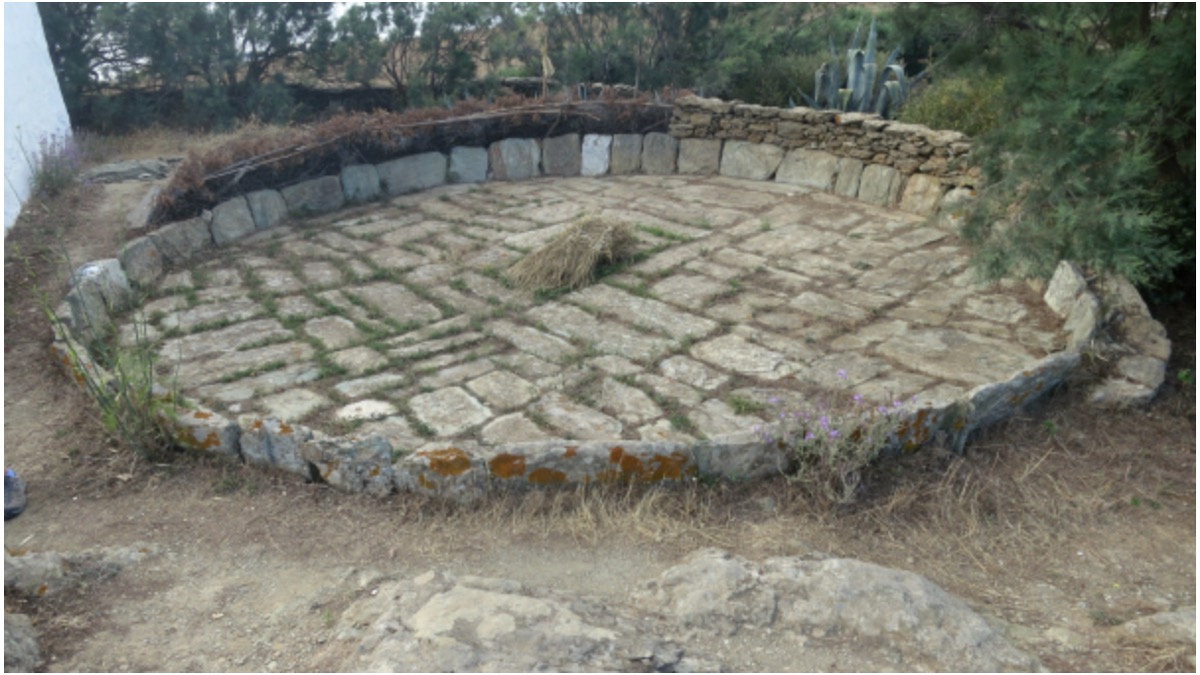
This post is an excerpt from the much longer exposition on the Book of Ruth. The term “threshing floor” is found in multiple places in the Bible. A threshing floor is a flat place, generally circular in shape, set apart to be used at harvest time to separate the desired harvested material (wheat or barley corn) from the undesired material (chaff). It involves the work of winnowing, the separating “barley from the chaff”, which involved the use of a fan in one’s hand, by throwing up the mixture of the collected harvest material into the air where the wind carries away the chaff and the wheat or barley drops to the floor for collection into heaps and then storage vessels, usually placed in a “barn” (which the Bible also refers to as a “garner” or “storehouse”). Threshing floors are generally located on hilltops where the wind blows most consistently to facilitate the process of separation.
The Threshing Floor is the means by which the desired harvested material (wheat or barley corn) is separated from the accompanying unwanted useless material (the chaff). The wheat spiritually represents the saints who are taken up to Heaven, and the chaff spiritually represents the unsaved who will be assigned to Hell.
But how can we be sure that this is really the correct interpretation?
Biblical References to the “Threshing Floor”
Several verses in the Bible speak of the “threshing floor” and provide insights on what it means from a spiritual perspective.
In Isaiah 41:13-17 we read, “For I the LORD thy God will hold thy right hand, saying unto thee, Fear not; I will help thee. Fear not, thou worm Jacob, [and] ye men of Israel; I will help thee, saith the LORD, and thy redeemer, H1350, the Holy One of Israel.(Note: It is particularly significant that the word “redeemer” is found together within the same context of threshing that we find in the Book of Ruth.) Behold, I will make thee a new sharp threshing instrument having teeth: thou shalt thresh the mountains, and beat [them] small, and shalt make the hills as chaff. Thou shalt fan them, and the wind shall carry them away, and the whirlwind shall scatter them: and thou shalt rejoice in the LORD, [and] shalt glory in the Holy One of Israel. [When] the poor and needy seek water, and [there is] none, [and] their tongue faileth for thirst, I the LORD will hear them, I the God of Israel will not forsake them.”
In Matthew 3:12, we read where John the Baptist was proclaiming Jesus and the future, “Whose fan [is] in his hand, and he (Jesus) will throughly purge his floor, and gather his wheat into the garner; but he (Jesus) will burn up the chaff with unquenchable fire.” This is also in Luke 3:17, “Whose fan [is] in his hand, and he will throughly purge his floor, and will gather the wheat into his garner; but the chaff he will burn with fire unquenchable.”
We should also note that this judgment separation was also mentioned back in the Old Testament in Hosea 13:3, “Therefore they shall be as the morning cloud, and as the early dew that passeth away, as the chaff [that] is driven with the whirlwind out of the floor, and as the smoke out of the chimney.”
We are clearly being told that on Judgment Day, Jesus will separate the harvest of souls, the believers who constitute the eternal Israel, from the chaff, the unbelievers, the reprobates. The saved will go into Jesus’s garner/harvest house/barn, while the chaff, the unsaved of humanity, will be burned for an eternity in Hell. This is not an easy fact to read or to tell, but it is the truth nonetheless.
Another indication of the Threshing Floor being equated to God’s Judgment is found in 2 Samuel 6:6&7, “¶And when they came to Nachon’s threshingfloor, Uzzah put forth [his hand] to the ark of God, and took hold of it; for the oxen shook [it]. And the anger of the LORD was kindled against Uzzah; and God smote him there for [his] error; and there he died by the ark of God.“
In a prophetic promise to the eternal Israel that will vanquish the nations of the enemies of God, we are told in Micah 4:12&13, “But they know not the thoughts of the LORD, neither understand they his counsel: for he shall gather them as the sheaves into the floor. Arise and thresh, O daughter of Zion: for I will make thine horn iron, and I will make thy hoofs brass: and thou shalt beat in pieces many people: and I will consecrate their gain unto the LORD, and their substance unto the Lord of the whole earth.“
Remember what we are also told in Malachi 4:1, “¶For, behold, the day cometh, that shall burn as an oven; and all the proud, yea, and all that do wickedly, shall be stubble: and the day that cometh shall burn them up, saith the LORD of hosts, that it shall leave them neither root nor branch.”
It is also notable that in Isaiah 30:18, we read of God’s Graciousness to His People, “And therefore will the LORD wait, that he may be gracious unto you, and therefore will he be exalted, that he may have mercy upon you: for the LORD [is] a God of judgment: blessed [are] all they that wait for him.” and then a few verses later in Isaiah 30:24, we read of one of the blessings being, “The oxen likewise and the young asses that ear the ground shall eat clean provender, which hath been winnowed with the shovel and with the fan.” The winnowing with the shovel and the fan takes place at the threshing floor.
Jeremiah 51:33, “For thus saith the LORD of hosts, the God of Israel; The daughter of Babylon [is] like a threshingfloor, [it is] time to thresh her: yet a little while, and the time of her harvest shall come.”
Please note that while this verse might only seem to be speaking of a temporal blessing, it also has a spiritual implication as we know from both 1 Corinthians 9:9, “For it is written in the law of Moses, Thou shalt not muzzle the mouth of the ox that treadeth out the corn. Doth God take care for oxen?” and 1 Timothy 5:18, “For the scripture saith, Thou shalt not muzzle the ox that treadeth out the corn. And, The labourer [is] worthy of his reward.” These two verses refer back to Deuteronomy 25:4, which states, “Thou shalt not muzzle the ox when he treadeth out [the] corn.” But the Apostle Paul was expounding on the spiritual meaning that the preachers of the Gospel (“elders that rule“) should also be partakers of that same spiritual food, which that preacher is helping to make available to the flock (as well as the flock being supportive of the preacher’s temporal carnal needs). This is made more clear in these verses: 1 Corinthians 9:11, “If we have sown unto you spiritual things, [is it] a great thing if we shall reap your carnal things?” and 1 Corinthians 9:14, “Even so hath the Lord ordained that they which preach the gospel should live of the gospel.”
The Threshing Floor of Boaz in the Book of Ruth
It was on the threshing floor of Boaz that Ruth made her petition for redemption (by marriage to Boaz) in Ruth Chapter 3, “And now [is] not Boaz of our kindred, with whose maidens thou wast? Behold, he winnoweth barley to night in the threshingfloor.” As a result of that marriage, Ruth and Boaz became the great grandparents of King David and joined in the earthy ancestral genealogical line of Jesus Christ via Mary. (Please see Jesus’ Earthly Ancestry)
Naomi, Ruth’s widowed mother-in-law, had instructed Ruth to go to Boaz at his threshing floor because she understood the timing of the barley harvest, and what was involved with preparing the grain for storage. She knew, likely from Ruth, that the harvesting had been completed and therefore that the work of winnowing the barley was underway.
The Threshing Floor of Ornan (Araunah), The Jebusite
There is another Threshing Floor mentioned in the Bible that we need to consider within this study of Ruth, and it is located a mere 6 miles from Bethlehem. It is known as the “threshingfloor of Ornan the Jebusite”.
NOTE: In 2 Samuel 24:16 Ornan is called “Araunah”(identified “[as] a king” in 2 Samuel 24:23). In 2 Samuel 24:15-18, we read about this threshing floor as a place where God’s Angel of Death was stayed, which serves as a picture of God’s intercession on behalf of His Elect people through the Atoning Sacrifice of Jesus Christ upon this exact spot on Mount Moriah. “¶So the LORD sent a pestilence upon Israel from the morning even to the time appointed: and there died of the people from Dan even to Beersheba seventy thousand men. And when the angel stretched out his hand upon Jerusalem to destroy it, the LORD repented him of the evil, and said to the angel that destroyed the people, It is enough: stay now thine hand. And the angel of the LORD was by the threshingplace of Araunah the Jebusite. ¶And David spake unto the LORD when he saw the angel that smote the people, and said, Lo, I have sinned, and I have done wickedly: but these sheep, what have they done? let thine hand, I pray thee, be against me, and against my father’s house. ¶And Gad came that day to David, and said unto him, Go up, rear an altar unto the LORD in the threshingfloor of Araunah the Jebusite.” This another Messianic reference to Jesus stepping in, and laying down His life, on behalf of His sheep at the Threshing Floor of God. See also this post on “The Good Shepherd“.
This was the precise location where the Temple of God was built in Jersusalem by Solomon as we read in 2 Chronicles 3:1, “Then Solomon began to build the house of the LORD at Jerusalem in mount Moriah, where [the LORD] appeared unto David his father, in the place that David had prepared in the threshingfloor of Ornan the Jebusite.” That, alone,is extremely significant! However, there were four very significant other events in the Bible that occurred at that precise location on Mount Moriah, one approximately 1000 years earlier, and then another most important one approximately 1000 years later.
- Mount Moriah, where the Threshing Floor of Ornan was later installed and that subsequently became the Temple Mount, was the location where Abraham went to sacrifice his only begotten son (of his wife Sarah) Isaac! In Genesis 22:2 we read where God instructs Abraham, “And he said, Take now thy son, thine only [son] Isaac, whom thou lovest, and get thee into the land of Moriah; and offer him there for a burnt offering upon one of the mountains which I will tell thee of.” and Genesis 22:14 tells us, “And Abraham called the name of that place Jehovahjireh: as it is said [to] this day, In the mount of the LORD it shall be seen.” And it was on this very location that Abraham prophesied in Genesis 22:8, “And Abraham said, My son, God will provide himself a lamb for a burnt offering: so they went both of them together.“ This was the first prefigurement of the Atoning Sacrifice of Jesus Christ, The Lamb of God, Who would come to be the burnt offering 2000 years later.
- One thousand years after Abraham and Isaac, king David sinned in numbering the people of Israel and brought about a plague upon the people as we read in 1 Chronicles 21:14&15, “So the LORD sent pestilence upon Israel: and there fell of Israel seventy thousand men. And God sent an angel unto Jerusalem to destroy it: and as he was destroying, the LORD beheld, and he repented him of the evil, and said to the angel that destroyed, It is enough, stay now thine hand. And the angel of the LORD stood by the threshingfloor of Ornan the Jebusite.” We next read in 1 Chronicles 21:16&17, “¶And David lifted up his eyes, and saw the angel of the LORD stand between the earth and the heaven, having a drawn sword in his hand stretched out over Jerusalem. Then David and the elders [of Israel, who were] clothed in sackcloth, fell upon their faces.” Whereupon next in 1 Chronicles 21:17, we read how David offered himself to be a stand-in for “the sheep”, “And David said unto God, [Is it] not I [that] commanded the people to be numbered? even I it is that have sinned and done evil indeed; but [as for] these sheep, what have they done? let thine hand, I pray thee, O LORD my God, be on me, and on my father’s house; but not on thy people, that they should be plagued.” King David was subsequently told to erect an altar to God on that threshing floor in 1 Chronicles 21:18-25, “Then the angel of the LORD commanded Gad to say to David, that David should go up, and set up an altar unto the LORD in the threshingfloor of Ornan the Jebusite. And Ornan turned back, and saw the angel; and his four sons with him hid themselves. Now Ornan was threshing wheat. And as David came to Ornan, Ornan looked and saw David, and went out of the threshingfloor, and bowed himself to David with [his] face to the ground. Then David said to Ornan, Grant me the place of [this] threshingfloor, that I may build an altar therein unto the LORD: thou shalt grant it me for the full price: that the plague may be stayed from the people. And Ornan said unto David, Take it to thee, and let my lord the king do [that which is] good in his eyes: lo, I give [thee] the oxen [also] for burnt offerings, and the threshing instruments for wood, and the wheat for the meat offering; I give it all. And king David said to Ornan, Nay; but I will verily buy it for the full price: for I will not take that which [is] thine for the LORD, nor offer burnt offerings without cost. So David gave to Ornan for the place six hundred shekels of gold by weight. What is most significant is that it was at this very location, that Christ would later separate the redeemed spiritual wheat (believers) and the unsaved spiritual chaff (unbelievers) at the cross. Interestingly, David paying 600 shekels of gold (the number 6 X 10 X 10 points to the “full price” of The Savior’s atoning work, please see the post on The Meaning of Numbers in the Bible)! Then in 1 Chronicles 21:26&27, “And David built there an altar unto the LORD, and offered burnt offerings and peace offerings, and called upon the LORD; and he answered him from heaven by fire upon the altar of burnt offering. ¶And the LORD commanded the angel; and he put up his sword again into the sheath thereof.” Finally, we read in 1 Chronicles 21:28, “At that time when David saw that the LORD had answered him in the threshingfloor of Ornan the Jebusite, then he sacrificed there.” We should also note that the above information is also referenced in 2 Samuel 24:25 where we read, “And David built there an altar unto the LORD, and offered burnt offerings and peace offerings. So the LORD was intreated for the land, and the plague was stayed from Israel.” These verses are telling us that spiritually, David, who is being used by God as an allegorical “Type” to provide the second prefigurement of the Lord Jesus Christ, Who Is the One Who built the altar of Sacrifice at this very same location, where Jesus offered Himself on Mount Moriah to be The Burnt Offering and Peace Offering for the sins of mankind descended from Adam, and Which intreated the Lord and stayed the plague as declared in Romans 6:23“For the wages of sin [is] death; but the gift of God [is] eternal life through Jesus Christ our Lord.” And as we also know from 1 Corinthians 15:22 “For as in Adam all die, even so in Christ shall all be made alive.“
- One thousand years later, in 33 AD, the two previous prefigurement “shadow of things to come“(Colossians 2:17 and Hebrews 10:1) were fulfilled in substance with Jesus Christ’s Atoning Sacrifice that began in the nearby Garden of Gethsemane (which lies directly across from Mount Moriah on the other side of the Brook Kidron), and then, within the gates of Jerusalem, and continued to suffer, and later ultimately die outside the gates of Jerusalem on nearby Golgotha hill. Is it not interesting that after purchasing the 1) threshing floor, 2) the sacrifice, and 3) the place, we read that, “At that time when David saw that the LORD had answered him in the threshingfloor of Ornan the Jebusite, then he sacrificed there.” Subsequently, in 1 Chronicles 22:1, with regard to the “place”, “Then David said, This [is] the house of the LORD God, and this [is] the altar of the burnt offering for Israel. Jesus was the Sacrificial Lamb of God for the true eternal Israel and Mount Moriah was the place of that burnt offering to God! By being the Mediator and laying down His Life, Jesus Christ saved God’s sheep and also turned aside the sword of the destroying Angel by His Sacrifice. It is all the more clear how the imagery of “the threshing floor” brings to mind that it is a place of separation, or division, between the desired (barely or wheat) and the worthless chaff. A division that is identical to the ones described in Jesus’ Parables of the wheat and the tares and the sheep and the goats.
Conclusion
God has provided numerous allegorical, metaphorical, “Typological” references in the Bible, which make a clear distinction/division/separation between 1) His chosen people (the elect of God, chosen by Grace before the foundations of this creation, and saved by the redemptive atoning blood of the Lord Jesus Christ), and 2) the unsaved of the world who remain dead in trespasses and sins. It is a hard reality to comprehend and accept, because it entirely supersedes the assumed will of man in determining his or her own fate (but which is nonetheless made clear in Romans Chapter 9).
The “Threshing Floor” is one of the many allegorical figures that God has used in the Bible to serve as a reference to Judgment Day, when this Great Division of souls will take place.
We know that Jesus will return on Judgment Day at the end of this world, and Jesus said explicitly, “the harvest is the end of the world;” according to Matthew 13:39, at a time when the world will be ready to be reaped, and there will be a great harvest of souls, and all those who are to be saved will have been saved and taken up into Heaven, and contrariwise the wicked will be Judged guilty and cast into Hell. Jesus said in Matthew 13:39 when explaining to His disciples the meaning of the “Parable of the Tares of the Field” that, “The enemy that sowed them (the tares) is the devil; the harvest is the end of the world; and the reapers are the angels.” For more on this, please see again the “Parable of the Sower.“
The final message remains consistently the same. The Great Division of all Mankind, between all those who have ever lived, and ever will live, will take place at the end of this world on Judgment Day. Judgment Day is when the harvest of souls occurs. One part of mankind (represented by the wheat) will enter into the Great Harvest Home of Heaven because those people will have The Lord Jesus Christ’s Righteousness imputed to them, while the other part of mankind (represented by the chaff) will stand naked before God in their unredeemed sinful state and be cast into the fires of Hell for Eternity.
The “Book of Remembrance“
Malachi 3:16-18, “Then they that feared the LORD spake often one to another: and the LORD hearkened, and heard [it], and a book of remembrance was written before him for them that feared the LORD, and that thought upon his name. And they shall be mine, saith the LORD of hosts, in that day when I make up my jewels; and I will spare them, as a man spareth his own son that serveth him. Then shall ye return, and discern between the righteous and the wicked, between him that serveth God and him that serveth him not.“
The “Book of Remembrance” can readily be compared with the Lamb’s (Jesus’) “Book of Life“, of which there are several mentions of in the New Testament… with these three being just a sample:
- Revelation 20:12, “And I saw the dead, small and great, stand before God; and the books were opened: and another book was opened, which is [the] book of life: and the dead were judged out of those things which were written in the books, according to their works.“
- Revelation 20:15, “And whosoever was not found written in the book of life was cast into the lake of fire.”
- Revelation 21:27, “And there shall in no wise enter into it any thing that defileth, neither [whatsoever] worketh abomination, or [maketh] a lie: but they which are written in the Lamb’s book of life.“
Are you ready? If you are not ready, it may still be possible for you to cry out to God for mercy through the Person and Atoning Sacrificial Work of the Lord Jesus Christ, such that He might show mercy to you before that Great and Terrible Day of the Lord, Judgment Day. The Lord Jesus Christ is mankind’s ONLY Hope, and The ONLY Means of salvation from God’s just penalty for our sins. There is only one alternative, and that is to spend an eternity in Hell.
Appendix: Additional Background on the Threshing Floor of Ornan the Jebusite
While Ornan the Jebusite, who we read about in 1 Chronicles 21, seems to have been an honorable man, by showing his willingness to do obeisance to king David, and to freely give away his threshing floor to king David. Subsequently, he also did meet David’s request to him to sell his threshing floor, and surrounding place, along with the sacrifice, and the threshing instruments for wood. We also read that Ornan was even called “a king” in 2 Samuel 24:23.
However, the Bible has a few other thing to say about the Jebusites:
- They are all descended from Noah’s grandson Canaan, via Ham (Genesis 10:16),
- In Exodus 33:2, God told Moses that, “I will send an angel before thee; and I will drive out the Canaanite, the Amorite, and the Hittite, and the Perizzite, the Hivite, and the Jebusite:”
- In 1 Chronicles 11:4-9 we read, “And David and all Israel went to Jerusalem, which [is] Jebus; where the Jebusites [were], the inhabitants of the land. And the inhabitants of Jebus said to David, Thou shalt not come hither. Nevertheless David took the castle of Zion, which is the city of David. And David said, Whosoever smiteth the Jebusites first shall be chief and captain. So Joab the son of Zeruiah went first up, and was chief. And David dwelt in the castle; therefore they called it the city of David. And he built the city round about, even from Millo round about: and Joab repaired the rest of the city. So David waxed greater and greater: for the LORD of hosts [was] with him.
The implication is that David conquered and slew of all of the Jebusites who rebelled against him. However, we should also note that in 2 Samuel 5:6, we are given some additional information, “And the king and his men went to Jerusalem unto the Jebusites, the inhabitants of the land: which spake unto David, saying, Except thou take away the blind and the lame, thou shalt not come in hither: thinking, David cannot come in hither.” Just as David was not deterred from entering into Jerusalem to conquer it, Jesus also was not deterred from entering into Jerusalem, where Jesus also took away “the blind and the lame“…by healing them, and, more importantly by atoning for their sins. Everyone is a sinner by nature, and therefore also viewed by God as being “blind and lame” from a spiritual perspective, and in desperate need of spiritual healing that only Jesus can provide, please see the exposition on Mephibosheth.
Dealing with an Apparent Discrepancy in the Price of the Threshing Floor
Regarding the purchase of the Threshing Floor of Ornan, see also 2 Samuel 24:18-25 and note that the amount of the purchase was “fifty shekels of silver” versus “six hundred shekels of gold by weight”. While this appears initially to be discrepancy, it has been conjectured by some Biblical theologians and academics that the fifty shekels of silver was merely a downpayment. However, it would seem far more likely that the price of the “threshingfloor and the oxen” was 50 shekels of silver 2 Samuel 24:24, while the price for the “place” (e.g., the surrounding mountain top of Mt. Moriah) was 600 shekels of gold 1 Chronicles 21:25.)


You must be logged in to post a comment.