
Introduction
We are introduced to a man named Baruch in the Book of Jeremiah in the Old Testament. Baruch served as the scribe and servant/confidant/friend of the prophet Jeremiah. As Jeremiah received messages from the Lord, Jeremiah would evidently dictate them to Baruch, who would then write them down on scrolls.
The Book of Jeremiah was written in the era roughly spanning the period between 609 BC just before Jerusalem was first captured by Babylon and later entirely destroyed in 587 BC. The historical essence of the book of Jeremiah involves Jeremiah’s pronouncement that the king Nebuchadnezzar of Babylon would be victorious against Israel and conquer Jerusalem and all of Judea. That foretold destruction was the consequence of God’s anger toward the Jewish people because of their adulterous pagan practices and the failure of both the secular and religious leadership of Judah. That message was not met with repentance, but rather only more rebellion against both God and His messengers (both Jeremiah, and his faithful scribe Baruch).
The very first mention of Baruch is in Jeremiah 32:6-15, where Jeremiah is told by God to buy a piece of land, and Jeremiah then assigns Baruch to handle all of the legal requirements regarding the deed. In Jeremiah 32:12, we read, “And I gave the evidence of the purchase unto Baruch the son of Neriah, the son of Maaseiah, in the sight of Hanameel mine uncle’s [son], and in the presence of the witnesses that subscribed the book of the purchase, before all the Jews that sat in the court of the prison.” The purpose of this transaction was to be a clear public testimony by God that He would bring back a remnant of His people to restore the land of Israel and that normal temporal activities would resume (which did certainly follow after seventy years of prophesied captivity Jeremiah 29:10).
This was a God ordained prophetic act: “For thus saith the LORD of hosts, the God of Israel; Houses and fields and vineyards shall be possessed again in this land.“
Then in chapter 36, Jeremiah was commanded to write down all the words the Lord gives him. It seems clear that the command was not that Jeremiah himself commit the words to the scroll because he called on Baruch to do the actual writing:
Jeremiah 36:1, “¶And it came to pass in the fourth year of Jehoiakim the son of Josiah king of Judah, [that] this word came unto Jeremiah from the LORD, saying, Take thee a roll of a book, and write there in all the words that I have spoken unto thee against Israel, and against Judah, and against all the nations, from the day I spake unto thee, from the days of Josiah, even unto this day. It may be that the house of Judah will hear all the evil which I purpose to do unto them; that they may return every man from his evil way; that I may forgive their iniquity and their sin. ¶Then Jeremiah called Baruch the son of Neriah: and Baruch wrote from the mouth of Jeremiah all the words of the LORD, which he had spoken unto him, upon a roll of a book.“
Once those words were inscribed, they were required to be read to the people. However, Jeremiah was prohibited from entering the temple grounds, due to previous altercations with the Jewish leadership, so he sent Baruch to read the message to all who would listen.
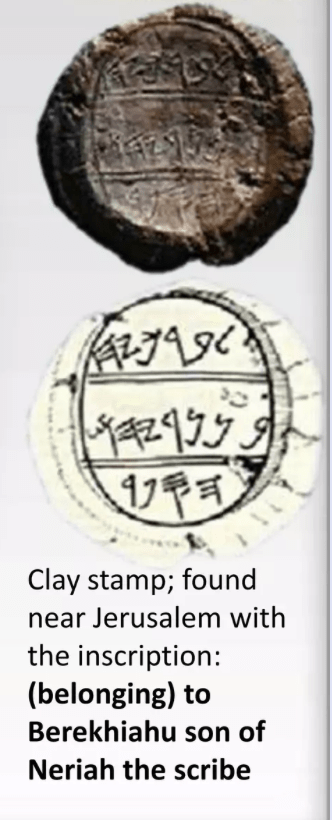
Jeremiah 36:5-8, “And Jeremiah commanded Baruch, saying, I [am] shut up; I cannot go into the house of the LORD: Therefore go thou, and read in the roll, which thou hast written from my mouth, the words of the LORD in the ears of the people in the LORD’S house upon the fasting day: and also thou shalt read them in the ears of all Judah that come out of their cities. It may be they will present their supplication before the LORD, and will return every one from his evil way: for great [is] the anger and the fury that the LORD hath pronounced against this people. And Baruch the son of Neriah did according to all that Jeremiah the prophet commanded him, reading in the book the words of the LORD in the LORD’S house.“
Some of the leaders heard what Baruch read and asked him to read it to them again, which he did (Jeremiah 36:11-15). We then read in Jeremiah 36:16, “¶Now it came to pass, when they had heard all the words, they were afraid both one and other, and said unto Baruch, We will surely tell the king of all these words.“
Then they asked Baruch about the source of the prophecy, and Baruch explained that Jeremiah had dictated all the words and that Baruch had written them in ink on the scroll (Jeremiah 36:17-19, “And they asked Baruch, saying, Tell us now, How didst thou write all these words at his mouth? Then Baruch answered them, He pronounced all these words unto me with his mouth, and I wrote [them] with ink in the book. ¶Then said the princes unto Baruch, Go, hide thee, thou and Jeremiah; and let no man know where ye be.” We also read in Jeremiah 36:26, that “the LORD hid them“, “But the king commanded Jerahmeel the son of Hammelech, and Seraiah the son of Azriel, and Shelemiah the son of Abdeel, to take Baruch the scribe and Jeremiah the prophet: but the LORD hid them.”
However, the leaders kept the scroll to read to the king. During the course of their audience with the king, every time several columns (“leaves”) had been read, the king cut them with a knife from the scroll and threw them into the fire. Eventually, the whole scroll had been burned up, but not before the king heard the word of the Lord (Jeremiah 36:20-23).
After the king burned the scroll containing the words that Baruch had written at Jeremiah’s dictation, the word of the Lord came to Jeremiah as we read in Jeremiah 36:27, “¶Then the word of the LORD came to Jeremiah, after that the king had burned the roll, and the words which Baruch wrote at the mouth of Jeremiah, saying, Take thee again another roll, and write in it all the former words that were in the first roll, which Jehoiakim the king of Judah hath burned. And thou shalt say to Jehoiakim king of Judah, Thus saith the LORD; Thou hast burned this roll, saying, Why hast thou written therein, saying, The king of Babylon shall certainly come and destroy this land, and shall cause to cease from thence man and beast? Therefore thus saith the LORD of Jehoiakim king of Judah; He shall have none to sit upon the throne of David:and his dead body shall be cast out in the day to the heat, and in the night to the frost. And I will punish him and his seed and his servants for their iniquity; and I will bring upon them, and upon the inhabitants of Jerusalem, and upon the men of Judah, all the evil that I have pronounced against them; but they hearkened not. ¶Then took Jeremiah another roll, and gave it to Baruch the scribe, the son of Neriah; who wrote therein from the mouth of Jeremiah all the words of the book which Jehoiakim king of Judah had burned in the fire: and there were added besides unto them many like words.” Burning the scroll could do nothing to prevent the words from coming to pass, and thus a new scroll was prepared. God’s Word will endure forever as Jesus said in Matthew 24:35, “Heaven and earth shall pass away, but my words shall not pass away.”
Shooting the Messenger: Falsely Accusing Baruch of Deceit
Later in Jeremiah 43:1-3, we read where Jeremiah brings Word from God that the people still residing in Jerusalem and Judea must submit to capture by the Babylonians and not flee to Egypt. They dismissed Jeremiah’s warnings as not being from God but rather a deceitful and treasonous effort by Baruch to coerce Jeremiah to say those words to put them into captivity in Babylon: “¶And it came to pass, [that] when Jeremiah had made an end of speaking unto all the people all the words of the LORD their God, for which the LORD their God had sent him to them, [even] all these words, Then spake Azariah the son of Hoshaiah, and Johanan the son of Kareah, and all the proud men, saying unto Jeremiah, Thou speakest falsely: the LORD our God hath not sent thee to say, Go not into Egypt to sojourn there: But Baruch the son of Neriah setteth thee on against us, for to deliver us into the hand of the Chaldeans, that they might put us to death, and carry us away captives into Babylon.“
Jeremiah Chapter 45 is Entirely Focused on Baruch
Baruch had his name besmirched as both a collaborator with Israel’s enemy (Babylon) and an instigator for alleged false prophesy by Jeremiah, and was most likely not happy about it while also fearing for his life (Jeremiah and Baruch fled and were hid by God according to Jeremiah 36:17-19, and 26.
Baruch was deeply grieved for having heard all the words of God at the voice of Jeremiah in advance (circa 607 BC) and written these woeful prophesies of Judgment upon the apostate Jews (his people). God then dedicated six verses that form the entirety of Chapter 45 (Jeremiah 45:1-6) to Baruch, to make a point that holds particular salience for all believers today…in these very last days before the final Judgment Day.
From Jeremiah 43:8 and all the way to the end of Jeremiah chapter 44 (Jeremiah 44:30), great calamities were also prophesied by God via Jeremiah including the death and destruction to all but a remnant of the Jews. Also prophesied was the destruction of the Egyptian empire and the capture and killing of the Egyptian Pharaoh by Babylon.
Then in about 587 BC, when all the Jews ignored God’s warnings (Jeremiah 44:16,) both Jeremiah and Baruch were taken into Taphenes in Egypt, where all those remaining in Judea had fled.
Baruch Was “Blessed” and Exemplary of Every “Child of God“
We need to stop for a moment to look closely at the name Baruch in the original Hebrew, which is בָּרוּךְ (bārûḵ)H1263, and we find that it means “Blessed“. According to Jeremiah 32:12, Baruch was also the son of Neriah, and the grandson or Maaseiah. Neriah in the original Hebrew is נֵרִיָּה (nērîyâ)H5374, which means “Lamp of Jehovah“. Maaseiah in the original Hebrew is מַחְסֵיָה (maḥsêâ)H4271, which means “Jehovah is a shelter“. These are all VERY positive names from the standpoint of a believer, because every true believer in Christ is a “Child of God”.
God’s Promise to Baruch
Jeremiah, chapter 45, is the last we ever read of Baruch in the Bible. This is not incidental (actually nothing in the Bible is ever “incidental”). In this case, it is most likely because of the spiritual implication that it presents. God makes a promise to Baruch of “life” while Baruch (and Jeremiah) are in a setting of promised imminent total destruction of his world. The spiritual implication applies to all believers throughout time but particularly those living in the time of Great Tribulation, just prior to the destruction of all creation on Judgment Day.
Jeremiah 45:1-6, “¶The word that Jeremiah the prophet spake unto Baruch the son of Neriah, when he had written these words in a book at the mouth of Jeremiah, in the fourth year of Jehoiakim the son of Josiah king of Judah, saying, Thus saith the LORD, the God of Israel, unto thee, O Baruch; Thou didst say, Woe is me now! for the LORD hath added grief to my sorrow; I fainted in my sighing, and I find no rest (מְנוּחָה (mᵊnûḥâ)H4496. ¶ Thus shalt thou say unto him, The LORD saith thus; Behold, [that] which I have built will I break down, and that which I have planted I will pluck up, even this whole land. And seekest thou great things for thyself? seek [them] not: for, behold, I will bring evil upon all flesh, saith the LORD: but thy life will I give unto thee for a prey in all places whither thou goest.“
Baruch was bemoaning his situation and said that he could find no “rest”, which in the original Hebrew is (מְנוּחָה (mᵊnûḥâ)H4496, which has been translated variously by the King James translators as rest (15x), resting place (2x), comfortable (1x), ease (1x), quiet (1x), still (1x). Baruch was essentially saying that he was burned out and could find no rest or consolation. God responds by providing Baruch with a comforting assurance.
The Reader should NOTE that God is Sovereign and He had warned of exactly this judgment upon Israel back in Jeremiah 12:17, “But if they will not obey, I will utterly pluck up and destroy that nation, saith the LORD.” (See also Isaiah 5:5-7 ) Also, at the beginning of that same chapter, in Jeremiah 12:1&2, Jeremiah petitioned God by saying, “¶Righteous [art] thou, O LORD, when I plead with thee: yet let me talk with thee of [thy] judgments: Wherefore doth the way of the wicked prosper? [wherefore] are all they happy that deal very treacherously? Thou hast planted them, yea, they have taken root: they grow, yea, they bring forth fruit: thou [art] near in their mouth, and far from their reins.” God can plant, and God can pluck up, as He sees fit.
Most importantly God promises to Baruch that, even though the devastation will be great all around him (all the people and city), which undoubtedly brought great sorrow to Baruch, he was assured by God that he personally would be spared wherever he would go. (NOTE: God made a similar promise to Jeremiah when he despaired of his situation in a perverse and apostate world in Jeremiah 15:21, “And I will deliver thee out of the hand of the wicked, and I will redeem thee out of the hand of the terrible.“) In at least the case of Jeremiah, it would have done well to remember what God also says in Psalm 37 and 73 (e.g., Psalm 37:1, “¶[[A Psalm of David.]] Fret not thyself because of evildoers, neither be thou envious against the workers of iniquity.”)
The Lord also cautions Baruch not to seek “great things” for himself. He should be satisfied with the great deliverance that the Lord has promised to him. We should also note that Baruch’s “life” was not just referring to this earthly temporal life, but rather signifying “eternal life” with God (Jesus) in Heaven.
In Philippians 3:17-21, all believers are similarly told by God (via the Apostle Paul), “¶Brethren, be followers together of me, and mark them which walk so as ye have us for an ensample. (For many walk, of whom I have told you often, and now tell you even weeping, [that they are] the enemies of the cross of Christ: Whose end [is] destruction,’ whose God [is their] belly, and [whose] glory [is] in their shame, who mind earthly things.) For our conversation is in heaven; from whence also we look for the Saviour, the Lord Jesus Christ: Who shall change our vile body, that it may be fashioned like unto his glorious body, according to the working whereby he is able even to subdue all things unto himself.”
And similarly in Colossians 3:2-4, “Set your affection on things above, not on things on the earth. For ye are dead, and your life is hid with Christ in God. When Christ, [who is] our life, shall appear, then shall ye also appear with him in glory.“
And more specifically, in Galatians 5:24-26, “And they that are Christ’s have crucified the flesh with the affections and lusts. If we live in the Spirit, let us also walk in the Spirit. Let us not be desirous of vain glory, provoking one another, envying one another.”
Finally, in Matthew 6:19-21, Jesus said, “¶Lay not up for yourselves treasures upon earth, where moth and rust doth corrupt, and where thieves break through and steal: But lay up for yourselves treasures in heaven, where neither moth nor rust doth corrupt, and where thieves do not break through nor steal: For where your treasure is, there will your heart be also.”
and Matthew 6:24, “¶No man can serve two masters: for either he will hate the one, and love the other; or else he will hold to the one, and despise the other. Ye cannot serve God and mammon.”
and then at the end of Jesus’ sermon on the mount, Jesus offers the cure for anxiety (see also Luke 12:22–31 ), in Matthew 6:31-34, “¶Therefore take no thought, saying, What shall we eat? or, What shall we drink? or, Wherewithal shall we be clothed? (For after all these things do the Gentiles seek:) for your heavenly Father knoweth that ye have need of all these things. But seek ye first the kingdom of God, and his righteousness; and all these things shall be added unto you. Take therefore no thought for the morrow: for the morrow shall take thought for the things of itself. Sufficient unto the day [is] the evil thereof.“
This point also seems to parallel what Jesus warned with regard to the very last days: Matthew 24:15-18, “¶When ye therefore shall see the abomination of desolation, spoken of by Daniel the prophet, stand in the holy place, (whoso readeth, let him understand:) Then let them which be in Judaea flee into the mountains: Let him which is on the housetop not come down to take any thing out of his house: Neither let him which is in the field return back to take his clothes.“
Note here what Jesus also said in Luke 17:31-33, “¶In that day, he which shall be upon the housetop, and his stuff in the house, let him not come down to take it away: and he that is in the field, let him likewise not return back. Remember Lot’s wife. Whosoever shall seek to save his life shall lose it; and whosoever shall lose his life shall preserve it.“
And just as the complete destruction of Jerusalem and Judea and also Egypt’s destruction were foretold (as well as prophesies against all surrounding lands in the subsequent chapters of Jeremiah, closing the book), so too is the end of this entire world and universe. All of creation will be destroyed by fire on the Last Day, that great and dreadful Day of the LORD, Judgment Day, exactly as we are told in 2 Peter 3:10-13, “¶But the day of the Lord will come as a thief in the night; in the which the heavens shall pass away with a great noise, and the elements shall melt with fervent heat, the earth also and the works that are therein shall be burned up. [Seeing] then [that] all these things shall be dissolved, what manner [of persons] ought ye to be in [all] holy conversation and godliness, Looking for and hasting unto the coming of the day of God, wherein the heavens being on fire shall be dissolved, and the elements shall melt with fervent heat? Nevertheless we, according to his promise, look for new heavens and a new earth, wherein dwelleth righteousness.“
Conclusion:
God’s Words to Baruch Directly Apply to All Believers Today!
Jeremiah Chapter 45 is actually an Historical Parable. This is because, while it clearly had a specific and literal historical focus regarding the man, Baruch, this final word to Baruch (in the Bible) is also pertinent to all true believing Christians today. Particularly so, because Christians are now living in a world that is steeped in sin and doomed to total destruction, exactly as God told Jeremiah, but on a much larger, universal, scale of which the world of Jeremiah and Baruch served as an allegory.
God used some key words that let us know this is the case:
“all flesh“–which at the time represented the whole Jewish nation and surrounding foreign peoples (Jeremiah 25:26). But we should also remember what God told Noah in Genesis 6:13 with regards to the world’ first Judgment Day, “And God said unto Noah, The end of all flesh is come before me; for the earth is filled with violence through them; and, behold, I will destroy them with the earth.“
The coming Judgment Day is real, and it coming very soon (and it will also be Final)! Christians should not be focusing on great things for themselves or seek to become great in the kingdom of this world (which is not of God, as Jesus said in John 18:36). Jesus also warned about this in the Parable of the Sower in Mark 4:19, “And the cares of this world, and the deceitfulness of riches, and the lusts of other things entering in, choke the word, and it becometh unfruitful.”
This world is temporal and will soon pass away, and in the meantime nothing is certain for anyone. Christians should simply be faithful in desiring to do what God requires (sharing the Gospel of Salvation and warning others of the Judgment to come, just like Jeremiah and Baruch did in their day) They should also rejoice in the fact that they will escape the coming Judgment and have eternal life in Heaven with Jesus.
Moreover, whatever may be our lot in this world, we should also remember what we are told in Romans 8:28, “And we know that all things work together for good to them that love God, to them who are the called according to [his] purpose.”
Postscript: BereanSearching Posts on Judgment Day
#1 Judgment Day is Coming Soon!
#2 God’s Warning of Coming Judgment: Isaiah Chapters 1-3
#3 Jesus’ Parables of The Great Division on Judgment Day
#4 The Great Sacrifice of Judgment Day
#5 Midnight in the Bible: a Metaphor for Judgment Day
#7 Lightning, Swords, and Arrows: Weapons of Judgment Coming on Judgment Day
#8 The Believers (The “Saints”) Will Be With Jesus in Executing Judgment on Judgment Day!
#9 Seeking Death and Not Finding It?
#10 “The Heavens Shall Be Rolled Together as a Scroll”
And to not end on a negative note, please remember this from Romans 6:23, “For the wages of sin [is] death; but the gift of God [is] eternal life through Jesus Christ our Lord.“
Finally, dear reader, please take a look at this very short post,“Day of Judgment, Day of Wonders” and “Amazing Grace”, Two Hymns, Both by John Newton noting in particular the 4th stanza of the first hymn, which ends where the Lord will say: “Come near ye blessed, See the kingdom I bestow; You forever Shall my love and glory know.” “Baruch“=”Blessed“! Hallelujah!
You must be logged in to post a comment.